Status checked August 27, 2026: The NHL has not released the official team-by-team 2026-27 opening-day rosters. Current team pages, offseason transaction lists and projected depth charts can show who is under contract or competing for a job, but they are not substitutes for the league's timestamped opening roster release.
The timing will be unusually compressed. The preseason runs from September 19 through September 26, and the regular season begins September 29. This guide tracks that release window, explains the 20-to-23-player roster rules and shows how to distinguish an opening-day roster from injured/non-roster lists, depth charts and one game's lineup.
Are the 2026-27 NHL opening-day rosters official yet?
No—not as of August 27, 2026. The league has announced the schedule and preseason, and clubs have active offseason rosters, contracts and prospect pools. It has not published the timestamped all-team opening-day list that answers this article's target query. Any page already presenting every 2026-27 roster as final is either a projection or a live offseason database unless it cites a later official release.
| Milestone | 2026-27 status | What it means for rosters |
|---|---|---|
| Training camps | Still ahead at this check | Invites and camp groups will be larger than opening rosters. |
| Preseason | September 19-26 | Clubs evaluate combinations and make assignments across an eight-day schedule. |
| Final preseason games | September 26 | Important decisions can remain until the last exhibition results and health checks. |
| Regular-season opening night | September 29 | Opening rosters must be settled before the season begins; public release time remains unannounced here. |
The three-day space between the final preseason slate and opening night is the safest public release window to watch, but it is not an invented deadline. The NHL's current Hockey Operations page says clubs submit an Opening Day Playing Roster before the season; it does not give this page an exact 2026 clock time. League Public Relations may publish the consolidated list on opening day, as it did on October 7 in 2025, or official club announcements may appear earlier.
Use the 2026-27 NHL preseason schedule to follow the evaluation period and the 2026-27 season date guide for the September 29 boundary. Do not treat a player surviving an early cut, appearing in the final exhibition or skating with regulars as proof that his roster filing is complete.
This page should change in two stages. When clubs announce their opening groups, their lists can be labeled club-confirmed with a timestamp. When NHL Public Relations releases all 32, the article can add the authoritative league snapshot and preserve separate injured/non-roster designations. Until then, “not yet official” is the accurate answer.
How many players can an NHL team carry?
The NHL's current Hockey Operations Guidelines give the clean opening-day range: a club's Opening Day Playing Roster can contain no more than 23 players, while the minimum is 20—18 skaters and two goaltenders. Players placed on Injured Reserve do not count against the 23-player limit described on that page.
The word “maximum” matters. A compliant opening roster does not have to contain 23 names. A club may carry 20, 21 or 22 because of salary-cap space, contract logistics, waiver risk, short-term injuries or the value of giving an unused prospect games elsewhere. The roster number by itself does not reveal whether the team has depth; it shows how many players are on that particular active list.
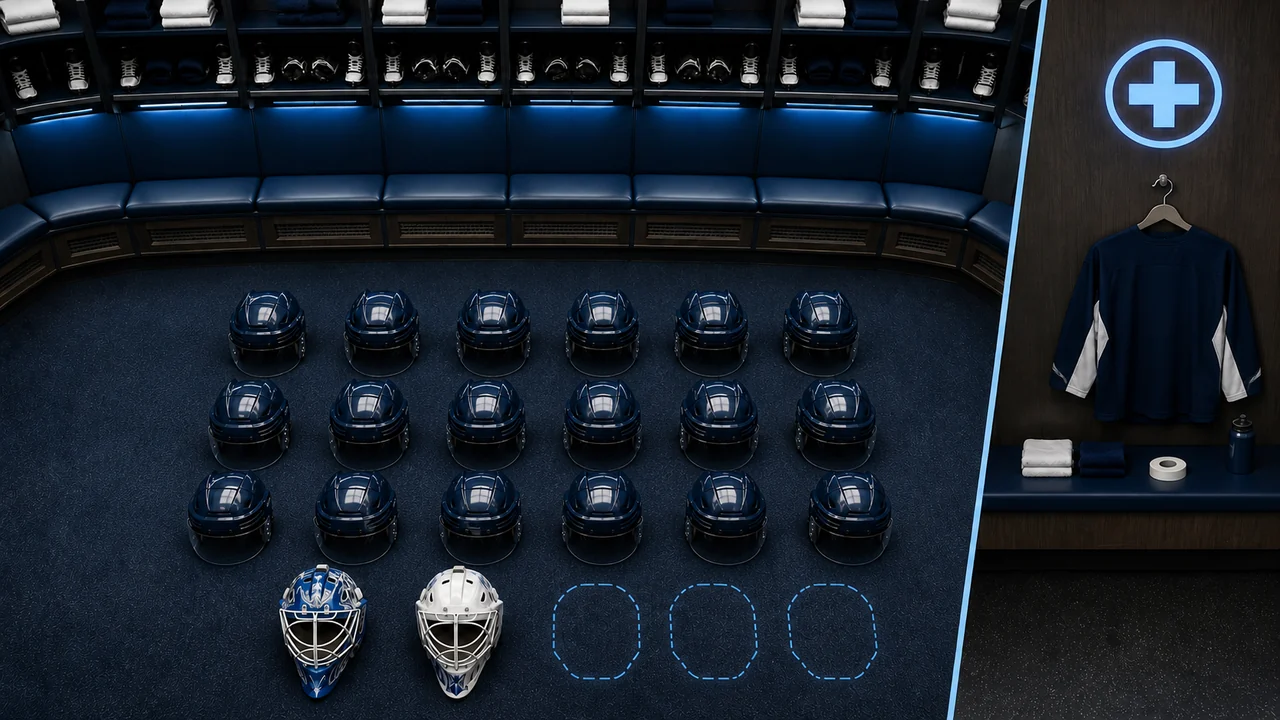
Do not turn “18 skaters” into one mandatory position split. A familiar game-night arrangement is 12 forwards, six defensemen and two goalies. On the broader active roster, the extra one to three places can be forwards, defensemen or—in unusual circumstances—another goalie. Coaches and general managers choose a composition that fits health, schedule, waivers and cap constraints.
Three totals should remain separate:
- 20 to 23 on the opening playing roster: the active NHL group submitted before the season, excluding players listed separately on Injured Reserve under the guideline.
- 20 in an ordinary game lineup: the 18 skaters and two goalies eligible to participate that night.
- The organization's larger player pool: contracted players, assigned prospects, unsigned draft rights and other reserve-list categories. It is not an active NHL roster.
A 23-player opening roster will normally produce three scratches when 20 players dress. A 22-player roster normally produces two. Those are arithmetic examples, not promises about which positions sit. An injury designation can also change how a public list is displayed, so count the active names and read the separate status heading rather than assuming every name in one article occupies a roster place.
The 2026 roster timeline from camp to opening night
The 2026 evaluation period is shorter than the familiar multiweek preseason. The NHL scheduled 65 exhibition games from September 19 through September 26, then opens the regular season September 29. Some clubs also use prospect events, physicals and practices around that window, but their reporting dates and public camp schedules are team-specific.
Follow decisions through seven stages:
- Prospect activity and medical reporting: young players may skate before the main NHL group. Participation shows evaluation, not an active-roster place.
- Main camp roster: clubs publish a large list containing NHL regulars, prospects, minor-league players and sometimes professional tryout participants. It is deliberately larger than 23.
- Early releases and assignments: players can return to junior, college pathways where applicable, European clubs or minor-league camps under their contract and eligibility rules. Read the exact transaction verb.
- Preseason games: split squads and experimental combinations spread opportunities. One exhibition lineup is not a depth chart for opening night.
- Final personnel moves: clubs handle assignments, waiver processes, contracts and injury designations while approaching the active limit and cap requirements.
- Opening roster submission: the club files its compliant playing roster and may separately identify injured/non-roster players.
- First game lineup: coaches select 20 eligible players from the available group for the opener. That is a second, narrower decision.
A player who appears in the September 26 finale may still be assigned afterward. A player who does not appear may simply be resting, recovering or awaiting a decision. A professional tryout is an invitation to compete, not proof of an NHL contract. Similarly, skating beside established forwards can demonstrate a real audition without guaranteeing a roster place or regular-season role.
The compressed calendar makes timestamps essential. A September 22 camp article can be accurate when published and obsolete after a September 23 transaction. Record the verb—invited, signed, recalled, assigned, placed on waivers, claimed, cleared, injured reserve or named to roster—along with date and source. Avoid rewriting all of those verbs as “cut.”
Finally, connect personnel to the actual opponent only after the list is settled. The 2026-27 NHL schedule identifies each club's opener, but it does not identify the 20 players who will dress. Schedule confirmation and roster confirmation are separate feeds.
How to read cuts, waivers, injured reserve and non-roster labels
Roster reporting becomes confusing when every transaction is summarized as “made the team” or “got cut.” The actual verb often describes only one step. Read the club or league transaction first, then check whether another step followed.
| Label | What it establishes | What it does not establish by itself |
|---|---|---|
| Placed on waivers | The player has entered the applicable waiver process. | That he cleared, was claimed or has already been assigned. |
| Cleared waivers | No claim was recorded in that waiver period. | That the club immediately assigned him or that he cannot remain. |
| Claimed | Another club obtained the player through the process. | His permanent role, line or game-one status. |
| Assigned or loaned | The club moved the player to the named destination under the applicable rules. | That he cannot be recalled later. |
| Released from tryout | The professional tryout ended without that player remaining in camp on the same basis. | Every future contract possibility. |
| Injured Reserve | The club placed an eligible injured, ill or disabled player on the NHL list. | An exact diagnosis or guaranteed return date. |
The NHL guideline says an IR placement applies when the club's medical staff determines that an injury, illness or disability leaves a player unable to perform for at least seven days. The player is ineligible for NHL games for no less than seven days, but may attend meetings and meals, travel and practice. That is why seeing an IR player skate does not prove he is eligible for opening night.
The league's 2025-26 opening release placed active names under each team and then used a separate “Injured and/or Non-Roster” line. Preserve that separation when the 2026-27 list arrives. Do not merge both groups into one count, and do not infer that every non-roster designation is the same medical or contractual category. Use the narrower official term if the club provides it.
For waiver news, wait for disposition. “Placed” is pending; “cleared” means no claim in that period; “claimed” names a new club context; “assigned” records the destination. A player can clear and remain temporarily while the club completes other moves. Conversely, an assignment can later be followed by a recall. Opening-day status is a timestamped snapshot, not a season-long prediction.
Medical restraint is part of accurate roster coverage. Report only the status and detail released by the player, club or league. Do not diagnose an undisclosed condition, calculate a recovery date from a generic injury, or equate cap treatment with medical readiness.
Opening-day roster, depth chart and game lineup are not the same
An opening-day roster is the club's active NHL group at the season boundary. A depth chart is an organizational view that orders players by position or expected role. A game lineup identifies who can participate in one contest. They can overlap heavily without becoming interchangeable.
Suppose a club opens with 23 active players. For a normal game, it submits 20 eligible names—18 skaters and two goaltenders—leaving three active players scratched. The coaches can arrange the 18 skaters as expected forward lines and defense pairs, then name the smaller starting group. Injury, illness or a transaction can alter the available roster before the next game, and the combinations can change during play.
Use this hierarchy:
- Opening-day roster: answers, “Who was on the active NHL roster at the official opening snapshot?”
- Current active roster: answers, “Who is active now?” after recalls, assignments, claims and injured-list moves.
- Depth chart: answers, “How does this publisher organize the club's options?” It may include injured players or prospects outside the NHL roster.
- Projected game lineup: answers, “Which 20 and which combinations are expected tonight?”
- Official game lineup: answers, “Which 20 are eligible for this game?”
- Starting lineup: answers, “Who is named to take the first shift and start in goal?”
Membership in the first category does not guarantee a player dresses for all 84 games, holds one line assignment or remains in the NHL all season. Likewise, missing the opening snapshot does not eliminate a player from the campaign. Prospects and veterans can be recalled after injuries or performance changes, and an opening-day scratch can enter the next game.
For present-tense decisions, begin with the NHL schedule today, select the correct matchup and then find its latest official game information. For historical analysis, use the dated opening roster. Never silently replace the opening snapshot with a live roster and continue calling it “opening day”; preserve both dates so the reader knows what changed.
How to verify all 32 team rosters when they are released
The best all-league source will be the 2026-27 NHL Public Relations opening roster release, if it follows the established format. It should provide a league timestamp, an active list under each club and separate injury/non-roster information. Before that page appears, a club's own announcement can support “club-confirmed” status, but it should not be represented as the league's consolidated snapshot.
Use the divisions as a completeness audit:
| Division | Eight clubs to verify |
|---|---|
| Atlantic | Boston, Buffalo, Detroit, Florida, Montreal, Ottawa, Tampa Bay, Toronto |
| Metropolitan | Carolina, Columbus, New Jersey, New York Islanders, New York Rangers, Philadelphia, Pittsburgh, Washington |
| Central | Chicago, Colorado, Dallas, Minnesota, Nashville, St. Louis, Utah, Winnipeg |
| Pacific | Anaheim, Calgary, Edmonton, Los Angeles, San Jose, Seattle, Vancouver, Vegas |
For each club, record the official team name, active-player count, source URL and the source's exact as-of time. Preserve forwards, defensemen and goalies if the source identifies them. Put injured and non-roster names in a separate field. If an announcement is corrected, keep a short change note rather than silently replacing the earlier snapshot.
Run four checks before calling the tracker complete:
- Coverage: all four divisions contain eight clubs, for 32 total.
- Count: each active group normally falls between 20 and 23; investigate rather than force a number when a status is unclear.
- Identity: normalize punctuation and accents, but do not merge two different players with similar names or list a traded player for both clubs.
- Status: no player should appear simultaneously in the active count and a separate injured/non-roster count unless the official source explicitly explains the presentation.
A printable or PDF version should be generated only from that verified dataset and labeled with the same timestamp. It should not be advertised as an official NHL PDF unless the NHL itself issued the file. The page can also offer CSV/print formatting later, but convenience formats must not outrun the underlying source.
Use the NHL calendar to monitor the approach to September 29. Once the season begins, keep the opening list as a historical snapshot and direct current-roster questions to live team sources. The answer today remains straightforward: the rules and dates are official; the 2026-27 player-by-player opening rosters are not.
Comments
Comments are reviewed before publication. Spam, abusive content and policy-violating links are not published.
Sign in with Google to leave a comment.
Loading comments...