2027 NHL All-Star Weekend Schedule at a Glance
Last updated September 5, 2026: the 2027 NHL All-Star Weekend is scheduled for Friday, February 5 and Saturday, February 6 at UBS Arena in Elmont, New York. All-Star Skills starts Friday at 7 p.m. ET; the five-team international 3-on-3 tournament starts Saturday at 3 p.m. ET.
| Date | Event | Venue | Confirmed TV | Time |
|---|---|---|---|---|
| Friday, Feb. 5, 2027 | NHL All-Star Skills | UBS Arena | ESPN (U.S.); Sportsnet (Canada) | 7 p.m. ET |
| Saturday, Feb. 6, 2027 | NHL All-Star Game tournament | UBS Arena | ABC (U.S.); Sportsnet (Canada) | 3 p.m. ET |
Those network assignments and Eastern Time starts are national confirmations, not a promise that every streaming service or international territory will carry the same feed. ESPN says its U.S. games are available through the ESPN App with an ESPN Unlimited subscription or pay-TV authentication. Canadian and other viewers should verify their provider and current access closer to the weekend. The site’s NHL viewing guide explains the difference between a network assignment and access through a specific subscription.
The calendar is firm enough to reserve the weekend and plan around puck drop, but fans still need door times, ticket terms and the final event run-of-show. Add both Eastern Time starts to a personal planner, then revisit the NHL announcement rather than relying on an old search snippet.
This is an exhibition showcase, so it does not add points to the regular-season standings. Check the weekly NHL schedule later to understand how the league pause and nearby club games fit around All-Star Weekend.
The Five Teams and Who Is Eligible for the World Team
The tournament organizes All-Stars into Canada, Finland, Sweden, the United States and World. The first four teams use national groups familiar from best-on-best hockey. The World team collects international NHL players whose countries are outside those four, allowing elite players from places such as Czechia, Germany, Switzerland, Slovakia and other NHL nations to participate in one competitive roster pool.
World is not a fifth country and should not be read as a ranking of hockey nations. It is an event device that keeps the field at five teams while including stars beyond the four largest named groups. Eligibility will ultimately be reflected in the NHL/NHLPA candidate lists and official rosters; a player’s birthplace, passport history or past junior representation should not be used by fans to override the published assignment.
Each team carries only 11 players: nine skaters and two goaltenders. That is far smaller than a normal NHL game roster because the tournament uses three-on-three play and five-minute games. Short benches create repeated shifts and allow more star combinations, while two goalies provide rotation and injury coverage.
The full event therefore has 55 selected players across the five game rosters. That number is separate from the Friday Skills field, which has its own ten-player, age-limited selection process and four participating All-Star goalies for the shootout phase.
NHL.com published projected national rosters during summer 2026, but “projected” is the operative word. Those features help fans debate combinations; they do not confirm invitations. Injuries, performance and the December vote can change the field. Only the official fan-vote candidate pool, results and NHL/NHLPA selections establish who will travel to Long Island.
How the 10-Game Round Robin Works
A single round robin among five teams creates ten matchups. Each team faces the other four once, so every team plays four games. Counting team appearances gives 20 slots—five teams multiplied by four games—and dividing by two teams per matchup produces the same total of ten.
Each round-robin game lasts only five minutes and uses three skaters per side. The compressed format is designed for quick changes of matchup and continuous attacking space. It is not a five-minute period inside a standard 60-minute NHL game, and normal regular-season pace or goaltending statistics should not be compared directly.
| Round-robin element | Confirmed format |
|---|---|
| Teams | 5 |
| Opponents per team | 4 |
| Games per team | 4 |
| Total games | 10 |
| Length per game | 5 minutes |
| Playing format | 3-on-3 |
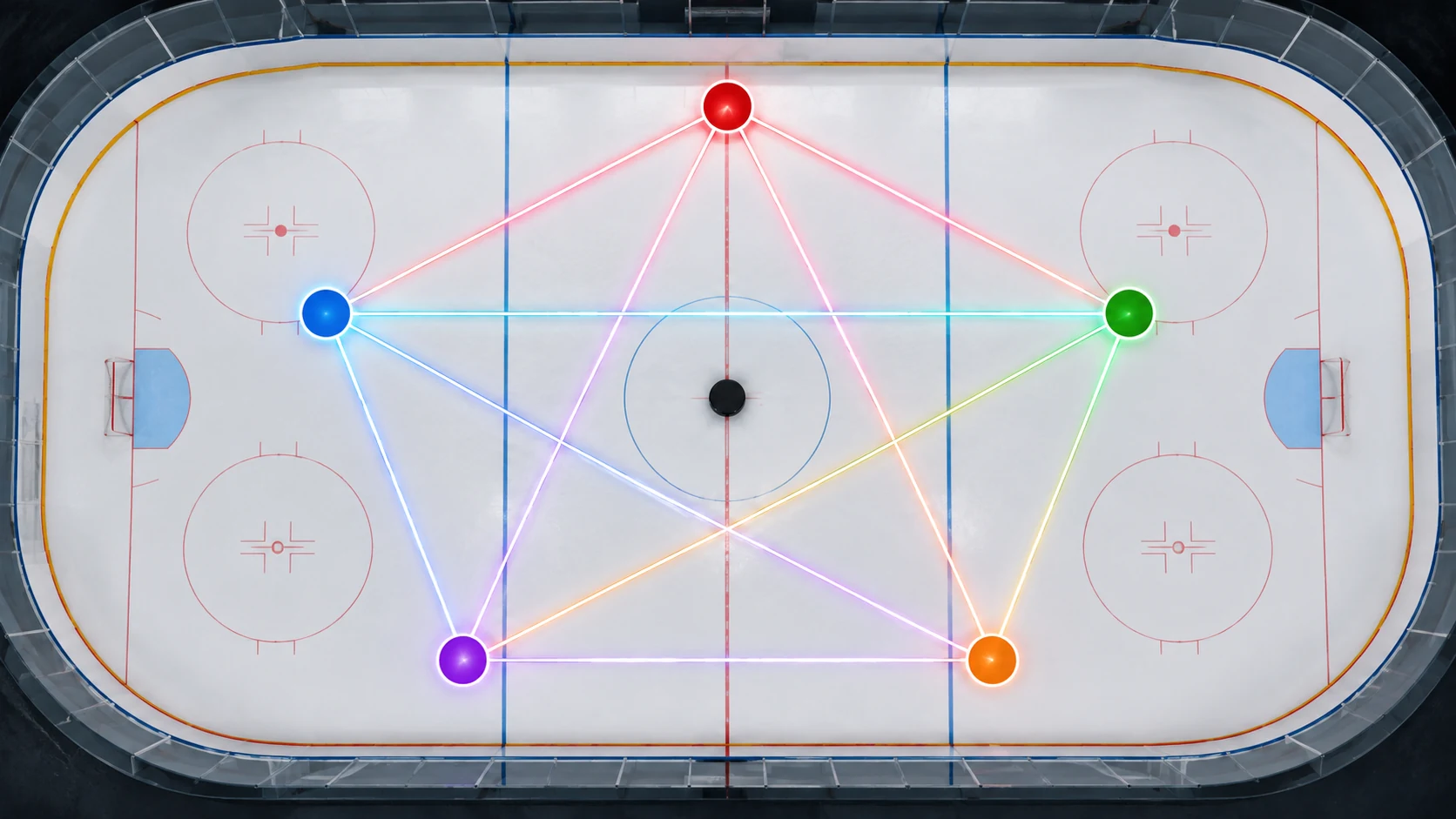
The entire preliminary stage contains 50 minutes of scheduled game time before stoppages and transitions. An individual team plays 20 round-robin minutes, though its games may be spread through the show. As of September 5, the NHL had confirmed the Saturday event’s 3 p.m. ET start but had not published the definitive matchup order.
That missing order matters for rest. A team assigned games close together may manage its nine skaters and two goalies differently from one with a longer interval. Until the run-of-show is official, bracket graphics that label “Game 1” through “Game 10” should be treated as mockups rather than a usable schedule.
Points, Ties and the 10-Minute Final
The standings system is intentionally simple: two points for a win, one for a tie and zero for a loss. Unlike a regular NHL game, a tied five-minute round-robin matchup ends without overtime or a shootout. Both teams bank one point and move to their next opponent.
With four games, a perfect preliminary record is worth eight points. A team that wins twice, ties once and loses once earns five. A club with four ties earns four points, which could keep it competitive despite never winning. That makes every short game meaningful and discourages treating a tie as no result.
| Example record | Points | Calculation |
|---|---|---|
| 4-0-0 | 8 | 4 wins × 2 |
| 2-1-1 | 5 | 2 wins × 2 + 1 tie |
| 1-1-2 | 4 | 1 win × 2 + 2 ties |
| 0-0-4 | 4 | 4 ties × 1 |
After all ten preliminary games, the top two teams advance to a 10-minute final. The final doubles the duration of a round-robin game, giving the finalists more time to separate while preserving the three-on-three showcase. The winning team receives a $2 million U.S. prize.
The June format announcement did not specify the tiebreak sequence if teams finish level on points. It also did not describe how a tied final would be resolved. Goal difference, goals scored, head-to-head results and shootouts are familiar possibilities in other tournaments, but listing them here as official would be guesswork. The NHL needs to publish the event regulations or run-of-show before fans can calculate every scenario.
That omission does not make the announced standings incomplete for basic viewing. Wins and ties establish the main table; any tied-position rule is needed only when equal point totals affect the two final places. A later update should add the exact procedure without rewriting the confirmed 2-1-0 system.
How the Fan Vote Builds Each Roster
Roster construction combines a league-and-union candidate screen with fan choice and three final appointments. The NHL and NHLPA first select 30 candidates for each of the five teams. That creates 150 ballot candidates across Canada, Finland, Sweden, the United States and World.
- The NHL and NHLPA publish each 30-player candidate pool.
- The All-Star Fan Vote opens in December 2026.
- Fans select eight players for each team.
- The NHL and NHLPA jointly add three players per team: one forward, one defenseman and one goaltender.
- Each final roster contains nine skaters and two goaltenders.
The final three selections provide positional balance that an unrestricted popularity vote might not. The announcement specifies the roles of those appointments but does not say that the eight fan choices must follow a particular forward-defense-goalie split. Ballot instructions published in December will control how many players fans may choose by position and how often they may vote.
The arithmetic is straightforward: eight fan-selected players plus three joint selections equals 11. Across five teams, fans directly choose 40 roster places and the league/union jointly fill 15. The 30-player pools are candidate lists, not reserve rosters; appearing on the ballot does not itself make a player an All-Star.
Availability can change after voting because of injuries or other circumstances. The June announcement did not publish replacement procedures, so it is safer to wait for official roster updates than to assume the next-highest vote-getter automatically enters.
Projected roster articles are useful conversation starters before December. They reflect editorial judgment and current performance, not a hidden selection decision. Fans should look for the official ballot branding and announcement from the NHL or NHLPA before sharing a list as final.
Friday’s Under-25 Skills Competition
Friday’s event is not a traditional all-roster skills night. The NHL and NHLPA jointly select 10 young stars age 25 or younger for an eight-event competition that progressively cuts the field. A player’s inclusion in Skills does not automatically identify him as one of Saturday’s 55 tournament players; the events have separate announced selection structures.
The First Six Events
- Fastest Skater
- Hardest Shot
- Passing Challenge
- One Timers
- Stick Handling
- Accuracy Shooting
Each competitor participates in four of those six. Points are awarded according to placement, rewarding a broad performance rather than requiring everyone to attempt every discipline. The detailed scoring values, athlete choices and event order were not included in the June overview and should be checked when the NHL publishes the full rules.
The Two-Stage Finish
The top four in the cumulative standings advance to a Shootout involving four All-Star goaltenders. From there, the top two performers reach the eighth and final event, the Obstacle Course Finale. The player with the highest cumulative score at the end becomes All-Star Skills Champion and earns a $1 million U.S. prize.
The funnel gives Friday a continuous competitive story: ten begin, four survive to the shootout, two reach the obstacle course and one wins. It also prevents a specialist’s single spectacular result from automatically deciding the championship, because advancement depends on accumulated performance across selected events.
Age eligibility is measured for this event under the published rules, but the announcement did not give the exact date on which a player must be 25 or younger. Until the full regulations appear, avoid deciding a borderline birthday case independently. The official participant announcement will resolve eligibility in practice.
Venue, TV and Planning: What Is Still TBD
UBS Arena is the New York Islanders’ home in Elmont on Long Island. The 2027 weekend will be the second time the franchise has hosted NHL All-Star festivities, following the 1983 game at Nassau Coliseum. The league had initially planned an Islanders-hosted event around the 2025-26 season, then did not hold a standard All-Star Weekend during the 2026 Olympic year and shifted the showcase to 2027.
Television and start times are confirmed: Friday Skills begins at 7 p.m. ET on ESPN in the United States, and Saturday’s tournament begins at 3 p.m. ET on ABC. Sportsnet carries both events in Canada. ESPN App access in the United States requires an ESPN Unlimited subscription or pay-TV authentication, and access elsewhere can depend on country, provider and later rights announcements. A network listing should not be converted into a universal free-stream promise.
Ticket availability and price are also dynamic. The format announcement invited fans to sign up for updates but did not establish a complete public on-sale schedule or price table. Use official NHL, Islanders, UBS Arena and authorized ticketing channels; be cautious with speculative listings that appear before seating and event inventory are confirmed.
- Use the confirmed 7 p.m. ET Friday and 3 p.m. ET Saturday starts, but wait for venue door times before booking tight same-day travel.
- Confirm whether a listing is for Friday Skills, Saturday’s Game or a package.
- Review refund and transfer terms before buying resale inventory.
- Check the Islanders schedule for nearby home dates.
- Use the site’s NHL calendar tools for released club games, while adding the confirmed All-Star event times manually.
Venue transportation, parking and security policies can change by event. The arena’s event page—not a generic hockey guide—should control those details. This article should be updated when official on-sale, door-time and additional access information becomes public.
2027 NHL All-Star FAQ
When and where is the 2027 NHL All-Star Game?
The Skills event starts Friday, February 5 at 7 p.m. ET, and the All-Star Game tournament starts Saturday, February 6, 2027 at 3 p.m. ET. Both take place at UBS Arena in Elmont, New York.
Which five teams will play?
Canada, Finland, Sweden, the United States and World. World is made up of international NHL players from countries outside the other four named teams.
How many games are in Saturday’s tournament?
There are ten five-minute round-robin games because every team faces the other four once. The top two then play one 10-minute final, creating 11 tournament games in all.
Can round-robin games end in ties?
Yes. There is no overtime or shootout in the preliminary stage. A win is worth two points, a tie one and a loss zero. The NHL had not published its tied-standings procedure in the June announcement.
How are players selected?
The NHL and NHLPA create 30-player candidate pools for each team. Fans choose eight per team in a vote opening in December, and the league and union jointly add one forward, one defenseman and one goalie to complete each 11-player roster.
Why was there no regular All-Star Weekend in 2026?
NHL players participated in the 2026 Winter Olympics, so the league did not stage its standard All-Star Weekend that season. The Islanders-hosted event moved to 2027, between the Olympics and the planned 2028 World Cup of Hockey.
Comments
Comments are reviewed before publication. Spam, abusive content and policy-violating links are not published.
Sign in with Google to leave a comment.
Loading comments...