
Checked August 27, 2026: NHL lineup news appears throughout game day, but the official eligible-player list is not due in the morning. Under the 2025-26 NHL rulebook, the visiting club submits its game lineup shortly after warm-ups—within five minutes after they finish, identified in the rule as 20 minutes before faceoff—and the home club follows within five minutes.
That is why a lineup posted at breakfast, after practice or during the afternoon is normally labeled projected. It can still be useful, but injuries, recalls, game-time decisions and a coach's final choice can change it. This guide explains the different lineup labels and gives you a practical countdown for verifying tonight's skaters and goaltenders.
The short answer: official NHL game lineups arrive after warm-ups
The most dependable answer comes from the NHL rulebook, not from a fantasy-app countdown. Rule 5.1 of the 2025-26 Official Rules says the visiting manager or coach must submit the eligible game lineup through the league's lineup-management system within five minutes after the pregame warm-up ends. The rule describes that point as 20 minutes before the scheduled faceoff. The home club then submits its list within five minutes of the visiting club's submission.
Therefore, there is no leaguewide promise that fans will see two public, final lineup cards at one exact minute. The rule controls what clubs send to NHL game operations. A team website, league feed, arena display, broadcaster or lineup service still has to receive and publish that information. One source may update before another, and a page can keep the word “projected” even when several individual decisions have been confirmed.
The named starters are part of this late process too. Rule 7 says the visiting club names its starting group with its submitted game lineup. The home club, after being advised of the visiting starters, names its own. That order is different from an afternoon graphic showing four expected forward lines and three defense pairs.
For a normal fan, the practical rule is simple: use morning and afternoon posts for planning, then check again after warm-ups if the identity of one player or goalie matters. Begin with the scheduled start on the NHL schedule today, count backward 20 minutes, and allow a few additional minutes for the home submission and public-feed update. If a game is delayed, do not assume a clock based on the originally advertised time is still exact.
This timing answers when the official game lineup is filed. It does not guarantee a player's workload, line assignment throughout the game or total ice time. Coaches can change combinations once play begins.
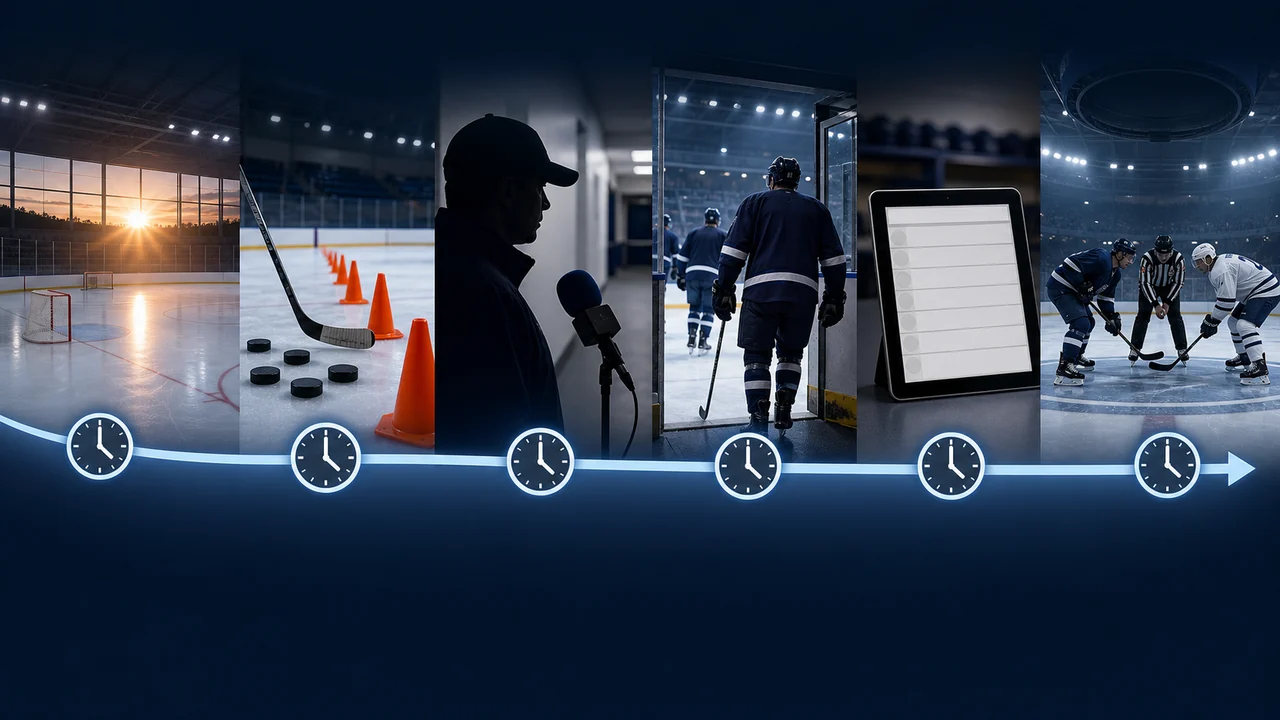
The NHL lineup timeline from morning skate to puck drop
Think of lineup news as a sequence of confidence levels, not one daily reveal. Teams do not all skate at the same local hour, and an optional skate can provide less evidence than a full session. Travel, afternoon starts and back-to-back games can also remove the familiar morning-skate checkpoint.
| Game-day stage | What may become known | How to label it |
|---|---|---|
| Previous practice or evening | Injury status, recalls, expected goalie or planned combinations | Early indication |
| Morning skate | Line rushes, defense pairs, extra skaters and which goalie uses a starter's routine | Projection unless the coach confirms it |
| Coach availability and afternoon | Game-time decisions, transactions and explicit player/goalie announcements | Confirmed item inside a still-projected lineup |
| Pregame warm-up | Who takes the ice, rush combinations and visible late absences | Strong evidence, not by itself the submitted list |
| After warm-up | Eligible game lineup and named starters are filed in the rulebook order | Official submission |
| Opening faceoff | The actual five skaters and goaltender who begin | Observed starters |
A January 29, 2026 St. Louis Blues game-day page shows the progression. Three players were described as game-time decisions before a 7 p.m. game. At 2 p.m., a roster activation and two assignments supplied new evidence. At 6:30 p.m., the club updated the page to say all three would dress and revised its forward combinations. That example is useful because the early post was not “wrong”; it recorded the uncertainty that existed at the time.
Use relative checkpoints for your game. Verify the start time, look once after the team's skate or media availability, then look again around warm-ups when a particular player matters. For a broader planning view, the NHL schedule this week helps identify the game's date and whether the club is traveling or playing consecutive days. Never copy the 6:30 p.m. St. Louis timestamp as a universal rule; it belonged to one 7 p.m. event.
Projected lineup, game lineup, starting lineup and roster are different
Four related labels often collapse into the word “lineup,” even though they answer different questions. Keeping them separate prevents the most common mistake: treating an analyst's expected line combinations as the club's official list.
- Active roster
- The group available to the NHL club over a stretch of the season. The league's Hockey Operations Guidelines describe a normal maximum of 23 players from the start of the regular season through the trade deadline and a minimum of 20. A player can be on this roster without dressing for tonight's game.
- Projected lineup
- An informed estimate of the 12 forwards, six defensemen and two goalies expected to dress, usually arranged as four forward lines and three defense pairs. It can incorporate practice rushes, reporting and coach comments, but the label means the arrangement is not the submitted card.
- Official game lineup
- The 20 eligible players submitted for that game under Rule 5.1: 18 skaters and two goaltenders. This list determines who may participate. Players on the broader roster who are omitted become scratches for the game.
- Starting lineup
- The specific skaters and goaltender named to begin the game. Rule 7 gives the visiting team the first submission and the home team the response. This group is much narrower than the complete game lineup.
Even a final game lineup does not freeze four forward trios and three defense pairs for the night. A coach can shorten the bench, double-shift a scorer, adjust matchups, change partners or shuffle special-teams usage after play begins. A player listed on the “first line” in a preview may not take the first shift, while a starter may later play fewer minutes than a teammate.
When checking the complete NHL schedule, ask what decision you are making. To know whether a player can appear, find the official game lineup. To anticipate linemates, use the latest combinations but retain the projected label. To identify who begins, watch the starter announcement or opening faceoff. To understand who might be recalled or scratched over several days, consult the active roster and transactions.
What morning skate can tell you—and what it cannot
A full morning skate offers useful clues because reporters can observe line rushes, defense pairs, power-play groups and goalie routines. If a player repeatedly works with the regular group while another rotates as an extra, the first player has stronger evidence behind his projection. A coach's direct statement that someone will play or start is stronger still.
However, observation and confirmation are different. An optional skate may include only part of the team. A healthy veteran can skip work for maintenance without losing his place, while an injured player can test his condition and remain a game-time decision. Coaches also try combinations that never reach the game. Which goalie occupies a particular net or leaves first can be a helpful local convention, but it is not an NHL-wide rule.
Read a morning report in this order:
- Was the session full, optional or absent? A full skate usually gives more lineup evidence than a lightly attended optional one.
- What was directly observed? Record rush position, pair, special-team unit, absence or extra rotation without converting it into certainty.
- What did the coach actually confirm? “Will play,” “will start,” “out” and “game-time decision” carry different meanings.
- Did a transaction occur? A recall, reassignment or injured-reserve activation changes the available group, but may not reveal the final choice alone.
- When was the item updated? A timestamp before warm-up can be superseded.
The St. Louis example illustrates the discipline. Its optional skate left several decisions open; a later activation made participation more plausible; the 6:30 p.m. team update finally said the players would dress. A separate NHL.com Vancouver–Vegas preview combined projected units with an injury list and status notes about assignments and a possible debut. The prose explained why the chart looked that way.
Do the same when reading any projection. Do not declare a healthy scratch only because a player skated with extras, and do not call a goalie confirmed solely because of one drill. Preserve the source's own label until a coach, club update or official game record resolves it.
Why starting-goalie confirmation follows a different path
Goalie news deserves its own check because every ordinary NHL game lineup contains two eligible goaltenders, but only one starts. Seeing both names on a lineup card confirms the dressed tandem, not their order. A preview may put the expected starter first, yet words such as “projected,” “likely” and “could start” still control the claim.
The highest-confidence signal is an explicit statement from the coach or club. Next comes the named starter in the official pregame process or a game feed that has updated from the submitted information. A credentialed reporter directly relaying the coach's statement is stronger than an unsourced aggregation. Morning-skate routines can help predict the choice, but they stay below confirmation unless the team explains what the routine means.
This distinction matters most on consecutive-game sets. Fans often expect a team to split a back-to-back between its goalies, but workload, travel, recent play, injury status and coaching preference can alter the plan. There is no safe formula that says the backup must start the second night. Use the NHL calendar to identify the scheduling pressure, then wait for team-specific evidence.
If you need the starter for fantasy or daily contests, build a fallback before the news arrives:
- Record the scheduled faceoff and your platform's lineup-lock rule.
- Mark the goalie as projected until a named source confirms him.
- Enable notifications from the club and a credible beat reporter.
- Keep an eligible alternative in a later game when the contest rules allow changes.
- Recheck after warm-ups rather than relying on a morning screenshot.
Confirmation only answers who begins in net. It does not predict saves, goals allowed or whether the starter will finish. A goalie can be pulled for performance, replaced after an injury or briefly leave for an equipment issue. Keep the starting decision separate from a performance forecast.
How to verify tonight's NHL lineup step by step
Start with identity before personnel. Confirm the two clubs, venue, local calendar date and scheduled faceoff. A search result can surface yesterday's preview, and consecutive games can make an old graphic look plausible. Television coverage may begin before the puck drops, so use the event time rather than the studio-show time; the 2026-27 NHL TV schedule guide explains that distinction.
Then follow this verification sequence:
- Open the club's newest game-day post. Read the timestamp and any update notes, not just the lineup graphic.
- Check the opponent's post too. The clubs publish their own personnel information, and one side may update later.
- Use the league view. The NHL.com daily projected-lineup page assembles combinations, injuries, scratches and status notes in one place. Respect its projected label.
- Find the claim's source. If a reporter says the coach confirmed a goalie or scratch, look for the direct quote, video or clearly attributed report.
- Recheck after warm-ups. Look for the submitted game list or a clearly updated official feed when the decision cannot tolerate uncertainty.
When sources conflict, the newest item is not automatically right; it must also refer to the same game and make a narrower, sourced claim. An afternoon “expected to play” post does not overrule a later club statement that the player is out. Conversely, an old injury list should not override a newer activation plus explicit confirmation. Preserve the time and wording of both until the conflict resolves.
A screenshot without its header is weak evidence. Save or note the page URL, publication/update time, opponent and label. If no official update appears, the honest output is “projected” or “game-time decision,” not a confident guess. That is especially important when a tool silently copies yesterday's combinations forward.
How fantasy and DFS players should handle late lineup news
Fantasy decisions add a second deadline: your platform's lock. Read those current contest rules before game day. Some formats freeze an entire roster when the first game starts; others lock each player at his own scheduled start. Postponements, late swaps and goalie eligibility can also be handled differently. An NHL lineup deadline does not extend a fantasy deadline.
Use four status labels in your own notes:
- Confirmed: a club, coach or official game source explicitly resolves the player or starting goalie.
- Projected: credible reporting supports the expected role, but the official list or direct confirmation is not available.
- Questionable: the player remains a game-time decision, missed a key session or has conflicting current evidence.
- Out: a current authoritative source says the player will not dress, or the final game list omits him.
Attach a time and source to the label. A “confirmed” cell copied from yesterday should not outrank a new game-time-decision update. Before lock, create one acceptable replacement for every questionable player. The replacement must fit the platform's position, salary and start-time rules; a better player whose game already locked is not a real alternative.
Be especially careful with correlated assumptions. Projected linemates can be separated before faceoff or after one period, and a player shown on a power-play unit may receive little advantage time in the actual game. Treat line and unit placement as information about opportunity, not a guaranteed minute or point total. Similarly, goalie confirmation eliminates one uncertainty—who starts—but leaves team defense, shot volume and performance unknown.
A sensible final check happens near the latest safe swap time, not after it. Refresh the official club item, league preview and the platform roster screen; record the decision; then stop chasing unsourced social posts. If certainty never arrives before lock, reduce exposure or choose the confirmed alternative rather than relabeling a projection to justify the original choice.
Late scratches, emergencies and the final pregame checklist
“Official” does not mean every public screen becomes immutable at the first update. Before the opening faceoff, a warm-up injury, sudden illness, approved starter change or corrected feed can produce another notice. Rule 7 requires referee review and approval for a change to the named starting lineup before the game. Once the game has begun, Rule 5.1 says no change is permitted to the submitted eligible-player list.
That boundary still allows coaches to alter deployment among eligible players. Switching two wingers, shortening to three lines or using a different defense pair is a tactical decision, not a new game lineup. This explains why a pregame combination chart can be accurately reported and still look different in the second period.
Run this final check when one personnel decision matters:
- Match the page to the correct teams, venue and local date.
- Verify scheduled faceoff, not only broadcast start.
- Read the newest update time and preserve labels such as projected or game-time decision.
- Check the complete 20-player game list when available: 18 skaters and two goalies.
- Separate injured and scratched players from the listed participants.
- Verify the named starting goalie rather than assuming the first displayed goalie starts.
- If using fantasy or DFS, compare the news time with the platform's actual lock and swap rules.
A player who participates in warm-up is likely being evaluated or prepared, but warm-up presence alone is not the rulebook submission. A player shown on the top line is expected to skate with those teammates, not guaranteed to begin the game or remain there. A goalie can dress as the backup without starting. Matinees and travel days compress or remove familiar morning checkpoints, so anchor every check to faceoff rather than a generic clock time.
The clean answer to “When are NHL lineups announced?” is therefore two-part. Projections can appear from the prior practice through the afternoon. The official eligible-player process happens after pregame warm-ups, with the visiting club filing first and the home club following. For decisions that require certainty, check an authoritative, timestamped source in that final window—and keep the word “projected” whenever the evidence has not crossed it.
Comments
Comments are reviewed before publication. Spam, abusive content and policy-violating links are not published.
Sign in with Google to leave a comment.
Loading comments...