
Checked August 27, 2026: There is no single leaguewide public-sale date for 2026-27 NHL tickets. Many teams already have tickets or plans available, but each club controls its own member presales, public single-game release and authorized resale options. Check the exact team and game before assuming that a listing is original box-office inventory.
The NHL released the full regular-season schedule on July 16, and the season starts September 29. Ticket releases did not all happen on those dates. Some clubs opened single-game sales in July or August, while at least one announced a September public sale. This guide explains the sequence, shows dated official examples and gives you a safe way to find the current sale status.
Is there one NHL ticket release date for 2026-27?
No. The league publishes one regular-season schedule, but the 32 clubs do not have to open their public single-game inventory at the same moment. A team's ticket office may first process season-ticket renewals and deposits, then offer presales to members or email subscribers, and only later open remaining seats to everyone. Another club may move through those steps weeks earlier.
The distinction is easy to miss because July 16 was an important leaguewide date. That was when the NHL announced the 2026-27 schedule, including an 84-game regular season for every club. It gave fans the dates and opponents they needed to plan. It did not establish a universal ticket release. In the same announcement, the league said ticket information for its own special events would arrive later.
Official club announcements show the difference in practice. St. Louis opened public single-game sales on August 21 after season-ticket holders and registered fans received earlier access. Nashville set its public opening for September 1 at 10 a.m. Central Time, following separate member and subscriber presales. Both are valid 2026-27 sales, even though their public dates are eleven days apart.
A marketplace saying “tickets are available” also needs context. It may mean that primary seats are open for many games, that ticket plans are available, or that existing buyers have listed verified resale seats. It does not guarantee that the box office has released every seat for your chosen matchup. Look for labels such as standard ticket, verified resale, presale or season-ticket package before checkout.
The safest starting point is to choose the matchup on the complete 2026-27 NHL schedule, then follow the participating home club's current ticket page. Confirm the date, listed time zone and inventory type there. That two-step check answers a more useful question than “Are NHL tickets on sale?”: Is the exact ticket I want officially available to me now?
How the NHL ticket on-sale timeline works
Ticket sales are better understood as a sequence than as a single release. Clubs can sell commitments for the coming season before the complete schedule exists, then give established members priority when individual matchups become selectable. The seats left after those windows form the public single-game inventory. Resale can appear alongside any of those stages when an eligible ticket holder lists a seat.
| Stage | Typical buyer | What may be available | What to verify |
|---|---|---|---|
| Season-plan sales and renewals | Returning or new members | Full season, half season, deposits or seat-selection priority | Commitment length, payment schedule and playoff terms |
| Member or subscriber presale | Season members, waitlist members, app users or registered email subscribers | Selected single games or plan add-ons before the public window | Code source, account eligibility, time zone and quantity limit |
| Public single-game sale | Any buyer with access to the authorized seller | Remaining standard inventory for listed games | Official start time, fees, delivery method and seat details |
| Authorized resale | Buyers shopping seats listed by existing ticket holders | Game-specific inventory whose asking price can change | Resale label, guarantee, transfer timing and final checkout total |
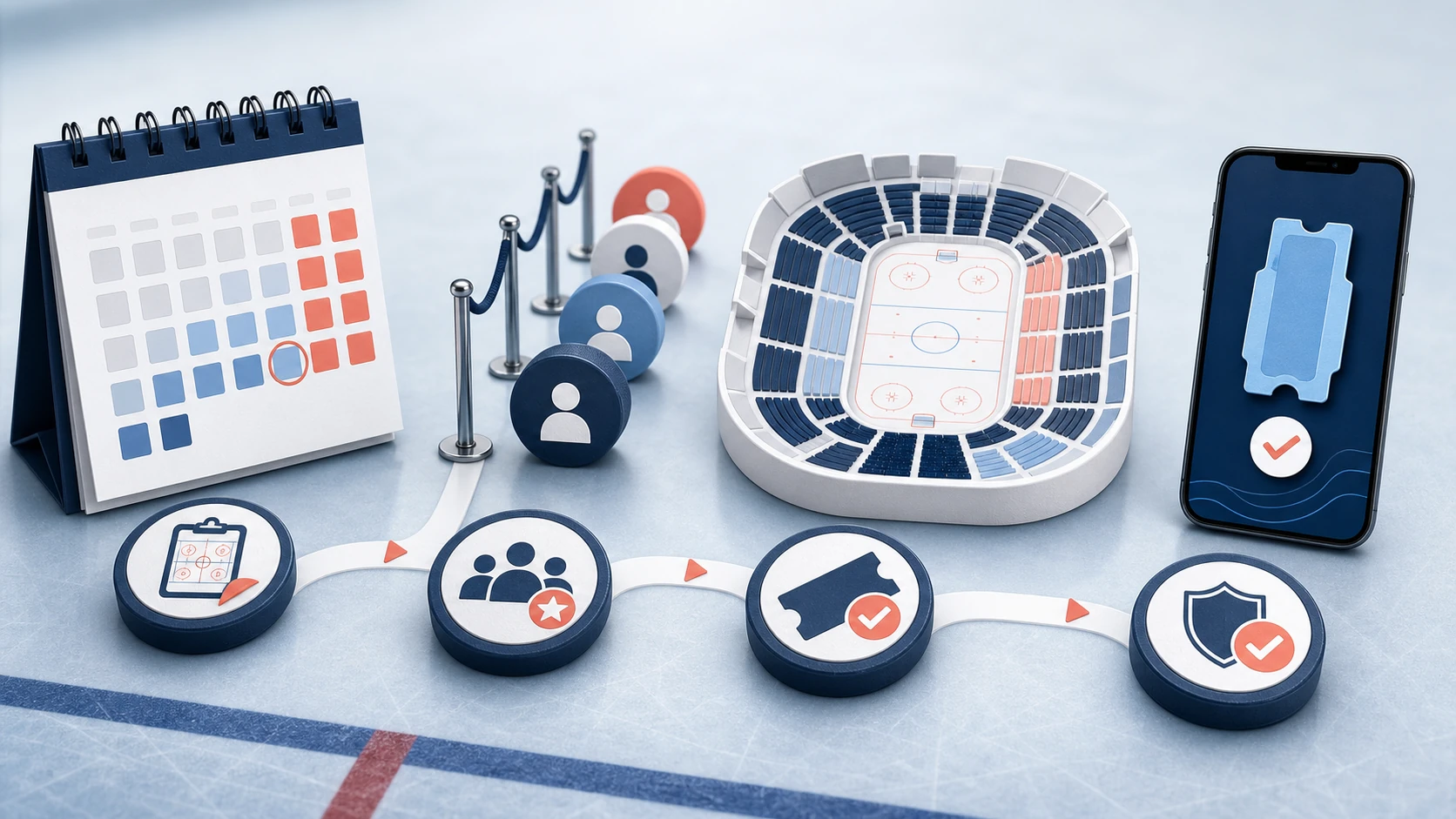
The order can overlap. A club may continue selling mini-plans after public single-game tickets open. Resale seats may be visible while a later presale or public release is still pending. A presale code merely grants entry to a protected window; it does not promise that every section, price level or marquee game will be offered.
Preparation matters most when demand is concentrated. Create or update your account with the seller linked by the club, confirm your contact and payment details, and translate the announced time into your own zone before the queue opens. Join only an official team mailing list, app notification program or membership channel. Codes copied from social posts may be expired, restricted or tied to another account.
Start by identifying important dates in the 2026-27 NHL home opener guide. Then check whether the home club treats that game like ordinary inventory, a member priority game or part of a required package. The schedule tells you what you want to attend; the club's ticket notice tells you when and how that inventory becomes available.
Confirmed 2026-27 team sale examples
The dates below are examples verified from official club pages on August 27, 2026. They show how widely the timeline can vary; they are not a substitute for a live 32-team inventory board. A date that has passed tells you when the public window began, not whether standard seats remain available today.
| Home club | Public single-game opening | Earlier access noted by club |
|---|---|---|
| Boston Bruins | July 17 at 2 p.m. ET | Season members, society members, plan holders and waitlist members |
| Buffalo Sabres | July 22 at 10 a.m., as listed by the club | Season-ticket members and other presale groups on July 21 |
| Carolina Hurricanes | August 20 at noon ET | Season-member access August 18; text presale August 20 at 10 a.m. ET |
| St. Louis Blues | August 21 | Season-ticket holders and registered/app audiences |
| Nashville Predators | September 1 at 10 a.m. CT | Member access August 24; subscriber access August 26 |
| Montreal Canadiens | September 14 | Newsletter presale; multi-game packs from August 21 |
The spread from Boston's July 17 opening to Montreal's September 14 date is the clearest reason not to optimize your plans around a rumored “NHL ticket day.” Boston tied its public opening closely to the schedule release. Nashville inserted multiple presale windows before a September public launch. Montreal offered multi-game packs weeks before public single-game inventory.
Use the linked club notices as models for what a trustworthy announcement looks like. The Bruins announcement names the date, hour, time zone and eligible presale groups. The Predators notice does the same for its staged August and September windows. A social graphic without those details should send you back to the club site for confirmation.
Once you choose games, the site's NHL schedule calendar can keep the dates together. Continue to rely on the home club for ticket status because schedule organization and ticket inventory are separate systems.
How to find your team's official on-sale date
Begin with the home team, not necessarily the team you support. The home club and venue control the game-night inventory and entry rules. If Toronto is visiting Seattle, for example, Seattle's current ticket page is the relevant starting point. The away club's schedule can confirm the matchup, but it does not run the home box office.
- Choose the exact game. Confirm the home team, arena and date before searching for tickets. Similar team names, neutral-site exhibitions and international events can lead to a different seller.
- Open an official route. Use the NHL ticket directory or the tickets menu on the club's verified NHL.com site. Do not trust a sponsored search result solely because it uses the team name.
- Find the current season label. The page or announcement should say 2026-27 and identify single-game tickets, a presale or a package. An indexed 2025-26 help page may otherwise look almost identical.
- Confirm the clock and eligibility. Note ET, CT, MT, PT or the event's local zone. Check whether access requires a membership, waitlist account, email registration or code, and whether quantity limits apply.
- Inspect the listing before checkout. Verify the opponent, date, seat section, ticket type, accessibility details, delivery method and full total. A listing visible before the public opening may be resale rather than standard inventory.
For a wider view before choosing, compare dates on the printable NHL schedule. Weekend games, home openers, rivalry matchups and special promotions can draw different demand. That comparison can help you create backup choices before a high-demand queue begins.
Bookmark the club page instead of relying on an old search result. Teams can add inventory, revise an opening time or announce a new offer. A current page inside the official domain is more useful than a cached snippet that still displays last season's wording.
Season tickets, mini-plans, groups and single-game tickets
“Tickets on sale” may refer to several products with different commitments. Pick the product first, then evaluate its release window. Buying a larger package simply because it opened earlier can be expensive if you only need one night; waiting for public singles can be frustrating if you actually want the same seat across many games.
- Full-season membership: usually covers every regular-season home game and may include priority benefits. Renewal deadlines, seat rights, playoff access, exchanges and payment plans are controlled by the club's current agreement. Never assume a benefit from another team's plan applies to yours.
- Half-season, mini or flex plan: reduces the number of games. Some products use a fixed set; others let buyers select from eligible dates. Marquee games may be included, excluded or bundled, so review the actual game list rather than the product name.
- Group, suite or premium product: often has a separate inquiry path, minimum party size or hospitality terms. Its availability does not prove that ordinary public seats are sold out, and a public single-game sale does not prove that a suite can be booked through the same checkout.
- Single-game ticket: offers the most control over opponent and date. Standard inventory comes from the initial seller; resale inventory comes from an existing buyer. Both can appear on the same event page with different labels and prices.
Real 2026-27 announcements illustrate the choices. St. Louis promoted full, half-season, mini, flex, group and premium options when public singles opened. Nashville sold a six-game flex option before its September public single-game date. Boston said full-season packages were sold out while limited 11-game plans, a waitlist and group products remained. “Sold out” therefore needs a noun after it: a full-season membership can be unavailable while individual or group routes still exist.
Your schedule certainty should drive the decision. A local fan planning repeated visits may value seat continuity and member access. A traveler should first confirm the 2026-27 NHL season dates, travel time and one specific matchup. Families or organizations should ask the official group office about seating together and accessibility rather than assembling a large order from scattered resale listings.
Read the payment and cancellation terms before placing a deposit. A deposit may establish priority without guaranteeing a particular location; a plan can renew automatically or have deadlines; and playoff access can require an additional commitment. Those conditions are contractual, team-specific and more important than a generic claim that one ticket type is always the “best deal.”
Primary tickets, verified resale and speculative listings
A ticket can be legitimate even when it was not part of the public box-office release. The important questions are who is offering it, whether that seller controls the seat, how ownership will transfer and what protection applies if delivery fails.
Primary inventory is released by the team, venue or its initial ticketing provider. Resale inventory is listed by a buyer who already acquired the ticket, often a season-ticket member. On an integrated marketplace, standard and resale seats may appear on the same map. Read the label and checkout details instead of using color or position on the map as your only clue.
Ticketmaster's current NHL buyer guide says its Verified Resale process invalidates the previous barcode and issues a new one to the buyer. The same guide notes club exceptions to how verified resale is handled. That is why “the NHL uses this marketplace” is not enough: inspect the guarantee and delivery language on the exact event you are buying.
A speculative listing is different. The seller advertises a ticket it does not yet control and intends to obtain later. The listing can appear before the public sale, which creates the false impression that all inventory has already opened. If the marketplace permits this type of listing, its terms should identify the delivery deadline and remedies. The lower-risk choice is to wait for confirmed inventory from the team-linked seller.
Copycat sites and informal social sales add another layer of risk. The FTC warns that scammers can use paid search and social posts to send buyers to convincing imitation sites. Before paying, check the domain reached from the team, the refund or replacement policy, the promised delivery method and the support process. A screenshot of a mobile ticket is not the same as a completed transfer into the account or app required by the arena.
Club guidance can be even more specific. The Colorado Avalanche ticket page encourages purchases through verified team- or venue-linked routes and warns that counterfeit tickets from unauthorized sources may not be replaceable or refundable. Save your order confirmation, use the official account-transfer flow, and confirm that every seat is present before traveling.
Special-event and playoff ticket timing
League events do not inherit a participating club's ordinary single-game release. The NHL event hub separately lists the 2026 Heritage Classic, Global Series games in Finland and Germany, the Winter Classic, the 2027 All-Star event and the Stadium Series. Some event cards currently offer a purchase link; others may show information without an active sale button. Treat the status of the exact card as authoritative for that moment.
This matters for venue and country changes. An outdoor game can use a stadium seller that differs from the home club's normal arena account. An international game can route buyers to a local-country marketplace with different currency, delivery and consumer terms. Start from the NHL event listing, confirm the city and date, then review the linked seller before booking travel. The existing 2026 NHL Global Series ticket guide explains the confirmed Finland and Germany matchups without treating them like ordinary home dates.
Playoff inventory has a different dependency: the participating teams and later-round home games are not known until competitive results establish them. Clubs can sell memberships, strips, reservations or conditional access before a matchup is final, but the product terms control what happens if a game is not played. A first-round public window for one qualifier is not a leaguewide playoff ticket release.
When a team clinches or advances, return to its official ticket page and read the round-specific notice. Confirm whether the listing is for a guaranteed game, a possible home game, a full-round strip or resale. Do not buy based only on a placeholder date or an assumed opponent. For a Stanley Cup Final seat, the same rule applies with greater urgency: wait for the participating club or NHL event path to identify the authorized sale and the game designation.
A practical buying checklist for 2026-27
Use this final check before joining a queue or paying for a listing:
- Confirm the opponent, date, home team and arena on the current schedule.
- Verify the public-sale or presale time and its time zone on the club or NHL event page.
- Reach the seller through that official page and check the domain before signing in.
- Identify whether each seat is standard inventory, verified resale or another listing type.
- Review the section, row, seat quantity, view notes and accessible-seating requirements.
- Compare the full checkout total, including mandatory fees, rather than only the first displayed price.
- Read the transfer, mobile-delivery, refund and event-cancellation terms.
- Keep one or two backup games in case the preferred inventory or seat group is unavailable.
- Save the confirmation and verify that transferred tickets appear in the account or app required for entry.
The durable answer for 2026-27 is not a single release date. It is a repeatable process: select the game, start with the home club or NHL event page, identify the sale stage, and verify the exact listing before paying. That process still works after a presale ends, after public inventory opens and when authorized resale becomes the only available route.
Comments
Comments are reviewed before publication. Spam, abusive content and policy-violating links are not published.
Sign in with Google to leave a comment.
Loading comments...