
Updated August 28, 2026: The NHL's official 2026-27 Trade Tracker covers completed deals since noon ET on July 1, while its Free Agent Tracker is a separate, rolling list of signings and unresolved player statuses. Use both. A single tracker does not capture every type of roster move or every June trade that affects the coming season.
This article records selected confirmed moves, explains the cutoff and gives you a verification workflow. It does not place rumors, proposed trades or “expected” contracts in the completed tables. Because the offseason remains active before the September 29 opener, every roster conclusion below is a dated snapshot.
Where the 2026-27 NHL transaction tracker stands today
The official 2026-27 NHL Trade Tracker describes itself as the list of completed trades since noon ET on July 1, 2026. In the version checked for this article, its newest entry was Detroit acquiring Sutter Muzzatti from Nashville for future considerations on August 20.
The official NHL Free Agent Tracker had an August 25 update date. It organizes signings and free-agent categories by team and says player contract status will be updated throughout the offseason. A name remaining in a free-agent group is not proof of retirement or a future destination.
| Question | Best starting source | Important limit |
|---|---|---|
| Was a trade completed after noon July 1? | 2026-27 Trade Tracker | Earlier June deals use the preceding tracker's date scope. |
| Did a free agent sign or re-sign? | Free Agent Tracker plus linked club announcement | Status can change after the page timestamp. |
| Was a player assigned, recalled or claimed? | Official club/league transaction feed | These are not all trades or free-agent signings. |
| How does the move affect a team? | NHL Team Reset and club reporting | Projected role is analysis, not guaranteed deployment. |
The cutoff explains an apparent contradiction. A major trade completed in June can be central to a club's 2026-27 roster while appearing in the 2025-26 season-labeled trade tracker. That is an archive boundary, not evidence the transaction never happened. Search by transaction date as well as destination season.
Use the NHL calendar to anchor updates before the September 29 opener. Save the source URL, page update date and transaction date. A rolling page may change without preserving the exact order in which you first saw it.
Confirmed trades since July 1 that reshape 2026-27 rosters
The following selected trades come from the official 2026-27 tracker and were confirmed by the August 28 check. They emphasize players likely to affect NHL depth or major future assets; they are not a substitute for the complete rolling list.
| Date | Acquiring club receives | Other club receives |
|---|---|---|
| July 1 | Nashville: Mavrik Bourque, Ilya Lyubushkin | Dallas: 2027 second-round pick, 2028 third-round pick |
| July 1 | Detroit: Keegan Kolesar | Vegas: 2029 third-round pick, 2027 seventh-round pick |
| July 1 | New York Rangers: Marcus Pettersson | Vancouver: 2030 first-round pick |
| July 1 | Boston: Will Borgen | New York Rangers: 2027 second-round pick, conditional 2028 third-round pick |
| July 1 | Utah: Vincent Trocheck | New York Rangers: Sean Durzi, Cole Beaudoin, 2027 third-round pick |
| July 1 | San Jose: Darnell Nurse | Edmonton: Shakir Mukhamadullin, Zachary Sharp |
| July 1 | Toronto: Nick Paul | Tampa Bay: Dennis Hildeby, 2027 fourth-round pick, 2028 third-round pick |
| July 1 | Edmonton: Devon Levi, 2028 seventh-round pick | Buffalo: 2028 third-round pick |
| July 2 | Minnesota: Blake Coleman, Olli Maatta | Calgary: Jacob Middleton, 2027 third-round pick, 2028 fourth-round pick, 2029 second-round pick |
Read both columns. A team acquiring the most recognizable NHL player did not necessarily “win,” because term, cap charge, prospect development, pick position and the condition on a future selection matter. This table intentionally does not invent salary retention or draft-pick conditions beyond the official summary.
The trades also answer different roster problems. San Jose added an established defenseman while Edmonton received two younger defensemen. Toronto acquired a forward and Tampa Bay received a goalie plus picks. Edmonton's separate Levi deal added a goalie while sending Buffalo a higher-round 2028 pick and receiving a seventh. These are descriptions of asset types, not forecasts of performance or opening-night roles.
Do not update a player only on the destination team's page. Remove him from the former club's live roster view, add every returned player and prospect, and record each future pick once. If a pick is conditional, keep the word “conditional” until an official source reports that the condition was met.
Finally, connect the player to the correct games through the 2026-27 NHL schedule. A trade changes which club controls or employs the player; it does not move the club's published dates, opponents or venues by itself.
Notable 2026 free-agent signings and re-signings
Free agency is broader than veterans changing teams on July 1. The official tracker includes restricted free agents who re-sign, unrestricted players who return to their former clubs, players who join a different NHL team and players who sign in another league. Preserve that path when summarizing a contract.
| Player | Confirmed outcome | Officially reported terms |
|---|---|---|
| Jacob Trouba | Joined San Jose from Anaheim as an unrestricted free agent | Four years, $33 million; $8.25 million AAV |
| Sergei Bobrovsky | Joined Toronto from Florida as an unrestricted free agent | Three years; financial terms not announced |
| Connor Bedard | Re-signed with Chicago as a restricted free agent | Five years, $75 million; $15 million AAV |
| Patrick Kane | Returned to Chicago after playing for Detroit | Two years, $16 million; $8 million AAV |
| Jason Robertson | Re-signed with Dallas | One year, $12 million |
| Trevor Zegras | Re-signed with Philadelphia | Four years, $36.5 million |
| Alex Ovechkin | Re-signed with Washington | One year; no amount added here without a linked official figure |
“Financial terms not announced” is useful information, not a blank to fill with rumor. Toronto and the NHL confirmed Bobrovsky's three-year contract while withholding the value in the reviewed releases. An estimated cap figure can be tracked separately if a reputable secondary source provides it, but it must not be relabeled the club's announcement.
Total value and AAV also differ. Trouba's $33 million is spread over four years for an $8.25 million average; Kane's $16 million over two produces an $8 million average; Bedard's $75 million over five produces $15 million. Those calculations do not reveal each contract's year-by-year cash, signing bonuses, trade protection or net pay unless the source supplies those details.
The destination language prevents another common error. Bedard stayed with Chicago after restricted free agency; he was not “acquired.” Kane changed clubs and returned to a former team; Bobrovsky and Trouba joined new teams. A team-level tracker should add newcomers under arrivals, retain re-signed players in the existing group and record departures on the former club's side.
This table is selected and dated, not a complete 32-team ledger. The official tracker still displayed unresolved names on August 25, so availability can change. Update only after a club or league source confirms the contract, and preserve “signed in Europe” or “signed in the AHL” rather than implying every resolution is an NHL deal.
Trade, signing, waiver, claim and assignment mean different things
A reliable transaction database stores the official verb, because each verb changes a different relationship. Replacing them all with “moved” loses whether a contract changed clubs, a player merely entered a waiver window or an assignment actually occurred.
- Traded
- Two clubs exchange player contracts or rights and/or other assets. Record both directions, future considerations and every condition.
- Signed or re-signed
- The player agrees to a contract. “Re-signed” keeps him with the same organization; “signed with” can mark a new destination. Neither guarantees he dresses on opening night.
- Placed on waivers
- The player enters the applicable claim process. It is pending, not proof that he cleared, was claimed or was assigned.
- Claimed
- Another club obtains the player through waivers. Add the destination only when the official result identifies it.
- Cleared waivers
- No claim was recorded during that window. The player can remain while the club decides its next step; do not invent an assignment.
- Assigned or loaned
- The club sends the player to the named affiliate, junior club or other destination under the applicable rules.
- Recalled
- The club brings the player to its NHL roster. This is not a new signing if the contract already existed.
- Released from a professional tryout
- The tryout ends. It does not by itself mean the player retired or cannot sign elsewhere.
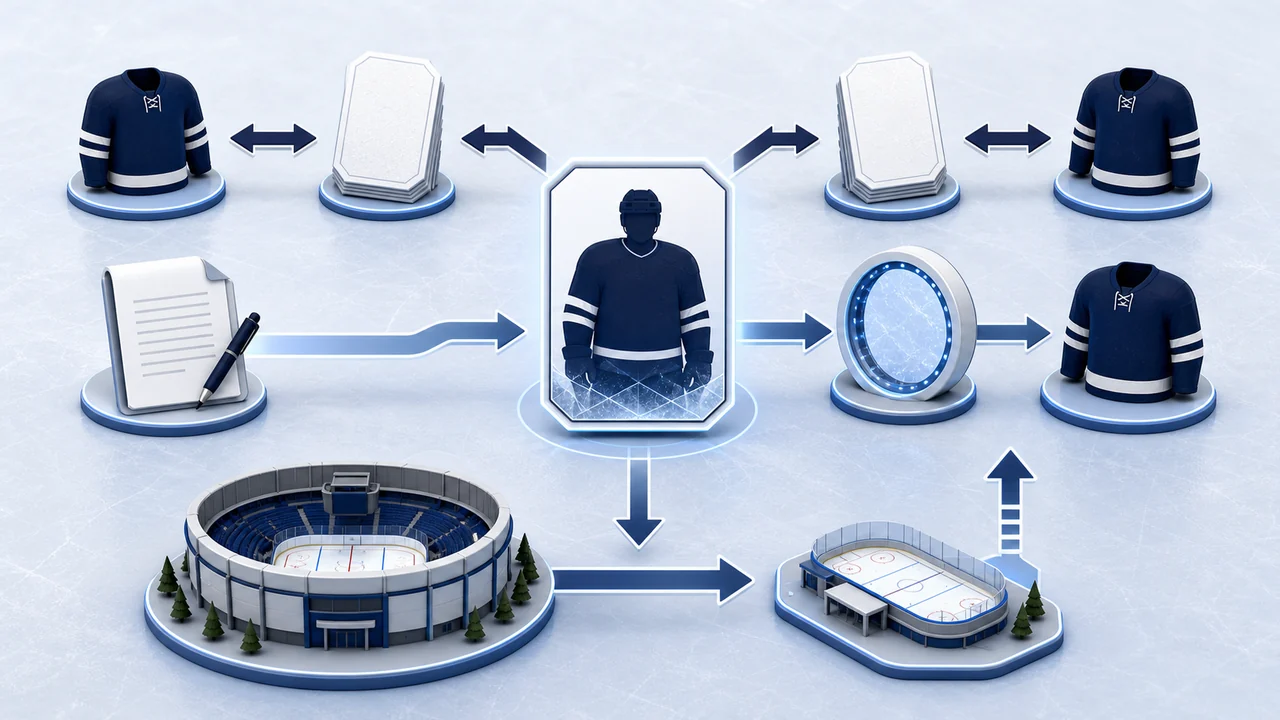
Rights require the same care. A trade can transfer an unsigned player's rights without producing a signed contract. A draft pick can be conditional without its final round or ownership being settled. “Future considerations” is the official return description when used; it should not be replaced with a guessed player or cash amount.
Injured Reserve is another status, not a change of employer. It can affect roster administration, but the player remains with the organization. Likewise, a signing can be followed by waivers or assignment. Store each event as a new dated row instead of overwriting the signing with the later move.
How transactions change rosters without changing the NHL schedule
A completed move changes personnel control or contract status. It does not, by itself, change a club's published date, opponent, venue or faceoff time. The NHL released the 2026-27 schedule on July 16, and those games remain scheduled unless the league or clubs separately announce an adjustment.
The player's relevant schedule does change. After San Jose acquired Nurse, future Sharks games became the matchups in which he could appear; Edmonton's dates did not move. “Could appear” remains the correct phrase until health, registration, roster and lineup status are confirmed. A trade announcement is not an opening-night lineup card.
Translate moves into roster effects at three confidence levels:
- Confirmed asset change: the club gained or lost the player, rights, prospect or pick named in the official transaction.
- Likely roster effect: an established NHL defenseman increases competition for defense minutes, or a goalie arrival changes the available tandem. This remains analysis.
- Unconfirmed deployment: line number, partner, power-play unit, starting role, ice time and game-one participation require later coach/lineup evidence.
For the next game, open the NHL schedule today, then check official team status and the submitted lineup. Do not rely on an old player page whose team field has not refreshed, and do not assume a fantasy platform will update position/team eligibility at the same speed as the league.
Tickets require similar restraint. Buying because a star signed or was traded does not usually create an appearance guarantee. Injury, scratches, later transactions and coaching decisions can intervene. Check the seller's event terms; a roster move does not automatically create a refund or change the matchup printed on the ticket.
The offseason tracker also should not be confused with the in-season deadline. The 2026 NHL trade deadline guide covers the prior deadline and its process; 2026-27 will have its own official critical date. Until that new date is officially confirmed, do not copy the old one forward.
In short: update the player-to-club relationship immediately after confirmation, update projected roles cautiously, and update the schedule only from a schedule authority. One transaction can affect many roster pages without changing a single game row.
How to verify NHL transactions by team without repeating rumors
Use a two-source check for trades whenever possible: the league tracker plus an announcement from one or both clubs. The league entry establishes completed status; the club pages often preserve fuller pick conditions, prospect rights, salary retention or quotes. If the summaries differ, do not merge them by guessing—record the narrower confirmed facts and investigate the discrepancy.
Separate confirmation levels in the newsroom and database:
- Completed: official NHL or club transaction language says acquired, traded, signed, claimed, assigned or recalled.
- Reported pending: a reputable reporter says clubs are finalizing or a player intends to sign, but no official completion exists.
- Rumor: possible interest, discussion or speculation without an attributable completed transaction.
Only the first belongs in a confirmed tracker. “Working on,” “close,” “expected,” “has interest” and “could be moved” are not synonyms for completed. A deleted social post, fake screenshot or search snippet without a live source is not enough.
Store one event with linked assets instead of duplicating a trade as two unrelated moves. Useful fields are transaction date/time, publication/update time, event type, player and asset identifiers, origin, destination, complete return, contract term and AAV when officially reported, condition text, primary source URLs and correction status. Team pages can render the same event from each side.
Then run a leaguewide audit:
- Review all eight Atlantic, eight Metropolitan, eight Central and eight Pacific teams.
- Check that every outgoing NHL player has the same destination shown on the receiving side.
- Prevent one player or pick asset from appearing in two active destinations.
- Keep unresolved free agents unattached rather than assigning their prior club by default.
- Preserve conditions and future considerations until an official later event resolves them.
- Append waiver results, assignments and recalls instead of overwriting the original event.
A printable or downloadable transaction list needs an “as of” time and the same filters as the web view. State whether it includes trades only, NHL signings, international/AHL outcomes, waivers or roster assignments. Without that scope, two correct exports can appear to disagree.
How often should the page update? During active windows, recheck the official trackers whenever new club announcements appear; during quieter periods, a daily review is more honest than pretending to be real time. If a free agent remains listed as available, retain that status. If financial terms were not announced, retain that too.
The governing principle is simple: preserve history, label uncertainty and let the official verb trigger the confirmed row. That produces a useful 2026-27 tracker even as the roster picture continues changing toward opening night.
Comments
Comments are reviewed before publication. Spam, abusive content and policy-violating links are not published.
Sign in with Google to leave a comment.
Loading comments...