The 2027 NHL trade deadline is Monday, March 1, at 3 p.m. Eastern Time. The NHL's published season calendar confirms it. For fans, the harder questions begin after putting the date in a calendar: why some announcements arrive later, which players can help in the playoffs, and how the current collective agreement changes the roster choices.
This guide explains those decisions for the 2026-27 season. It separates the confirmed cutoff from future deals and shows what to check when a deadline alert turns into an actual lineup change. Information reviewed November 10, 2026.
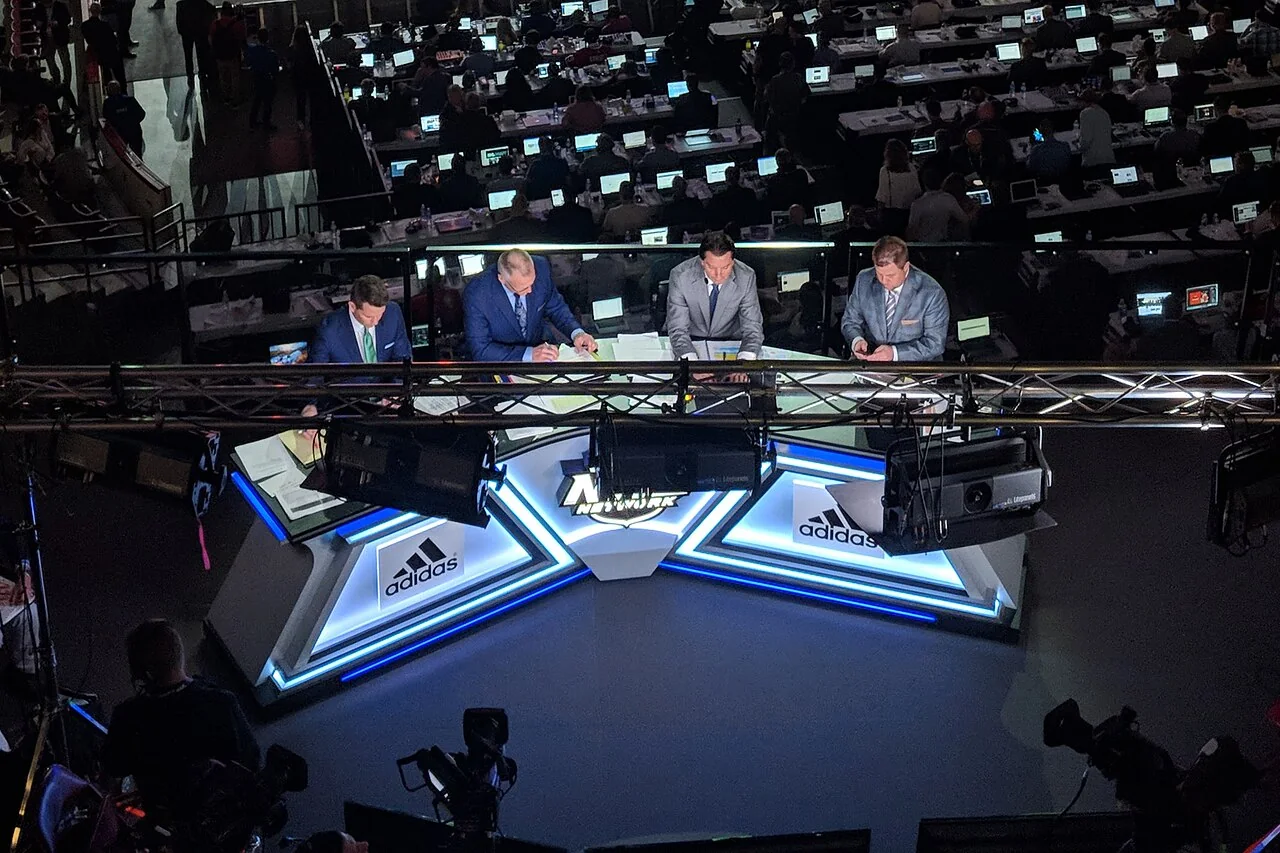
Cover: NHL Network's booth at the 2019 NHL Entry Draft, a historical reporting scene. Northwest / Wikimedia Commons, CC BY-SA 4.0; resized and converted to WebP, shared under the same license.
The confirmed 2027 NHL trade deadline
The 2027 NHL trade deadline is Monday, March 1, at 3 p.m. Eastern Time. The NHL lists that date and time in its official 2026-27 calendar. It is a confirmed entry, rather than a prediction based on the previous season's deadline.
| Question | 2026-27 answer |
|---|---|
| Deadline day | Monday, March 1, 2027 |
| Eastern Time cutoff | 3 p.m. |
| Pacific Time equivalent | Noon |
| Regular-season finale | Saturday, April 10, 2027 |
The calendar year can cause confusion. This March deadline belongs to the season that began in September 2026 and finishes its regular-season schedule in April 2027. A page displaying March 6, 2026 concerns the preceding campaign. Do not carry its countdown, completed-deal totals or transaction list forward merely because its title says NHL trade deadline.
March 1 is also a Monday. If your usual routine is to follow a Friday deadline show, put the actual date in your calendar now. Fans outside North America should convert the Eastern Time cutoff for their own location; an afternoon in New York is not an afternoon everywhere. The Pacific equivalent above is a time-zone conversion, not a second deadline.
The April finale provides context for why these moves matter: teams are shaping the group that will play the stretch run and, if they qualify, the postseason. It does not identify the playoff field in advance. Use the current weekly schedule for actual games. The deadline is a roster-management cutoff, not a ticket-release date or a promise that a newly acquired player will dress immediately.
Why a trade can be announced after 3 p.m.
The public announcement does not have to appear before the cutoff. The NHL's deadline explanation distinguishes timely submission to Central Registry from later publication. That is why refreshing a feed at exactly three o'clock does not necessarily reveal the final list of completed business.
There is a recent practical illustration: the 2026 deadline blog still discussed a Central Registry queue after the cutoff. Treat that as an example of processing and reporting time, not permission for clubs to keep negotiating a new deadline deal indefinitely.
Agreement, filing and approval are different
Read a breaking report according to the stage it actually describes. Two clubs reportedly agreeing on a framework is different from a submitted transaction, and a submitted transaction is different from the final club announcement spelling out the exchange. Your first alert may contain the main player while omitting a retained-salary percentage, an unsigned prospect's rights or the conditions attached to a draft pick.
Those missing details can change the assessment. A pick described only as a first-rounder could involve a particular year or a protection condition. A player's destination can also depend on contractual movement rights. In a 2022 example, the league reversed Vegas' proposed Dadonov trade to Anaheim because Anaheim was on his no-trade list.
For the reader, the useful habit is to keep a provisional note until the details settle. Record who reported the agreement, then replace the tentative package with the confirmed assets when the clubs publish them. A later timestamp alone does not establish a rules violation, while an early confident headline does not establish that every requirement has been satisfied. Compare the final transaction with your original interpretation before declaring a clear winner or loser.
Who remains eligible for the Stanley Cup Playoffs?
The important distinction is between a club's reserve list and the players currently dressing for its NHL team. The collective agreement's definitions include unsigned draft choices on the reserve list. An NHL game roster, an active roster and a list of organizational rights therefore answer different questions.
The reserve-list deadline has real consequences: Edmonton explained that Quinn Hutson could not play in the 2025 playoffs because he missed its deadline reserve list. Seeing a player in a late regular-season game is consequently insufficient evidence that he can dress in the postseason.
An acquired player and a new contract are different cases
Do not turn that rule into a claim that every playoff participant must sign his first contract before March 1. A drafted prospect whose rights already belong to the organization presents a different question from a player arriving from another organization after the cutoff. Check the rights history before treating a late signing as a loophole.
For a concrete historical example, Ryan Leonard signed on March 31, 2025, then appeared in eight playoff games for Washington. The apparent contradiction disappears once you distinguish signing a player already in the system from acquiring somebody else's player. That example does not guarantee that any particular college player will sign, arrive healthy or receive a place in the lineup in 2027.
Waiver claims and minor-league moves need their own check
When an alert describes a waiver claim, a loan or a recall, first identify which league and roster the transaction affects. Our NHL waivers guide explains the vocabulary. A player's availability for an affiliate should not be treated as an automatic answer about the NHL postseason.
For a borderline case, look for an explicit club explanation covering the player's eligibility, rather than inferring it from an updated roster page. Separate three questions in your notes: who owns the rights, where the player is assigned, and which competition he can enter. They often travel together in a news report, but confusing them can turn a routine developmental move into an imaginary playoff reinforcement.
What changes for rosters and recalls after the deadline
Deadline planning includes the players who stay. A club can improve one position with a trade while making another part of the roster harder to manage. Read the acquired player's role alongside the organization's remaining ability to bring help up from the minors.
The active roster can grow, but the cap still matters
The NHL's roster guidelines apply the normal 23-player maximum through the trade deadline. Afterward, the removal of that ceiling does not remove regular-season salary-cap compliance under the collective agreement. More roster room and more spending room are different things.
Consider a hypothetical team that adds a defenseman without sending an NHL player away. It has gained an option for the coach, but the new salary charge still has to fit its circumstances. Likewise, keeping an extra forward nearby can help with travel and short-term uncertainty without creating another place in the dressed lineup. Counting names on a roster page tells you little about whether a particular combination is affordable or available.
Use the current recall rule rather than an old summary
The current agreement permits five regular recalls in the post-deadline period, with no more than four of those recalled players on the active roster at once. Issue 16 of the 2025 NHL/NHLPA memorandum changes the older provision. A guide repeating only the old four-recall total can lead you to the wrong conclusion about a 2027 move.
There are two separate limits to follow: the recall allowance used over the period and the number of relevant recalled players present together. Sending somebody back does not justify assuming that every earlier transaction disappears from the count. Nor should a headline using the word emergency be treated as interchangeable with a regular recall; the classification and applicable conditions matter.
That gives depth already in the organization a practical value at the deadline. A versatile player who can cover several lineup jobs may reduce the need for repeated changes afterward. The trade evaluation should therefore include the bench and the affiliate, rather than stopping at the projected first night together. Our 2026-27 CBA guide covers the wider agreement beyond this deadline decision.
How retention and the playoff cap affect 2027 deals
A trade can solve an immediate lineup problem and still leave a difficult financial choice for April. The NHL confirmed that playoff lineups must meet the salary cap, beginning with the 2025-26 season. Treating the postseason as a place to ignore the cap is an outdated starting point for evaluating the 2027 deadline.
For a contender, the relevant question becomes which usable combination it can assemble. An expensive addition is less helpful if fitting him into the desired postseason lineup forces another useful player out. A cheaper specialist can be attractive when he complements the existing group, although a low cap charge alone says nothing about whether he can handle the assignment.
Why routing salary through another club needs scrutiny
The signed memorandum's second-retention provision requires 75 regular-season days between retained-salary transactions on the same contract. Playoff, offseason and training-camp days do not count toward that interval. It can therefore stretch across league years.
That changes the assumptions behind an old-style proposal to pass a contract through an intermediary that retains again immediately. In a hypothetical same-afternoon chain, waiting a few minutes between announcements does not meet a requirement measured in regular-season days. Conversely, the provision is not a blanket statement that a contract can never be retained a second time. The earlier transaction and the elapsed qualifying days have to be checked.
When assessing a reported package, identify which club is retaining, the portion it retains and whether the report describes an additional retention on an already retained contract. Do that before calculating an attractive final cap charge. A proposal can look elegant on a fan-made spreadsheet while depending on a transaction sequence the rules do not permit.
Finally, assess the commitment beyond this spring. Retention on a player with term can affect future flexibility, while a short rental may leave no player behind after the season. The two acquisitions can carry similar immediate lineup benefits but very different costs. For buyers and sellers alike, the deadline price includes the obligations left after the excitement of announcement day has passed.
Judge the full exchange, not only the headline name
Start your evaluation with the job the acquiring team needs done. A scorer, a defensive center and an injury replacement solve different problems. Ask which existing player loses minutes, whether the newcomer improves those minutes, and whether the likely postseason matchup makes that improvement especially useful. A recognizable name can be an awkward fit; a less prominent addition can fill a precise vacancy.
Then inspect the return without reducing it to the number of assets. A future first-round choice needs a year and any protection conditions attached to it. A prospect needs a plausible path to the NHL rather than a label based only on where he was drafted. A roster player going the other way can create a replacement problem even when the incoming player appears stronger individually.
Here is a hypothetical comparison: one buyer spends a premium pick on a winger who would enter its second line; another spends a later pick on a center who would replace a struggling penalty killer. The first move may offer more upside, while the second may address a clearer weakness at a lower cost. Neither description proves the better trade until you consider the rest of each lineup, the available alternatives and the buyer's realistic chance to contend.
For the selling club, apply a different horizon. An expiring contract that becomes future value can be sensible even when the immediate roster weakens. Moving a player with useful years remaining asks a harder question: is the return worth surrendering those seasons? A deadline decision should not be judged by an identical standard for every team.
Keep the initial verdict provisional. The deal can be reasonable when announced and still fail because of injury, deployment or ordinary uncertainty. Conversely, one early goal does not repay every asset sent away. Evaluate the decision using what was known at the time, then evaluate the results separately as the remaining schedule unfolds.
How to follow deadline day and the games afterward
Use the official 2026-27 NHL Trade Tracker for completed exchanges, then open the individual club announcement for the full package. Keep that source separate from a rolling program discussing what might happen. Our season transaction guide provides context when an alert describes a signing rather than a trade.
Before the cutoff, concentrate on what would change the roster: the incoming role, the outgoing assets, the remaining contract and any required consent. As the cutoff passes, allow processing time for timely submitted deals. Once the final details arrive, update the package rather than preserving the incomplete version simply because it appeared first.
For the next game, the decisive information shifts from the negotiating desk to the team. Watch for travel updates, practice participation and the coach's lineup announcement. An acquisition does not guarantee an immediate debut, and a player skating with the group does not by itself establish a particular line combination. If you are buying tickets chiefly to see the newcomer, wait for the strongest available confirmation of his availability.
Then connect the move to the actual race. The NHL standings show the competitive setting, while the next games reveal the assignments the coach trusts the player to handle. Look beyond a debut's points: who takes difficult defensive shifts, who joins special teams, and whether the addition changes the minutes of the players already there.
The date to keep is March 1, but the useful assessment continues afterward. A deadline roster is a plan, and the remaining regular season tests whether its parts work together. Follow the confirmed transaction through to its on-ice role before deciding how much it changes a team's spring.
Comments
Comments are reviewed before publication. Spam, abusive content and policy-violating links are not published.
Sign in with Google to leave a comment.
Loading comments...