
What Ovechkin has announced about his final NHL season
Alex Ovechkin confirmed on October 5 that 2026-27 will be his final NHL season, according to the Capitals' announcement. For fans deciding whether to see him play, the useful starting point is Washington's current schedule and game-day information. The announcement identifies a season; it does not guarantee his participation in every remaining fixture.
That distinction matters when headlines shorten the news to a retirement date. A season contains many possible endings for an individual player: the team's last regular-season game, its last playoff game if it qualifies, or an earlier appearance if availability changes. Those possibilities should remain separate when you plan a trip or save a television listing. A meaningful game to attend does not have to carry the label “last ever.”
The scope of the announcement is also specific to the NHL. Avoid treating it as confirmation of a future team, another league, or the end of every form of competitive hockey. Those would require their own announcements. For following Washington this year, however, there is a clear reason to pay attention: the remaining season offers opportunities to watch a defining Capitals player in the setting where fans know him best.
A good personal plan starts with what you want from the experience. An arena visit gives you the crowd, warmups and the rhythm of a live game. Watching from home makes it easier to follow several games, compare shifts and hear the broadcast discussion. Tracking the record book offers another way to stay engaged even when you cannot watch a complete game. None of these requires guessing which evening will produce a ceremonial moment or a particular goal.
Think about the people sharing that experience, too. A longtime fan might prefer a familiar rivalry; a child seeing an NHL game for the first time might benefit more from a manageable start time and a clear view of the whole rink. An out-of-town supporter may value flexible travel arrangements more than being present at the latest possible date. Choosing for those reasons can produce a better night than buying solely because an online listing describes a game as part of a farewell tour.
This guide reflects the confirmed announcement as checked on October 11, 2026. Use it to organize your next steps, then check the current fixture, ticket terms and lineup close to the game. The season will generate new news, but a practical plan can already make room for uncertainty without taking away the excitement of watching it unfold.
Choosing a Capitals game to attend
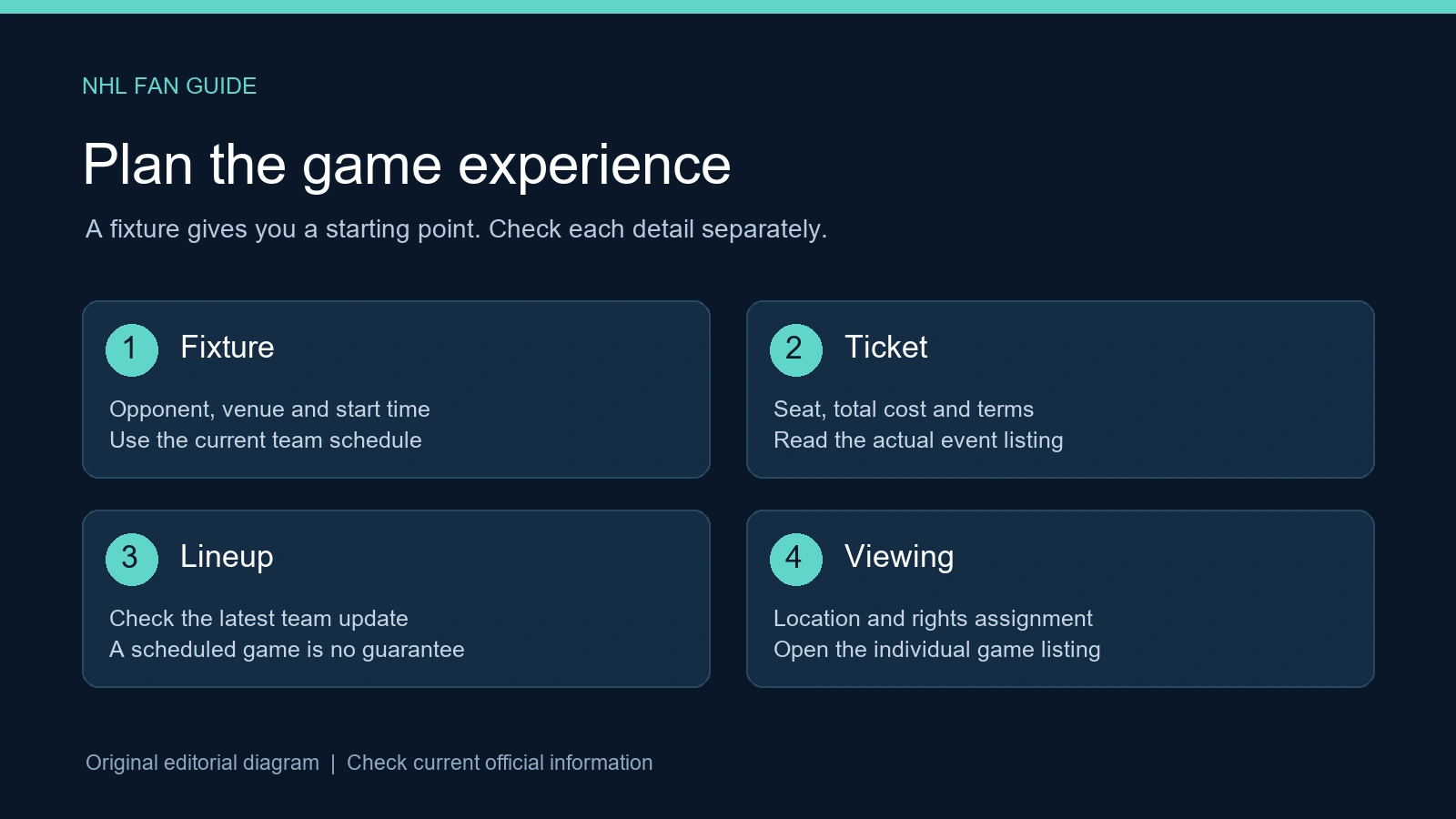
Start with the Capitals schedule and choose a short list of dates you can realistically attend. Check the opponent and arena before comparing tickets: a Washington fixture may be a home game or a visit to another city. Write down the local start time, especially if you are traveling across time zones. A screenshot taken weeks earlier is a useful reminder, but the current event listing should guide the final plan.
A scheduled visit is not a guaranteed appearance
A ticket buys admission to the event described by its terms. It does not automatically promise that a particular player will dress, play a certain number of shifts or participate in a tribute. Keep that in mind when a seller uses Ovechkin's name or calls a date his final visit. Even an accurate team schedule cannot settle player availability months in advance.
If seeing him on the ice is your main reason for going, check the team's current pregame reporting as the date approaches. Warmup observations can add information, but the confirmed lineup is more useful than a fan's expectation. When you must book early, consider whether you would still enjoy the Capitals and the opponent if your preferred player did not appear. That is a practical way to decide how much uncertainty you are willing to accept.
Compare the whole trip before buying a ticket
Use the team's official ticket gateway as your starting point. It helps you identify the intended purchasing route instead of relying on a search advertisement or an unfamiliar seller. Compare the full checkout amount, the seating section and the applicable transfer or cancellation terms. A low initial price can become less attractive once fees and travel costs enter the comparison.
For the seat itself, decide whether proximity or perspective matters more. A close seat can make warmups and individual details memorable; a higher view can make it easier to follow formations and the movement of the puck. Check whether the listing discloses an obstructed view, whether adjacent seats are actually together and whether your group needs an accessible seating arrangement. Do not assume a premium description answers those questions.
Build some room into the evening. Transit, parking, the entry queue and finding your section all take time. Check the arena's current entry instructions before packing, rather than borrowing rules from a different venue. If you are bringing someone new to hockey, explain the whistle-to-whistle pace and how to follow the benches before the game starts. That small preparation can make an ordinary scheduled night feel special without depending on a goal, a presentation or a particular result.
Finally, set a complete budget before shopping. Include transportation, a meal, accommodation if needed and the possibility that plans change. There is no single reliable “farewell tour price”: different opponents, seats, dates and sellers produce different offers. Choose the experience you can comfortably afford, and save the actual event and purchase details with your travel reservation.
How to follow the season from home
You can follow a farewell season closely without turning every night into an expensive outing. Pick a viewing routine that fits your week: full games when possible, a few chosen matchups when time is limited, and official game reports when you miss the live action. Start with today's NHL games to locate the current fixture, then open the exact game's broadcast information.
Check the listing for the individual game
The Capitals' viewing page is an official starting point. Your location and the game's rights assignment determine the next step. A regional broadcast, a national exclusive and an out-of-market stream can require different access. Knowing the team's usual broadcaster does not mean that broadcaster carries every fixture you want to watch.
Check what the event listing actually asks you to use. A television provider login, a direct streaming subscription and an app installation are different things. Installing the correct app alone does not establish an entitlement. Before buying a plan for one special night, confirm that it includes that particular game in your current location and that the device you intend to use supports playback.
The site's NHL viewing guide explains the broader categories. Keep this farewell-season plan focused on Washington, rather than assuming a single service is an all-purpose solution. If you are traveling, check the rules for where you will physically watch. A setup that works at home may present different choices in another country or territory.
Test the account and screen before puck drop. Sign in, update the app if necessary and try permitted non-live content. If several people are sharing the television, agree on the game window and the backup plan ahead of time. Technical preparation is particularly useful when you care about seeing the opening presentation: solving a password problem during the first shift can mean missing the moment you planned around.
Use the schedule calendar to remember selected dates. Check how the calendar application handles your time zone, and confirm the current listing again near the game. A reminder should prompt a fresh look at the fixture; it should not be treated as a permanent promise about time or coverage. Avoid duplicate subscriptions that create two alerts for every event.
If you will watch later, decide how much you want to avoid spoilers. Turning off score notifications, opening the authorized replay directly and postponing social media are simple choices. Highlights are useful when time is short, but they show selected moments rather than the whole game. A full replay can reveal the passing sequences, defensive adjustments and quieter shifts that make the season more interesting than a collection of scoring clips.
Milestones worth following without mixing the record books
Following Ovechkin's numbers can make individual games more memorable, but the label on a statistic matters as much as the number. A regular-season career total, a playoff career total and a combined total answer different questions. Read the category before deciding that two graphics disagree. One can be correct for regular-season goals while another is correct for a wider collection of games.
The same care applies to goals and points. Points combine goals and assists, so a player can move toward a points milestone on an evening when he does not score. If you are following a goals target, an assist is meaningful hockey but does not change that particular count. The career scoring records guide helps distinguish these categories before you compare players.
Use the official player statistics for the latest game-dependent information. A number in an announcement or a saved social graphic belongs to its publication date. It may remain a useful historical snapshot without remaining the current total. When a broadcast shows a milestone graphic, note both the competition category and the point in the game at which the count was displayed.
For Ovechkin specifically, the NHL player data checked October 11 listed 929 regular-season goals, 1,688 regular-season points and 1,577 regular-season appearances. That snapshot leaves 71 goals to 1,000, 12 points to 1,700 and 23 games to 1,600. These are useful targets to follow, not forecasts of dates when he will reach them.
The same data separated 77 playoff goals from his regular-season total. Adding the two produces 1,006 combined goals, but the regular-season column remains 929. A goal in a future playoff game would increase the combined collection and the playoff column; it would not move his regular-season count toward 1,000. Keeping those columns separate lets you follow both stories without creating an incorrect record claim.
Build a personal tracker with the category, latest checked total and date beside the official link. The October 11 snapshot's latest listed appearance was October 9; check again after later games before sharing the count. A dated entry stays useful as history even after the live total changes.
A milestone prediction deserves another layer of caution. A recent scoring pace can illustrate what might happen, but it cannot tell you the night when a goal will arrive. Ice time, game situations, opponents and availability all affect opportunities. Buying a ticket because a player is near a round number can be exciting, as long as you understand that the milestone is an additional possibility rather than something included in the purchase.
There is also more to watch than the running total. Pay attention to how a scoring chance develops: the pass into space, the positioning before the puck arrives, the pressure from defenders and the goaltender's movement. Following those details lets you enjoy shifts that never reach a highlight package. It can make the farewell season satisfying even during a stretch without a headline number.
If you keep a scrapbook or share a post after a game, use the official result and final scoring credit. Record corrections can change the details you saw live. A dated, clearly labeled entry is more useful over time than a confident claim that combines regular-season and playoff figures without explaining how it was calculated.
Farewell events, community announcements and the final-game question
The announcement also includes community initiatives. For the details as they develop, follow the Capitals' official news and community information. Treat each new announcement as its own event information, with its own date and access conditions. A farewell season can create interest in celebrations without making every rumored activity part of the team's confirmed calendar.
Keep tribute plans separate from the hockey schedule
There are several different experiences fans might describe as a farewell: an arena presentation, an opponent's recognition, a public community activity or a ceremony organized later. Do not combine those into one presumed package. If an activity matters to your trip, find the organizer's actual notice and check whether admission is included with a game ticket, requires separate registration or is restricted to invited participants.
Pay particular attention to the time and location. A presentation could occur before puck drop rather than during the game, and a community activity might be held somewhere other than the arena. Those are possibilities to check when an event is announced, not a prediction of what Washington will arrange. Confirm access before altering travel reservations or paying extra for a seller's description of a “special farewell night.”
A jersey-retirement date is a separate question, too. Do not infer one from a player's retirement announcement or from an enthusiastic fan graphic. If the team announces such a ceremony, its own release should establish the date and practical details. Until then, you can enjoy the season's hockey and follow official news without filling an unannounced calendar with assumptions.
Could his final NHL game be in the playoffs?
Yes, if Washington reaches the playoffs and Ovechkin plays there, his NHL season could continue beyond the regular-season schedule. That is a conditional possibility, not confirmation of a playoff berth or a particular series. The final appearance would then depend on Washington's postseason path and his availability. A regular-season finale is therefore a scheduling landmark rather than a guaranteed end to his NHL career.
The same logic applies to the last home game. A team can have a final home fixture on its regular-season calendar and still host more games in the playoffs. When a headline or ticket listing says “last home game,” ask whether it means the last currently scheduled regular-season home game. That careful wording protects you from treating a reasonable calendar description as a promise about the whole spring.
If you want to watch the ending as closely as possible, keep the later weeks flexible. Follow the standings and official playoff announcements as they become relevant, then decide whether additional games fit your budget and schedule. You do not need to postpone every earlier opportunity while waiting for a final date that cannot yet be settled.
The most reliable plan is to choose a game you would enjoy, check the latest details and leave room for the season to develop. A night with family, a carefully watched shift or a meaningful conversation with another fan can be worth remembering on its own. Those experiences do not depend on predicting the final goal, the last shift or the exact evening when the farewell becomes complete.
Comments
Comments are reviewed before publication. Spam, abusive content and policy-violating links are not published.
Sign in with Google to leave a comment.
Loading comments...