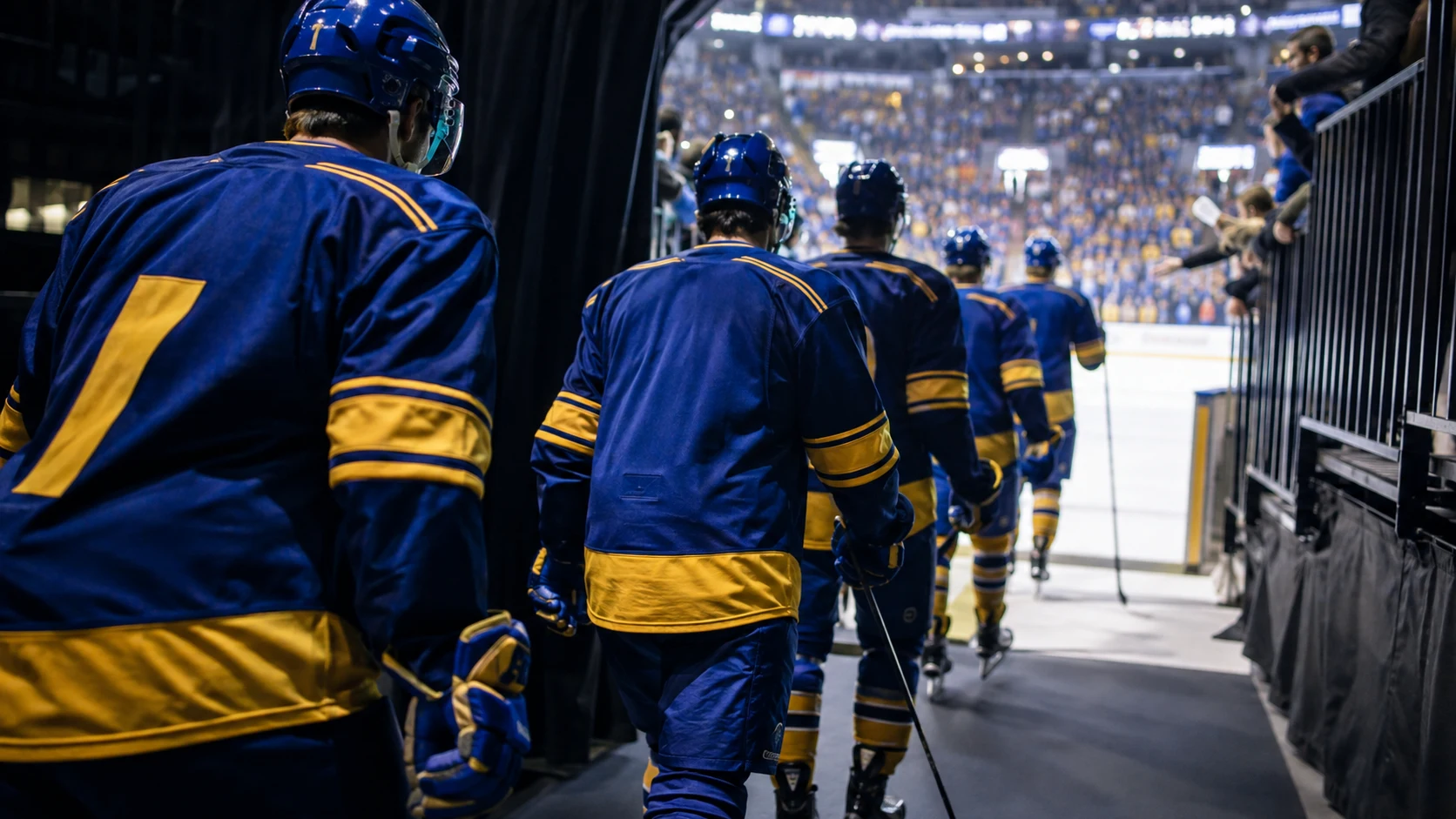
The Buffalo Sabres went 7-6 in the 2026 Stanley Cup Playoffs, defeated the Boston Bruins in six games, and then lost to the Montreal Canadiens in overtime of Game 7 in the second round. That ending hurt, but it did not erase the scale of the breakthrough. Buffalo had returned to the postseason for the first time since 2011, won a series for the first time since 2007, and came within one goal of reaching the Eastern Conference Final.
Buffalo Sabres 2026 Playoff Run at a Glance
| Regular-season finish | 50-23-9, 109 points, first in the Atlantic Division |
|---|---|
| Playoff record | 7-6 in 13 games |
| First Round | Defeated Boston Bruins, 4-2 |
| Second Round | Lost to Montreal Canadiens, 4-3 |
| Final game | Montreal 3, Buffalo 2 in overtime on May 18, 2026 |
| Historic markers | First playoff berth since 2011; first series win since 2007 |
Buffalo entered the bracket as the Atlantic Division champion after a 50-win, 109-point regular season. The Sabres then played 13 postseason games between April 19 and May 18. They won all three games at Boston in Round 1, survived elimination with an eight-goal outburst in Montreal in Round 2, and finally fell when Alex Newhook scored the overtime winner in Game 7 at KeyBank Center.
This is a finished-results archive, fact-checked September 4, 2026. It covers only Buffalo's path. Readers looking for every series and the Stanley Cup Final can use the complete 2026 NHL playoff bracket and results.
Complete Buffalo Sabres 2026 Playoff Schedule and Results
The Sabres' 2026 playoff schedule ultimately contained 13 games: six against Boston and seven against Montreal. The table uses Buffalo's perspective, so “vs.” means KeyBank Center and “at” means the opposing team's arena. Every result is final.
| Date | Round / game | Matchup | Result | Series after game |
|---|---|---|---|---|
| April 19 | Round 1, Game 1 | vs. Boston | Won 4-3 | Buffalo led 1-0 |
| April 21 | Round 1, Game 2 | vs. Boston | Lost 4-2 | Tied 1-1 |
| April 23 | Round 1, Game 3 | at Boston | Won 3-1 | Buffalo led 2-1 |
| April 26 | Round 1, Game 4 | at Boston | Won 6-1 | Buffalo led 3-1 |
| April 28 | Round 1, Game 5 | vs. Boston | Lost 2-1 (OT) | Buffalo led 3-2 |
| May 1 | Round 1, Game 6 | at Boston | Won 4-1 | Buffalo won 4-2 |
| May 6 | Round 2, Game 1 | vs. Montreal | Won 4-2 | Buffalo led 1-0 |
| May 8 | Round 2, Game 2 | vs. Montreal | Lost 5-1 | Tied 1-1 |
| May 10 | Round 2, Game 3 | at Montreal | Lost 6-2 | Montreal led 2-1 |
| May 12 | Round 2, Game 4 | at Montreal | Won 3-2 | Tied 2-2 |
| May 14 | Round 2, Game 5 | vs. Montreal | Lost 6-3 | Montreal led 3-2 |
| May 16 | Round 2, Game 6 | at Montreal | Won 8-3 | Tied 3-3 |
| May 18 | Round 2, Game 7 | vs. Montreal | Lost 3-2 (OT) | Montreal won 4-3 |
Buffalo scored 20 goals and allowed 12 against Boston, then scored 23 and allowed 27 against Montreal. Those totals illustrate how different the rounds felt. The Bruins series tilted toward Buffalo after the Sabres took both games at TD Garden in the middle of the round. The Canadiens series swung repeatedly and included three games decided by at least four goals before ending with the closest possible margin in Game 7.
“If necessary” dates disappear from a schedule once a team wins four games. Boston forced Game 6 by taking Game 5 in overtime, but Buffalo ended that series before a seventh game was needed. Against Montreal, neither club reached four wins through Game 6, so the deciding May 18 date became official and completed Buffalo's postseason.
First Round: Buffalo Beat Boston in Six Games
Buffalo's first playoff series in 15 years began with 52 quiet minutes and then turned into a statement. The Sabres trailed Boston 2-0 late in Game 1 even though they had generated most of the pressure. Tage Thompson finally broke through with 7:59 remaining, scored again to tie the game, and watched Mattias Samuelsson put Buffalo ahead only 52 seconds later. Alex Tuch's empty-net goal became the winner after David Pastrnak answered in the final seconds.
The Game 1 comeback established Buffalo's identity
The 4-3 opener did more than give Buffalo a series lead. It showed that a roster with limited postseason experience could stay composed when a long-awaited home playoff night appeared to be slipping away. Thompson scored his first two career playoff goals, Ukko-Pekka Luukkonen made two breakaway saves against Pastrnak, and Buffalo delivered a season-high 52 hits. Instead of allowing the weight of the drought to define the night, the Sabres converted it into late-game urgency.
Boston responded 4-2 in Game 2, but that loss changed Buffalo's goaltending story. Alex Lyon entered in relief during the third period and started the next four games. The Sabres then won Games 3 and 4 at TD Garden by a combined 9-2. Their 6-1 Game 4 victory was especially decisive: Buffalo scored four times in the first period after failing to score a first-period goal in the first three games.
Road wins carried the Sabres through the clincher
The Bruins prevented a home celebration when Pastrnak won Game 5 in overtime, cutting Buffalo's series lead to 3-2. The Sabres did not allow that missed opportunity to become a collapse. In Game 6, Tuch and Samuelsson scored in the first period, Zach Benson added separation in the third, and Josh Norris finished the 4-1 win with an empty-net goal.
Lyon made 25 saves in the clincher and had stopped 106 of 111 shots after first entering the series. Thompson assisted on both first-period goals and finished tied with Tuch for the team lead at seven points in the round. Most strikingly, Buffalo went 3-0 at TD Garden against a Boston team that had owned the NHL's second-best regular-season home record. The May 1 victory gave the Sabres their first series win since they eliminated the New York Rangers in 2007.
Second Round: Montreal Won a Seven-Game Swing Series
The second round rarely settled into a rhythm. Buffalo opened with a 4-2 win at home, then Montreal answered with 5-1 and 6-2 victories. The Sabres restored their defensive shape in Game 4 and won 3-2 at Bell Centre, only for the Canadiens to score six again in Game 5. Five games into the series, Buffalo was behind 3-2 and had been outscored 21-13 overall.
That volatility made the response in Montreal even more striking. Facing elimination in Game 6, Buffalo conceded three of the first four goals and changed goaltenders after only 10 minutes. The Sabres then scored seven unanswered. Their power play, which had needed a breakthrough, went 4-for-6. Jack Quinn scored twice, Tage Thompson collected four points, and Rasmus Dahlin produced one goal and four assists. According to the Sabres, it was only the 10th five-point playoff game by a defenseman in NHL history.
Buffalo's eight-goal Game 6 forced one more night
Ukko-Pekka Luukkonen stopped all 18 shots he faced after replacing Alex Lyon, while Buffalo kept attacking instead of protecting a narrow lead. The 8-3 final was the Sabres' highest-scoring game of the postseason and turned a potential elimination night into a winner-take-all return to KeyBank Center.

Game 7 went from a comeback to one decisive shot
Montreal scored twice in the first period of Game 7, including a power-play goal by Zachary Bolduc. Buffalo answered in stages. Jordan Greenway redirected a Mattias Samuelsson shot in the second period, and Dahlin tied the game with 13:33 left in regulation. A later Buffalo push appeared to force the puck across the goal line, but play had already been whistled dead, so the score remained 2-2.
The Sabres entered overtime having recovered from another two-goal deficit. They generated chances, but Alex Newhook ended the series 11:22 into the extra period with a wrist shot from the left circle. Montreal won 3-2 and advanced to face Carolina. Buffalo's season ended at home even though two of its strongest second-round answers—Game 4 and the extraordinary Game 6—had come on the road.
The ending explains why the run can be remembered as both progress and a missed opportunity. Buffalo had home-ice advantage as the higher Atlantic seed, yet it lost three of four games at KeyBank Center in the series. It also proved it could recover from ugly defeats and an elimination-game deficit. Both truths belong in an honest recap.
The Players and Performances That Defined the Run
Buffalo's postseason was not carried by one line or one goaltender from start to finish. Its shape changed as the rounds unfolded, which was part of what made a largely playoff-new roster competitive for 13 games.
- Rasmus Dahlin drove the second-round response. The captain finished his first NHL postseason with four goals and 10 assists in 13 games. His 14 points tied the Sabres' single-postseason record for a defenseman, while his four goals also matched the club record for a defenseman in one playoff year. The five-point performance in Game 6 at Montreal was the peak, but his tying goal in Game 7 was just as important to the immediate stakes.
- Tage Thompson delivered at both ends of the run. His two late goals changed Game 1 against Boston, and his four-point night helped save Buffalo's season in Montreal. He finished with 15 points after entering the playoffs without an NHL postseason game on his record.
- Alex Tuch supplied experience and first-round production. Tuch and Thompson each had seven points against Boston. Tuch scored the eventual winner in the Game 1 comeback and opened the scoring in the Game 6 clincher.
- Alex Lyon changed the Boston series in relief. After entering Game 2, he started the final four games of the round and posted a 1.14 goals-against average with a .955 save percentage. The switch gave Buffalo stability just as the series moved to Boston.
- Ukko-Pekka Luukkonen answered when the second round demanded it. He won Game 4, stopped all 18 shots after entering Game 6, and made key breakaway saves in Game 7 while Buffalo tried to erase its early deficit.
- The younger group produced under pressure. Zach Benson scored in both rounds, Josh Doan created the play that gave Buffalo breathing room in the Boston clincher, and Jack Quinn scored his first two career playoff goals in the must-win Game 6 at Montreal.
The useful lesson is not that every performance was consistent. It is that Buffalo found different answers: elite forwards late in Game 1, a relief goaltender for most of Round 1, defense-generated offense, and young players contributing in elimination conditions. That range helped the Sabres survive the ordinary turbulence of a long series even when it was not enough to carry them through Game 7.
Why the 2026 Run Changed the Sabres' Story
For Buffalo, simply appearing in the postseason carried unusual weight. The franchise had missed 14 consecutive seasons, an NHL-record drought, and many core players had never experienced an NHL playoff series. The 2025-26 team did not merely scrape into the field. It recovered from last place in the Eastern Conference in December, reached 50 wins for only the third time in franchise history, and secured its first division title since 2010.
The win over Boston moved the achievement from participation to proof. Buffalo handled a physical opponent, adjusted in goal, won three times in a difficult road building, and closed a series after failing on its first opportunity. That first series victory since 2007 gave players and supporters something more durable than a drought-ending date on the calendar.
Montreal supplied a different lesson. The Sabres experienced lopsided losses, a seven-goal comeback run in an elimination game, and the pressure of overtime in Game 7. Those games did not guarantee future success, and a second-round exit should not be rewritten as a championship. They did, however, expose a young core to the tactical and emotional changes that arrive inside a best-of-seven series.
The fairest way to measure the legacy is through the team's new baseline. Before 2026, the recurring question was whether Buffalo could return at all. After an Atlantic title and a series win, the next standard became whether the Sabres could repeat that level and advance further. That shift is meaningful precisely because it was earned through results, not an offseason projection.
It also explains why the Game 7 loss remained painful. Buffalo did not spend the spring celebrating a symbolic appearance; it reached a position where one overtime goal separated the team from the Eastern Conference Final. The run changed the story, but it left the final chapter open.
Where to Find the Current Sabres Schedule
The dates above belong to the completed 2026 postseason. They are useful for revisiting the run, but they should not be used to answer when Buffalo plays next. Start times, opponents, and television assignments for a new season belong on pages built to update with the schedule.
Use the current Buffalo Sabres schedule for the full team slate. It can be filtered by opponent, home or away, and month, and it keeps game time and available TV information beside each matchup. That is the best starting point for “When do the Sabres play again?” or for planning several weeks ahead.
For a single date, check today's NHL games. The page shows whether the league plays that day and can point to the next available slate when the schedule is dark. For a wider planning window, the NHL games this week view keeps multiple days together.
Fans who prefer reminders instead of repeated schedule checks can use the NHL calendar tools. A subscribed calendar is the better fit for dates that may later receive time or broadcast updates. Keep this recap bookmarked for history; use those dynamic pages for the next puck drop.
Buffalo Sabres 2026 Playoffs FAQ
How far did the Buffalo Sabres go in the 2026 playoffs?
Buffalo reached the Eastern Conference Second Round. The Sabres defeated Boston 4-2 in the First Round, then lost 4-3 to Montreal. They were one win away from an Eastern Conference Final matchup with Carolina.
Who eliminated the Sabres in 2026?
The Montreal Canadiens eliminated Buffalo. Montreal won Game 7 at KeyBank Center 3-2 when Alex Newhook scored 11:22 into overtime. It was Buffalo's first and only Game 7 of the postseason.
When had Buffalo last won a playoff series?
Before 2026, the Sabres had not won a playoff series since 2007, when they eliminated the New York Rangers in the Eastern Conference Semifinals. The May 1, 2026 win at Boston ended that 19-year wait between series victories.
How many playoff games did the Sabres play in 2026?
The Sabres played 13 games: six against Boston and seven against Montreal. They won seven and lost six. Two games went to overtime—Game 5 against Boston and Game 7 against Montreal—and Buffalo lost both.
Did Buffalo have home-ice advantage?
Yes. Buffalo was the Atlantic Division's No. 1 seed, so it hosted Games 1 and 2 and the if-necessary Games 5 and 7 in both series. The Sabres advanced despite winning only one of three home games against Boston, then lost three of four at home against Montreal.
Was 2026 Buffalo's first playoff appearance since 2011?
Yes. Buffalo's previous postseason ended in April 2011. Returning in 2026 closed a 14-season absence, and winning the Boston series ensured that the comeback amounted to more than a single-round appearance.
The 2026 run is now historical. The schedule table and recap should remain fixed, while current opponents, start times, and TV details should be checked on the live team and league schedule pages linked above.
Comments
Comments are reviewed before publication. Spam, abusive content and policy-violating links are not published.
Sign in with Google to leave a comment.
Loading comments...