Who leads the early 2026-27 Calder conversation?
Porter Martone led NHL.com's first early-season Calder Trophy panel for 2026-27, followed by Gavin McKenna, with Ivar Stenberg and Cole Hutson tied behind them. That is a useful starting watchlist for the NHL rookie-of-the-year race. It is not an official list of finalists or the result of the award vote. This guide was checked on October 11 and uses the panel published on October 5 as a clearly dated snapshot.
In the NHL.com Trophy Tracker, the 16-person panel gave Philadelphia's Martone 70 points and nine first-place selections. Toronto's McKenna received 59 points and five first-place selections. San Jose's Stenberg and Washington's Hutson each had 34 points and one first-place selection. Those are panel voting points, not goals and assists from games.
The distinction becomes important when a headline says a rookie leads the race. It may mean the writer's assessment, a predictive panel, a statistical category or a betting market. Each measures a different thing. A player leading a prediction panel has not won a portion of the actual award, and another rookie can enter the conversation as his role and performance develop.
The real Calder Memorial Trophy is selected by the Professional Hockey Writers Association at the end of the regular season. Voters rank five candidates on a 10-7-5-3-1 points system, and the top three vote-getters become finalists. The Trophy Tracker panel used its own 5-4-3-2-1 scale. The numbers from that October panel therefore cannot be carried over into the award's final voting totals.
Matthew Schaefer won the previous season's Calder in 2026. For the 2027 award, the relevant competition is the current 2026-27 rookie season, which is still unfolding. No winner or final finalist list is established by this early-season article. The useful task now is to identify eligible players, understand their opportunities and watch how they perform over meaningful stretches.
This year's leading discussion covers different development paths. Martone had a short Philadelphia introduction last season; McKenna and Stenberg arrived as high 2026 draft picks; Hutson had already played a limited NHL stretch after college. They are not all beginning from the same experience base, and the best way to compare them is not simply to sort their draft positions. Eligibility comes first, then the actual NHL responsibilities that let each player build a rookie-season case.
Calder eligibility is about age and prior NHL games
An NHL rookie can have played in the league before. Rookie qualification is not simply a test of whether a player has ever worn an NHL jersey. The NHL's Hockey Operations Guidelines set an age cutoff and two separate prior-game thresholds. A brief introduction in an earlier season can leave a player eligible for a later rookie campaign.
The September 15 age cutoff
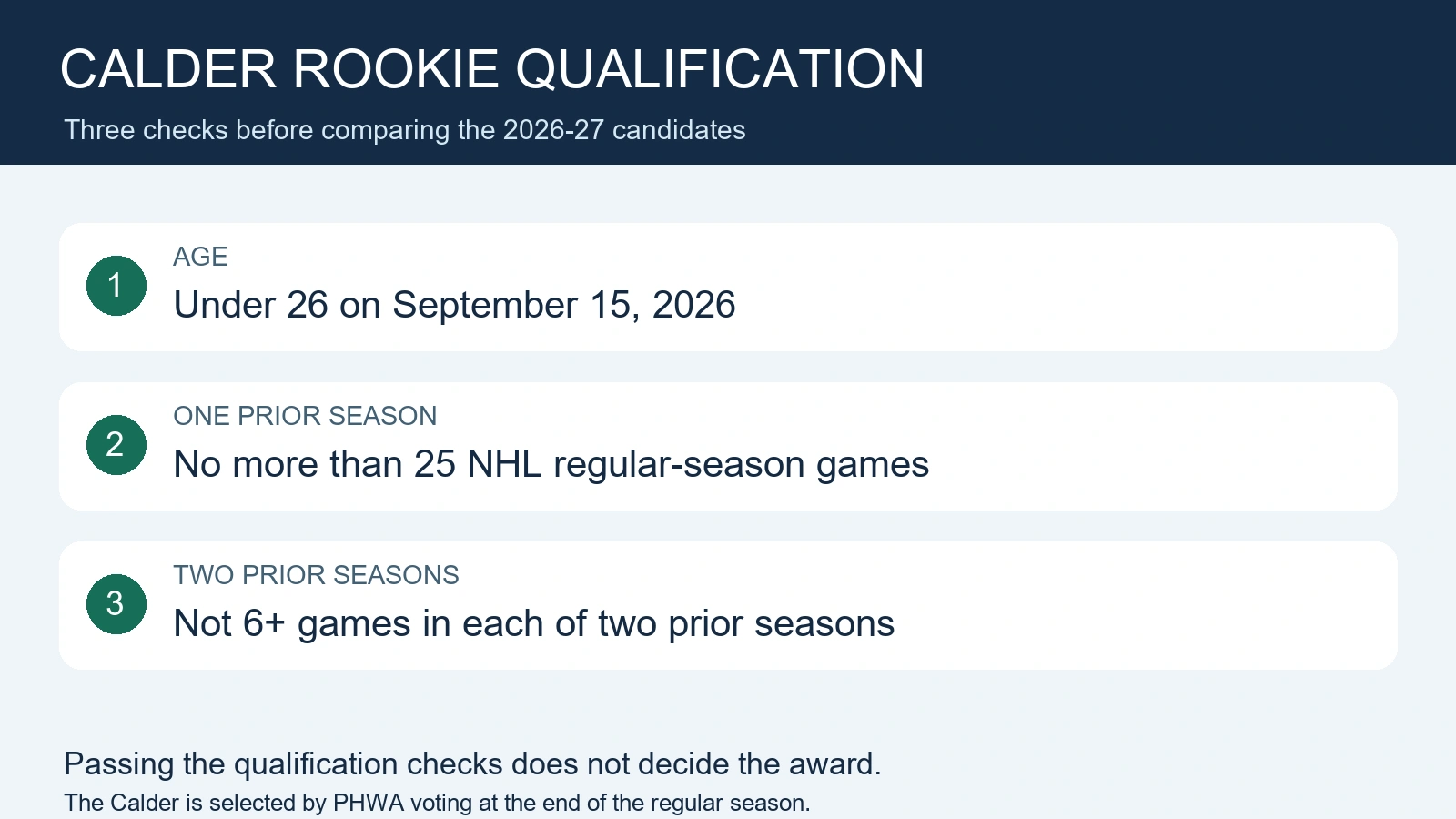
Under the operations guidelines, a player who is at least 26 years old by September 15 of that season is not considered a rookie. For 2026-27, the checkpoint is September 15, 2026. The relevant question is the player's age on that date, rather than his age at the awards ceremony or the end of the schedule.
A birthday later in the season does not move that checkpoint. Stenberg, for example, turned 19 on September 30, according to the October 5 Trophy Tracker. The date matters for describing him accurately now, but it does not present a problem at the upper-age qualification boundary. An eligible older newcomer can also compete with an 18-year-old; the award is not restricted to the youngest draft class.
Why a previous NHL cameo may preserve rookie status
The first games test excludes a player who played more than 25 NHL games in any previous season. The second excludes a player who played six or more NHL games in each of any two previous seasons. Those are separate conditions. Checking only whether someone has ever reached 26 games in one season can miss the two-season rule.
As a hypothetical example, 25 games in one earlier season would not exceed the first threshold, while 26 would. Six games in each of two earlier seasons would trigger the second threshold even though neither season approached 25. Six in one and five in another would not trigger that particular two-season condition, assuming the player's other qualification requirements were satisfied. These examples explain the boundaries rather than certify an individual player's status.
Martone illustrates why earlier experience and rookie status can coexist. The NHL's October tracker treats him as a candidate after nine regular-season games and 10 playoff appearances in 2025-26. Hutson remains in the conversation after 14 regular-season games with Washington last season. Logan Stankoven provides a stronger test of which appearances count. The NHL's May 2025 report on his rookie season explained that he remained eligible after playing 24 regular-season games and 19 playoff games the year before. Those 43 combined appearances did not remove his rookie status. The report specifically said two additional regular-season games would have ended his eligibility. That example establishes why playoff appearances are excluded from the prior regular-season game threshold, rather than assuming every NHL appearance counts.
Contract status is another separate question. An entry-level contract, a brief trial and rookie award qualification are not interchangeable labels, and a player's draft year does not establish eligibility on its own. Begin with the league's age and prior-appearance conditions, then verify the player in current NHL rookie coverage and statistics. That keeps the watchlist focused on players who can actually compete for the Calder, including those whose first short NHL visit occurred before this season.
Three forwards offer different paths into the race
Martone, McKenna and Stenberg bring different experience into 2026-27. One already had an NHL and playoff introduction, one came through an NCAA season before being selected first overall, and one played against adults in Sweden's top league. Their backgrounds help explain the early interest, while their actual NHL usage will determine how much opportunity they have to produce.
Porter Martone: build on a short Philadelphia introduction
Martone, the sixth pick in the 2025 draft, produced 10 points in nine regular-season games for Philadelphia last season, with four goals and six assists. He added five points in 10 playoff games. Before that arrival, he led Michigan State with 50 points, including 25 goals, in 35 games. That gives his early Calder case a concrete NHL foundation rather than relying entirely on junior or college projections.
The October 5 tracker described the 19-year-old on the right wing alongside center Trevor Zegras in Philadelphia's top six. At that snapshot, he had no points through three games and averaged 12:31 of ice time, including 1:46 on the power play. Those details show the difference between a favorable preseason reputation and the opportunities delivered in the first games. The early panel still favored him, but the scoring case needed to be built across the season.
Follow the Flyers schedule and watch whether Martone maintains useful offensive minutes, gets to finishing areas and contributes when the initial scoring burst is absent. His earlier nine-game production demonstrates what he has already done; it does not guarantee the same pace over a much longer season.
Gavin McKenna: turn playmaking into sustained NHL production
McKenna was selected first overall by Toronto in the 2026 draft. The 18-year-old had 51 points in 35 NCAA games at Penn State, with 15 goals and 36 assists, and 14 points in seven games for Canada at the 2026 World Juniors. The balance of goals and assists in those records helps explain why playmaking is central to his profile.
The October 5 NHL report placed him at left wing alongside John Tavares and recorded an average of 14:32 of ice time over three games, with three shots on goal. Those are dated observations, rather than a promise that the same line will remain together. The important continuing question is how effectively he creates and finishes NHL chances while earning the minutes to use his offensive strengths.
The Maple Leafs schedule gives fans a way to follow that development across opponents. Draft position creates attention, but it does not add votes to a Calder ballot. A useful assessment separates McKenna's underlying offensive promise from what he actually contributes in the NHL games being judged.
Ivar Stenberg: translate experience against adults
Stenberg, San Jose's second-overall selection in 2026, turned 19 on September 30. He had 33 points in 43 games for Frolunda in the Swedish Hockey League last season, with 11 goals and 22 assists. He also recorded 10 points in seven games during Sweden's gold-medal run at the 2026 World Juniors. His SHL experience means he has already dealt with a professional adult competition, even though NHL pace and roles remain a new test.
The NHL's early assessment highlighted the potential to play with San Jose's young core, including Macklin Celebrini, Will Smith and Michael Misa. That is an opportunity to monitor, not a guaranteed permanent line combination. His route into the race depends on translating his playmaking and positioning into NHL contributions while keeping a meaningful role.
Use the Sharks schedule to compare his performances over a stretch. Preseason goals and previous SHL production explain the excitement, but they are not Calder-season scoring points. The award case has to be made in the current NHL regular season, with the responsibilities and opponents he actually encounters.
Defensemen and goalies need a different comparison
A forward's scoring total cannot do every job in a Calder comparison. Defensemen handle a different set of responsibilities, and goalies have no equivalent of a normal goals-and-assists scoring race. To compare those players fairly, begin with what their teams ask them to do and how much opportunity they receive.
Cole Hutson's minutes matter alongside his points
Hutson received the same 34 points as Stenberg in the October 5 panel. The 20-year-old Washington defenseman had recorded 10 points in 14 NHL games last season, with three goals and seven assists. The early-season tracker reported that he scored in Washington's opener and averaged 19:06 of ice time through two games. Each figure describes the snapshot in that report rather than a live total.
For Hutson, minutes help reveal responsibilities that a points column can hide. Watch his ability to move the puck out of the defensive zone, keep possessions alive and manage the situations in which the coach uses him. Power-play opportunity can help a defenseman produce offense, but it should be considered alongside his work when the team does not have the puck. Those are viewing priorities, rather than a claim that the award uses a published mathematical formula.
His brother Lane won the Calder in 2025, and Schaefer won in 2026. That recent history demonstrates that a defenseman can win; it does not establish that the next trophy must go to another defenseman or that Cole inherits a case from his brother. His own current-season performance and role are the relevant evidence.
A goalie needs starts as well as strong save numbers
Dylan Garand illustrates how an opportunity can change quickly for a young goalie. The NHL's October 10 Rangers update lists him at age 24 with five career NHL appearances, including four starts, and a .954 save percentage. With Igor Shesterkin out for the remainder of the season and Joonas Korpisalo also injured, Garand was identified for the next starting opportunity.
That makes him an example to monitor in our own opportunity-based watchlist, not a claim that he joined the leaders in NHL.com's October panel. His limited career appearances and age fit the qualification boundaries discussed above. What remains to be established is the sustained current-season performance: how many starts he receives, how well he plays and whether he keeps earning the role as the roster changes.
A strong save percentage over a few appearances can be encouraging without settling the award race. Goals-against average also reflects playing time and the rate of chances the team allows. A larger workload brings different demands and provides more evidence. For a goalie, the combination of availability, starts and repeated performance is more informative than selecting one impressive percentage and treating it as directly comparable to a forward's point total.
Follow opportunity, performance and availability together
A useful Calder assessment brings three things together: the opportunity a rookie receives, the performance within that opportunity and the availability to sustain it. Points remain important for skaters, but the surrounding game count and role tell you what those points mean. For goalies, starts and minutes provide the setting for saves and goals allowed.
The NHL's 2025-26 finalist announcement illustrates the range of information that can describe a rookie season. Ivan Demidov finished with 62 points in 82 games, while Beckett Sennecke had 60 in 82. The league's descriptions also discussed even-strength production, power-play production and ice time. A points total was central context, but it was not the only detail used to explain their seasons.
For the current forwards, look at whether offensive opportunities persist. Is a player still receiving power-play minutes after a scoreless stretch? Is he being used in the same kind of role against different opponents? For a defenseman, consider whether the coach trusts him to move the puck and defend as well as support offense. The October 5 minutes for Martone, McKenna and Hutson show different workloads; comparing only their points would erase that distinction.
Games played also prevent misleading comparisons. A larger total across more games and a faster scoring rate across fewer games answer different questions. Neither automatically decides the award. Availability can influence the amount of evidence a player supplies, while changing lines or special-teams assignments can alter the chance to accumulate that evidence. Keep those changes alongside the scoring record rather than using an early-season pace as a guaranteed final number.
Our this week's NHL games page can help you select a few matchups involving these rookies. Watching repeated games is especially helpful when assessing work away from the puck that a highlight reel may leave out. A successful exit, a recovered possession or a difficult save may explain why a rookie keeps receiving opportunities even before a scoring total becomes eye-catching.
As the season continues, the watchlist should change with confirmed roles and actual results. The October panel remains an early reference point, while later performances supply new information. Check eligibility before adding a new name, keep game statistics separate from prediction votes, and assess each position on its own responsibilities. That approach makes the 2026-27 race worth following throughout the season without pretending the 2027 Calder has already been decided.
Comments
Comments are reviewed before publication. Spam, abusive content and policy-violating links are not published.
Sign in with Google to leave a comment.
Loading comments...