
Connor Hellebuyck is a New Jersey Devil. The October 23, 2026 trade sent Dawson Mercer, Nico Daws, Nick Bjugstad, Alexander Command’s rights and two draft selections to Winnipeg. For New Jersey, the deal concentrates resources in an established starting goaltender. For Winnipeg, it ends an extended standoff and exchanges a franchise player for a mixture of current NHL help and future possibilities.
The headline answers where Hellebuyck is going. The harder questions concern what each team can reasonably expect next. Mercer’s role, Daws’ opportunity, the value of an unsigned prospect and the timing of Hellebuyck’s first start all operate on different clocks. This analysis was updated October 27, following his first full Devils practice, and separates the completed transaction from judgments that will take longer to settle.
Cover: Hellebuyck with Winnipeg on October 24, 2024, before the Devils trade. Jenn G, CC BY-SA 2.0; resized and converted to WebP under the same license.
What exactly was in the Hellebuyck trade?
The Devils’ official announcement confirmed the acquisition on October 23. The package is more useful to assess when its components are listed accurately, rather than combined with names mentioned during earlier speculation.
| New Jersey received | Winnipeg received |
|---|---|
| Connor Hellebuyck | Dawson Mercer; Nico Daws; Nick Bjugstad; Alexander Command’s rights; a 2029 second-round pick; a 2027 seventh-round pick |
There is no newly transferred first-round selection in that list. A prospect who was previously chosen in the first round is a different type of asset. Likewise, an early report about possible participants is not a second version of the completed deal. Start with the final package before attaching a grade to the return.
Command’s rights and the two draft selections are different assets
The NHL’s transaction account identifies Command as an unsigned draft choice whose rights changed hands. Winnipeg acquired an interest in a player already selected and scouted; the two picks are opportunities to select players in future drafts. Neither category guarantees an NHL regular, but they present different development and decision questions.
A pick’s round and year also matter. A second-round choice in 2029 cannot help the Jets’ next line combination, while a seventh-round choice in 2027 does not carry the same expected value as an early selection. Combining both under the phrase draft capital conceals those differences. The practical return includes players available to evaluate now and assets whose value will emerge later.
The deal followed Hellebuyck’s trade request and absence from Winnipeg’s camp. That history explains the urgency around a resolution, but this article focuses on the hockey exchange. Contract discipline and the rules governing a holdout are separate questions from whether the six components represent a good return.
What problem is New Jersey trying to solve?
At the trade, the Devils were 6–4–0 with a .876 team save percentage, tied for 23rd, according to the NHL’s October 24 analysis. That dated snapshot explains the immediate need; it is not a live October 27 ranking. New Jersey chose an established starting-goalie résumé to address that weakness, while giving up a larger collection of assets.
An established starter changes the goaltending plan
The strongest hockey argument is about responsibility. New Jersey can build a plan around a player with extensive experience carrying a starting workload, rather than ask a less-established option to prove that capacity at the same time the club pursues wins. Jake Allen remains part of that plan; acquiring a starter does not remove the need for another goalie who can play meaningful games.
Hellebuyck’s own recent seasons show the range of the bet. His .925 save percentage in the award-winning 2024–25 season fell to .895 in 2025–26. The NHL’s analysis of the acquisition put that weaker season alongside his wider record. New Jersey is betting on the established goalie, not acquiring a guarantee that his best season will repeat. Comparing his individual percentages with a team figure also requires care: different defensive environments affect the chances goalies face.
That matters when assessing the first few appearances. Better goaltending can rescue a difficult shift, but it cannot prevent every lost assignment or make every dangerous rebound harmless. Watch whether New Jersey reduces repeat chances and gives its goalies a clear view. A big save can preserve a result without proving the defensive process has improved.
The remaining contract makes this a long-term choice
Hellebuyck is 33 and signed through 2030–31 at an $8.5 million average annual value. This is therefore more than a short experiment with a veteran. New Jersey has committed to multiple seasons of the same goaltending decision, including years beyond the immediate excitement of the trade.
The upside is continuity if the fit works. The risk is that age, health and performance can change while the obligation remains. Neither side of that assessment requires inventing a precise decline date. It simply means the price must be judged across the remaining contract, not only by what Hellebuyck does in his first week.
The Devils’ upcoming opponents provide the practical testing ground. Different workloads and styles will reveal more than a single debut can about the partnership between Hellebuyck, Allen and the skaters in front of them.
What did Winnipeg get for its franchise goalie?
Winnipeg’s return combines different kinds of value. The Jets’ announcement identifies the acquired players and selections. The hockey evaluation starts with when each can contribute, how much uncertainty surrounds that contribution and what the club must do to develop the assets.
Mercer offers an immediate NHL role
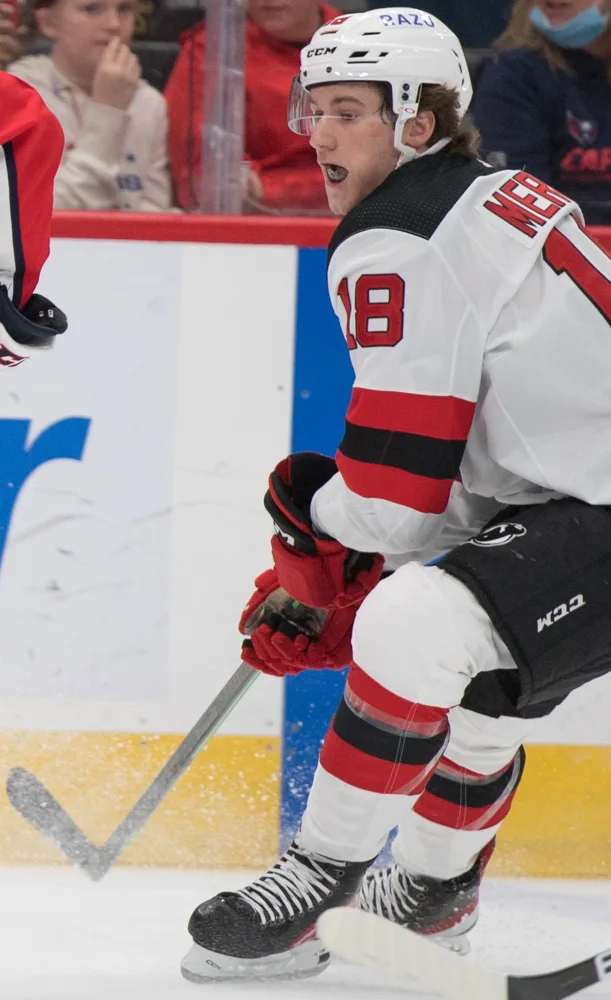
Mercer is 24 and already an established NHL forward. That distinguishes him from a prospect whose ability to handle NHL minutes remains entirely untested. In the post-trade reporting, Kevin Cheveldayoff emphasized Mercer’s versatility and the opportunity for a different role.
A change of role is worth watching rather than assuming. More responsibility can mean different linemates, more offensive opportunities or a position adjustment; it does not guarantee more production. The useful test is whether Mercer’s usage gives Winnipeg something it lacked and whether he converts that opportunity into repeatable play. An early goal would be encouraging, but it would not settle that question.
Daws adds an option, not a guaranteed replacement
Daws joined a department that already included Stuart Skinner and Clay Stevenson. The NHL’s Heritage Classic preview even identified Daws as a likely scratch behind those two goalies. That was a dated lineup expectation, but it makes the central point clear: he did not inherit an empty starting job.
The new question is how Winnipeg distributes opportunities among its available options. Experience acquired in a trade can deepen a group without immediately changing its hierarchy. A start for Daws would provide evidence about his fit, rather than certify him as Hellebuyck’s long-term successor. Judge the actual assignments and performance before treating any three-goalie arrangement as permanent.
Command and the picks extend the evaluation window
Command was selected 12th overall in the 2026 draft. His rights give Winnipeg a specific development project, while the 2027 and 2029 picks add later choices. The attractive possibility is that the club eventually receives several useful contributors. The uncertainty is that development, signing and selection all remain necessary steps.
Bjugstad belongs in a separate availability category. Sportsnet reported that he was recovering from pectoral surgery when the deal occurred. Listing him as an acquired veteran should not imply that he immediately fills a healthy lineup spot. The Winnipeg schedule will show the competitive tests ahead, but the return will enter those tests on different timelines. That is why a single-night comparison of Hellebuyck against the entire package is incomplete.
What does losing the outgoing players cost the Devils?
New Jersey did not obtain an elite goalie without giving something up. Mercer leaves an NHL role to replace, Daws leaves the organization’s goaltending options, and Command and the selections leave its future asset pool. Those costs are real even if the new starter makes the team better overall.
At the same time, six assets do not mean six healthy NHL regulars removed from the next lineup. Command is an unsigned prospect, the picks are future choices and Bjugstad was injured. Counting the pieces without describing them can make the price appear either larger or smaller than the actual hockey consequences. The useful comparison is their likely contribution and flexibility against the value New Jersey expects from Hellebuyck.
Mercer creates the most immediate skater question. Someone must absorb the work he was doing, and any adjustment can affect more than one line. If that replacement produces less offense or leaves a different defensive burden, the team has to include it when assessing the benefit in net. Evaluating the trade through goals prevented alone would miss that side of the exchange.
The future cost is harder to see on television. A retained prospect or pick could have developed into a player, supported another transaction or given management a different option later. Trading those assets is a choice to use that flexibility now. It can be reasonable for a team that believes its current core is ready, while still carrying a cost if another need emerges.
There is a human transition as well. Nico Hischier’s comments in the NHL’s player-reaction coverage acknowledged that welcoming Hellebuyck also meant losing teammates. That is normal context for a major trade, not evidence of a divided dressing room. Excitement about the arrival and disappointment about departures can coexist.
The defensible argument for New Jersey is therefore a comparative one: the organization believes Hellebuyck’s contribution over the remaining term is worth the outgoing players, development chances and flexibility. Describing him as the missing piece is a statement of expectation. The actual test includes whether the rest of the roster can carry the work left behind.
When can Hellebuyck make his New Jersey debut?
The latest concrete step was his first full Devils practice on October 26. The NHL’s update that day reported his confidence that he was ready, while Sheldon Keefe left the actual start decision subject to further assessment. Those are compatible positions: a player can feel ready while the club still has decisions to make.
Full practice is a step toward a start, not the announcement
The road trip through Dallas, Colorado and Vegas presents possible opportunities, but the October 26 update did not name a confirmed debut opponent. Keefe described the intention to involve Hellebuyck during the trip while taking the process a day at a time. A fan booking a night specifically to see him should therefore seek the actual starter announcement rather than rely on the trip’s first date.
Readiness also has different components. Conditioning is one. Tracking shots through an NHL practice, communicating with new defensemen and managing live-game sequences are others. A goalie can maintain a demanding individual routine without reproducing every situation he will encounter behind a new team. That is why returning to a full practice environment is meaningful even for someone with Hellebuyck’s experience.
Puck handling is a particularly useful detail to watch. When a goalie holds the puck behind the net, defensemen need to know whether to present an outlet, move away from pressure or prepare for a different pass. The goal is shared timing. A turnover in that setting can reflect a relationship still developing, rather than a sudden change in the goalie’s underlying ability.
The team’s practice notebook also cautioned that listing order did not establish starter and backup assignments. That small warning captures the broader point: use a report for what it confirms. Practice participation confirms participation; a coach naming a starter confirms a start.
Check the weekly NHL game listings for the trip’s schedule, then pair that information with the club’s latest goalie update. The schedule tells you when New Jersey plays. It cannot alone tell you who will be in its crease.
How should fans judge the trade over the next few weeks?
Start with the problems each club is trying to solve. New Jersey wants a reliable foundation in net without losing too much elsewhere. Winnipeg wants useful value from a difficult situation while continuing to develop the next version of its roster. Those objectives can be evaluated separately before anyone declares one side the winner.
For the Devils, watch three connected areas: Hellebuyck’s integration, Allen’s workload and the work left by Mercer’s departure. A stronger goalie performance paired with weaker skater depth would produce a different overall result from an improvement across the lineup. The team must also manage rest across closely spaced games. The presence of a famous starter does not eliminate the value of a credible second option.
For the Jets, Mercer’s actual responsibilities and Daws’ opportunities provide immediate evidence. Command’s development and the eventual draft choices require patience. A trade can be questioned now on its logic while remaining impossible to grade conclusively on all its outcomes. That distinction is especially relevant when a large portion of the return cannot yet contribute to a nightly NHL result.
The Winnipeg fan discussion contains both relief about a resolution and disagreement over the package. It illustrates why a simple verdict travels quickly: people are evaluating the player, the standoff, the return and their own expectations at once. It is a discussion sample, not proof of a single fan consensus.
The first New Jersey start will be an important new chapter, but it will not settle the entire exchange. A shutout would not guarantee a championship, and a difficult debut would not erase years of goaltending evidence. The same restraint belongs on Winnipeg’s side if Mercer has an immediate breakout or Daws has an uneven night.
The completed facts are clear: an established goalie moved east, and Winnipeg received a package spread across the present and future. The next useful judgment comes from how the two teams use what they acquired, rather than how dramatic the announcement felt.
Comments
Comments are reviewed before publication. Spam, abusive content and policy-violating links are not published.
Sign in with Google to leave a comment.
Loading comments...