
Fantasy hockey streaming means adding a player for a short period to capture extra usable games. It does not mean watching an NHL video stream. The schedule creates the opportunity; the player's current role, your scoring settings and your open lineup slots decide whether the move is worthwhile.
What “Streaming” Means in Fantasy Hockey
A simple example shows the edge. Suppose your regular starters already fill every active wing slot on a busy Saturday. A waiver player with four games that week may offer only three actual starts if the Saturday game stays on your bench. Another player with three games on lighter Monday, Wednesday and Friday slates could enter your lineup three times. The four-game player has more scheduled games, but the three-game player may have equal or greater usable value.
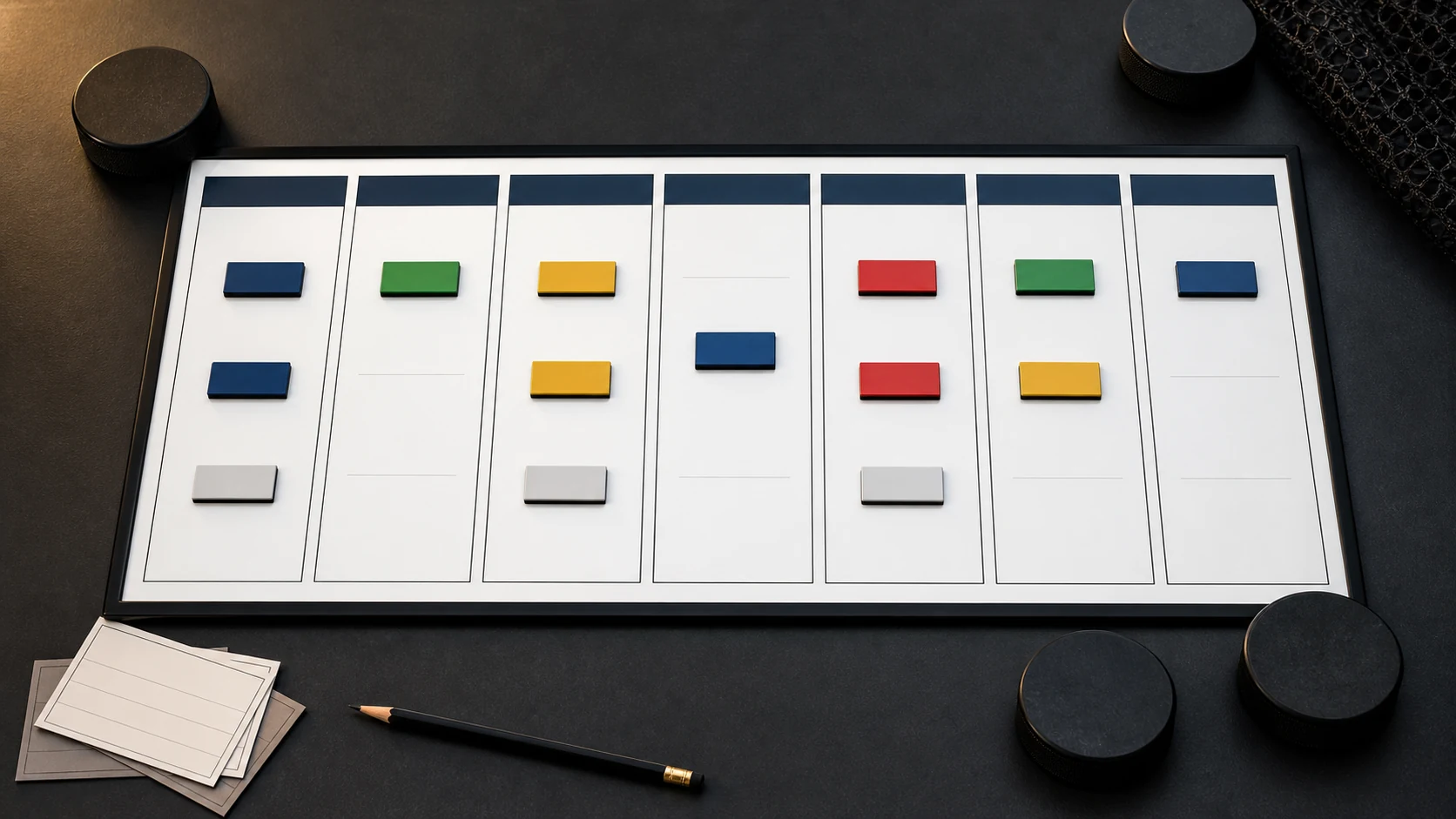
That is why this guide tracks three schedule signals:
- Games: the number of NHL games the team plays in the Monday-Sunday week.
- Light-night games: games on dates with eight or fewer NHL games, when fantasy lineups are less likely to be full.
- Back-to-back opportunities: consecutive team game days, which can create a compact skater stream or a possible backup-goalie opportunity.
The weekly team list is therefore a screening tool, not an automatic add list. It deliberately avoids preseason player names. Injuries, line combinations, power-play roles, starting goalies and roster percentages can change within hours, and inventing those details months in advance would make the advice less useful. Once games begin, open the current NHL schedule this week, compare it with your lineup and then check reliable same-day team news.
League settings matter as much as schedule shape. A daily-moves league can exploit individual off-nights; a weekly-lock league may force one lineup decision before Monday. Transaction caps can make a two-game weekend add expensive, while unlimited moves reward aggressive churn. Head-to-head categories may favor shots, hits or goalie appearances; points leagues value different roles. Use the schedule to locate opportunity, then apply your own rules before acting.
How We Ranked the 2026-27 Weekly Schedule
The calculations start with the NHL's published 2026-27 regular-season slate: 1,344 games and 84 games per team. We grouped the schedule into 28 Monday-Sunday windows. Week 1 runs September 28-October 4, even though the first NHL games are Tuesday. Week 28 runs April 5-11, while the current regular-season schedule ends April 10.
For each team and week, we counted total games, light-night games and back-to-back pairs. A light night in this guide is a calendar date with eight or fewer NHL games. That is an editorial threshold chosen because no more than half the league is playing. It is not an official NHL label and may differ from a fantasy tool that defines “off-night” as seven or fewer games or simply uses Monday, Wednesday, Friday and Sunday.
Teams are ordered by:
- more total games in the week;
- more games on our light nights;
- more back-to-back pairs;
- team abbreviation alphabetically when every schedule flag remains tied.
The table shows the first three teams after that sort. It does not imply that the third team is decisively better than every unlisted tie. Nor does it use opponent records, because no 2026-27 results exist yet and preseason strength estimates would become stale. “Best” here means the most favorable combination of game volume and lineup-friendly dates under the published method.
A back-to-back count records a pair of team games on consecutive calendar days. For skaters, that can compress two starts into a short roster stay. For goalies, it can make the backup relevant, but it never guarantees who starts either game. Confirm a starter close to puck drop rather than using this table as a goalie announcement.
You can audit the aggregate against the complete 2026-27 NHL schedule. The companion guide to the NHL's 84-game format explains why this season contains two more games per club. If a postponed game is rescheduled, weekly counts must be recalculated.
Best Fantasy Hockey Streaming Teams for All 28 Weeks
Read each code as games/light-night games/back-to-back pairs. For example, 4G/3L/1 B2B means four scheduled games, three on dates with eight or fewer NHL games, and one pair on consecutive days. These are the first three teams after the published tiebreakers; another club can have an identical profile and fall outside the display on alphabetical order.
| Week | Monday-Sunday dates | Top schedule targets |
|---|---|---|
| 1 | Sept. 28-Oct. 4 | Rangers 4G/4L/1 B2B; Canucks 4G/3L/1; Panthers 3G/3L/0 |
| 2 | Oct. 5-11 | Penguins 4G/3L/1; Flyers 4G/2L/1; Hurricanes 4G/1L/1 |
| 3 | Oct. 12-18 | Wild 4G/2L/1; Sabres 4G/1L/1; Panthers 4G/1L/1 |
| 4 | Oct. 19-25 | Avalanche 4G/3L/1; Ducks 4G/1L/1; Wild 4G/1L/1 |
| 5 | Oct. 26-Nov. 1 | Flames 4G/3L/1; Oilers 4G/3L/1; Jets 4G/2L/1 |
| 6 | Nov. 2-8 | Flames 4G/4L/0; Panthers 4G/3L/1; Sharks 4G/3L/1 |
| 7 | Nov. 9-15 | Predators 4G/4L/1; Oilers 4G/3L/1; Flyers 4G/3L/1 |
| 8 | Nov. 16-22 | Canadiens 4G/2L/1; Canucks 4G/2L/1; Sabres 4G/1L/1 |
| 9 | Nov. 23-29 | Wild 4G/2L/0; Ducks 4G/1L/1; Flames 4G/1L/1 |
| 10 | Nov. 30-Dec. 6 | Blackhawks 4G/3L/1; Canadiens 4G/3L/1; Penguins 4G/3L/1 |
| 11 | Dec. 7-13 | Rangers 4G/3L/1; Blue Jackets 4G/2L/1; Lightning 4G/2L/1 |
| 12 | Dec. 14-20 | Avalanche 4G/3L/0; Flyers 4G/3L/0; Sabres 4G/2L/1 |
| 13 | Dec. 21-27 | Blue Jackets 4G/2L/2; Blues 3G/2L/1; Bruins 3G/1L/1 |
| 14 | Dec. 28-Jan. 3 | Oilers 4G/3L/1; Panthers 4G/3L/1; Penguins 4G/3L/1 |
| 15 | Jan. 4-10 | Avalanche 4G/4L/0; Capitals 4G/4L/0; Stars 4G/3L/1 |
| 16 | Jan. 11-17 | Oilers 4G/4L/0; Kings 4G/3L/1; Rangers 4G/2L/2 |
| 17 | Jan. 18-24 | Stars 4G/4L/1; Capitals 4G/3L/1; Blackhawks 4G/3L/0 |
| 18 | Jan. 25-31 | Mammoth 4G/4L/0; Red Wings 4G/3L/1; Rangers 4G/3L/1 |
| 19 | Feb. 1-7 | Lightning 2G/2L/1; Mammoth 2G/2L/1; Jets 2G/2L/1 |
| 20 | Feb. 8-14 | Blue Jackets 4G/3L/1; Kings 4G/3L/1; Blackhawks 3G/2L/1 |
| 21 | Feb. 15-21 | Hurricanes 4G/2L/1; Penguins 4G/2L/1; Kraken 4G/2L/1 |
| 22 | Feb. 22-28 | Islanders 4G/3L/2; Avalanche 4G/3L/1; Stars 4G/3L/1 |
| 23 | March 1-7 | Blackhawks 4G/3L/1; Kraken 4G/3L/1; Sharks 4G/3L/1 |
| 24 | March 8-14 | Blackhawks 4G/3L/1; Bruins 4G/2L/1; Senators 4G/1L/1 |
| 25 | March 15-21 | Flames 4G/3L/0; Avalanche 4G/3L/0; Kraken 4G/3L/0 |
| 26 | March 22-28 | Canadiens 4G/3L/1; Capitals 4G/3L/1; Red Wings 4G/2L/2 |
| 27 | March 29-April 4 | Wild 4G/4L/0; Avalanche 4G/3L/1; Kings 4G/3L/1 |
| 28 | April 5-11 | Bruins 4G/3L/1; Stars 4G/3L/1; Mammoth 4G/3L/1 |
The abbreviations are intentionally replaced with recognizable short team names, but “Rangers” means the New York Rangers and “Mammoth” means Utah. Week 19 is a warning rather than a high-volume recommendation: the top displayed profiles contain only two games because the 2027 NHL All-Star events interrupt the week. A two-game leader should not be compared with a four-game leader from another week.
Fantasy platforms can label or combine periods differently, especially around holidays and the All-Star break. Match the date range—not just the week number—to your league. Adding selected teams to the NHL calendar can make the day pattern easier to compare with your own lineup.
Early-Season Streaming Windows: Weeks 1–9
Week 1 looks short because the NHL season starts Tuesday, but it is not short for every club. The Rangers and Canucks each fit four games into September 29-October 4. The Rangers' four all fall on light nights under this guide's threshold, while Vancouver has three light-night opportunities. Florida offers only three games, yet all three occur on lighter dates. This is a good illustration of why team volume and usable volume need separate columns.
Do not spend every transaction before opening lineups are known. Early-season depth charts can move quickly, and a player drafted for a presumed role may not occupy it when games begin. Check official team news and the day's NHL game list before locking a move. The schedule can tell you that New York plays; it cannot tell you that a particular waiver player will remain on a scoring line.
Weeks 2–4: favor starts you can actually use
Pittsburgh leads the Week 2 screen with four games, three light-night dates and one back-to-back. Minnesota tops Week 3, while Colorado's four-game Week 4 includes three lighter dates. In each case, compare the exact play days with occupied roster positions. If your lineup is already full on the team's one heavy night, the other three dates may still justify the move. If two light dates collide with your own stars, the displayed profile overstates your personal benefit.
Weeks 5–7: the clearest early clusters
Calgary and Edmonton each post 4G/3L/1 B2B profiles in Week 5. Calgary improves to four games on four light nights in Week 6; Nashville matches that 4G/4L pattern and adds a back-to-back in Week 7. These are strong team-level schedules, but they are not instructions to add any available skater wearing that sweater. Confirm ice time, special-teams usage, position eligibility and recent deployment first.
Weeks 8–9: plan the weekend before it arrives
Montreal and Vancouver lead Week 8 with four games and two light dates apiece. Minnesota leads Week 9 with four games and two light dates. Look at the sequence several days ahead: a transaction used late Sunday cannot recover an empty Monday slot. In leagues with weekly acquisition caps, deciding which days need help before the period begins preserves moves for injuries or goalie confirmations.
Holiday and All-Star Schedule Traps: Weeks 10–20
Midseason planning has two danger zones: a holiday week can produce uneven team totals, and the All-Star break can make an ordinary Monday-Sunday ranking look more generous than it is. Compare the absolute game count in every row, not just the team's position.
Week 13 is compressed and uneven
For December 21-27, Columbus reaches four games with two light dates and two back-to-back pairs. St. Louis and Boston are the next displayed targets even though each has only three games. That does not make them bad options; it means the available league-wide volume is different from a normal four-game-heavy week. Check your fantasy host's holiday scoring period because it may not use the same seven-day boundary as this article.
Multiple back-to-back pairs can be attractive for short skater stays, but they can also concentrate games on dates when your lineup is already full. For goalies, two pairs indicate possible opportunities for more than one netminder; they do not identify which goalie will start. Wait for credible confirmation when a goalie appearance is the purpose of the move.
Weeks 14–18 return to normal volume
Edmonton, Florida and Pittsburgh each show 4G/3L profiles in Week 14. Colorado and Washington then post four games on four light nights in Week 15. Edmonton does the same in Week 16; Dallas follows in Week 17 and Utah in Week 18. Those clusters are excellent planning prompts because more dates are likely to fit, but the roster decision still belongs to the current role and your category needs.
Week 19 is an interruption, not a normal target week
The NHL scheduled All-Star Skills for Friday, February 5 and the All-Star Game for Saturday, February 6 at UBS Arena. In the Monday-Sunday Week 19 used here, Tampa Bay, Utah and Winnipeg lead the screen with only two regular-season games apiece. A “top team” label in that row means 2G/2L/1 B2B—not four games.
Do not burn moves merely to match a volume benchmark that the calendar cannot provide. Some fantasy hosts may combine days around the break, pause matchups or number the period differently. Match our dates to the settings visible in your league, and use the NHL calendar tools to see where the interruption falls. Week 20 restores four-game options led by Columbus and Los Angeles.
Fantasy Playoff Schedule Targets: Weeks 21–28
There is no universal fantasy hockey playoff calendar. Your host or commissioner chooses the qualifying rounds, matchup length and championship dates. Treat Weeks 21-28 as a late-season map, then circle only the rows that correspond to your league. A manager whose final ends March 28 needs Weeks 25-26; a league that plays into April needs Weeks 27-28.
Weeks 21–24: repeated options matter
Carolina, Pittsburgh and Seattle open this span at 4G/2L/1 B2B in Week 21. The Islanders lead Week 22 with four games, three light nights and two back-to-back pairs. Chicago then appears at the top in both Week 23 and Week 24, posting 4G/3L/1 B2B each time. A favorable profile in consecutive weeks is useful because it may reduce churn, but only if the same available player still has a role worth holding.
Seattle also ranks in Weeks 21 and 23, while Colorado ranks in Week 22. These repeats are reasons to examine a team's exact dates, not permission to roster a weak fit blindly. In category leagues, identify what you can realistically gain before choosing a player. In points formats, compare projected usage under your scoring rather than assuming all four-game skaters are interchangeable.
Weeks 25–26: build a two-week bridge
Calgary, Colorado and Seattle each carry 4G/3L profiles in Week 25. Montreal and Washington lead Week 26 at 4G/3L/1 B2B, with Detroit at 4G/2L/2. A two-week playoff move can be more efficient than two unrelated one-week adds, but the bridge must work on both sides. Before Week 25 begins, compare the candidate's Week 25 dates, Week 26 dates and the day your transaction rules reset.
Weeks 27–28: verify your league is still playing
Minnesota offers the standout Week 27 schedule: four games, all on light nights. Colorado and Los Angeles follow with four games and three light dates. In Week 28, Boston, Dallas and Utah each show 4G/3L/1 B2B. Those are attractive calendar shapes, but some fantasy competitions will already be complete.
Late-season lineup roles can change because of health, performance and real NHL standings. This preseason schedule cannot predict which clubs will rest anyone or which players will be available. Reopen the live weekly NHL schedule, inspect current team reporting and confirm your league's add deadline before making a playoff transaction.
Turn a Good Team Schedule Into a Smart Waiver Move
A 4G/4L team profile answers only one question: “Could this team create several lineup-friendly opportunities?” It does not answer whether a particular free agent is good, available or legal to add under your settings. Use this order before committing a transaction.
- Read the league rules. Confirm daily or weekly lineup changes, add limits, waiver processing, roster locks, games-played maximums and the scoring period. Major fantasy hosts allow settings to vary, and private leagues can differ from public defaults.
- Count your empty active slots. Place the candidate's dates against your existing starters. Count only games that can enter an active slot; do not value a bench collision as a start.
- Check eligibility. A winger who cannot fit your open position may be less useful than a lower-profile multi-position option. For goalies, verify that the roster slot and any appearance minimum or maximum make sense.
- Verify the current role. Use recent official team reporting and same-day information for health, line deployment, power-play work and goalie status. Do not rely on this preseason table for those facts.
- Match the move to scoring. In a categories league, target the category you can still win. In a points league, use your league's weights. Schedule volume cannot rescue a player whose contributions do not count meaningfully for you.
- Consider opponent and venue last. Home/road sequence and opponent context can break a tie, but early-season records are not available yet and later form changes. Treat those inputs as current analysis, not fixed schedule facts.
- Budget the exit. Decide when you would drop the player and what later empty slot the next move could fill. One good two-day stream should not consume the last transaction needed for an injury replacement.
The process works best as a funnel: schedule, lineup fit, current role, scoring fit, then transaction cost. Managers often reverse that order after seeing a familiar name on waivers. Starting with usable dates keeps reputation from hiding a bench conflict.
On game day, review the current NHL games before the relevant roster lock. If a postponement or time change removes the expected opportunity, stop and recalculate. A move you choose not to make can be as valuable as an add that produces one extra start.
2026-27 Fantasy Streaming FAQ
What is a light night in this guide?
It is a date with eight or fewer NHL games, meaning no more than half the league is playing. That threshold is our planning definition, not an official NHL or fantasy-platform rule. Other tools may use a different cutoff.
Is a four-game team always a better streaming target?
No. Four scheduled games help only when the player fits active lineup slots and contributes under your scoring. Three games on open dates can produce more usable starts than four games that collide with established starters.
How should fantasy managers use back-to-backs?
For skaters, consecutive game days can provide two starts during a short roster stay. For goalies, a back-to-back can create an opportunity for the backup, but it does not guarantee either starter. Wait for credible, current confirmation.
Why does the table rank teams instead of individual players?
The 2026-27 schedule is published, but player availability, injuries, deployment and roster percentages change constantly. A preseason player list would age quickly. Use the team screen to build a candidate pool, then apply current role and league-specific scoring.
Which rows are the fantasy playoffs?
That depends on your league. Compare your matchup dates with Weeks 21-28 rather than assuming the host uses these week numbers. The table supports several possible playoff windows and does not label one as universal.
When should these weekly rankings be recalculated?
Recalculate after any postponement, rescheduling or official date change because one moved game can change team totals, light-night counts and back-to-back pairs. Check the current complete NHL schedule before a high-stakes add.
Comments
Comments are reviewed before publication. Spam, abusive content and policy-violating links are not published.
Sign in with Google to leave a comment.
Loading comments...