
Shesterkin is out for the rest of the 2026-27 season
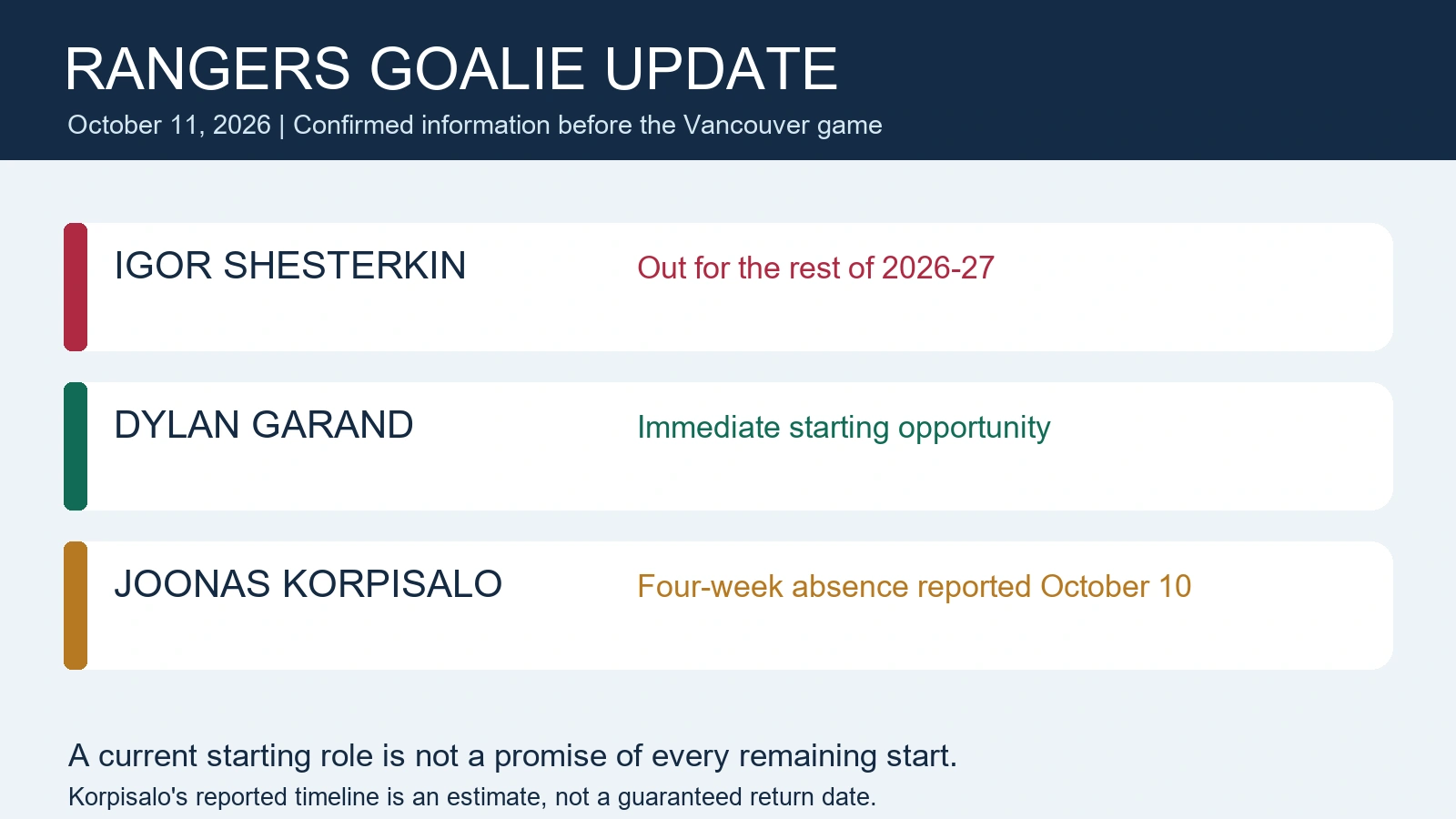
Igor Shesterkin will miss the remainder of the 2026-27 NHL season with a lower-body injury. The New York Rangers announced that status on October 10, following his exit from their game at Washington the previous night. This update was checked on October 11, before New York's scheduled home game against Vancouver. The full-season absence is the confirmed answer; a specific medical diagnosis and a precise return date are not disclosed in the NHL's announcement.
The NHL's October 10 report describes the injury occurring at 8:20 of the second period of a 3-1 loss to the Capitals. Shesterkin appeared to jam his right skate into the goalpost while scrambling back toward his net. His leg bent underneath him, and Rangers defensemen Sean Durzi and Marcus Pettersson helped him off the ice. He had stopped 13 of the 14 shots he faced before Dylan Garand replaced him.
Those observations explain the sequence of the incident, but they should not be turned into an unannounced diagnosis. Describing a skate meeting the post is different from naming the damaged structure, a procedure or a recovery timetable. The team used lower-body injury language. A video replay of the fall cannot establish details that the club has not released.
The dates also explain why search results appear inconsistent. The first reports from Washington described the injury and said coach Mike Sullivan did not have an update on its severity. The next-day announcement supplied the more definite season-long status. An early article expressing uncertainty does not contradict a later confirmed announcement; it reflects what was known earlier. Readers should check the publication time as well as the headline when comparing reports about a developing injury.
This is also a separate episode from Shesterkin's absence during the previous season. The NHL's current report notes that he missed 13 games after a January 5 injury against Utah in 2025-26. That history is useful for identifying old search results, but it does not establish a medical connection between the two injuries. Reports of the earlier collision, earlier projected returns or earlier practice appearances cannot answer his current availability.
The immediate consequence is straightforward: New York must plan its remaining 2026-27 games without its established starter. Fans do not need to wait for an additional diagnosis to understand that change in availability. Further team announcements may add detail, but they should be reported when released rather than anticipated. The next practical question is who takes the starts now, especially because another Rangers goalie is already unavailable.
Dylan Garand takes the immediate starting role
Dylan Garand is the Rangers' immediate replacement in goal. The NHL's October 10 report says he will get his first opportunity in the new starting role when New York hosts Vancouver on Sunday. That assignment follows his appearance in relief of Shesterkin at Washington, where he made 11 saves. It is an identified next step, rather than a prediction about which outside goalie the Rangers might acquire.
Garand was already with the NHL team when the injury occurred. He had been recalled from Hartford of the American Hockey League on October 1, after clearing waivers and being sent down in late September. The Capitals pregame lineup listed Shesterkin and Garand as New York's goalies. His relief appearance was therefore a change within the dressed goalie pair, not an emergency trip from Hartford during the game.
Korpisalo's injury leaves another opening
New York's depth issue extends beyond Shesterkin. Joonas Korpisalo is also unavailable with a lower-body injury. The October 10 NHL report gives a four-week absence, while the earlier Washington injury update described him as week to week. The later estimate gives fans a more useful current picture, but it is still a reported timetable rather than a guaranteed return on a specific calendar day.
Korpisalo's absence explains why the Rangers cannot simply move their established backup into Shesterkin's spot and keep the rest of the arrangement unchanged. There is an immediate need for Garand to handle the next opportunity and for the club to provide appropriate support behind him. A report about a potential recall is not the same thing as a completed roster transaction. The identity of a backup should be checked against the team's latest roster and game-day information.
This distinction matters when reading a depth chart. A goalie listed in the organization is not necessarily available to dress that night, and a goalie on an injury list is not an active option just because his name is familiar. The relevant questions are which players are healthy, which are on the current roster and which one the coach names to start. The Rangers schedule provides the game sequence against which those choices will be made.
A named starter is different from a season-long workload
Garand's immediate opportunity does not mean the Rangers have committed him to every remaining start. Teams make game-by-game decisions around availability, performance and the schedule. A confirmed starter for Vancouver answers Sunday's question; it does not settle every future back-to-back, road trip or return from another goalie's injury.
Sullivan's comments in the official report express confidence in Garand's ability to make timely saves and give the team a chance to win. That is meaningful support from the coach, but it is not a fixed workload announcement. Keep the two updates separate: Shesterkin's absence is described for the remainder of the season, while the allocation of starts among the available goalies can change. A later adjustment to Garand's role would not, by itself, change Shesterkin's injury status.
What Garand's early NHL results actually show
Garand's first NHL results give the Rangers a reason for confidence, although the sample remains small. The October 10 NHL update lists him at 3-1-1 with a 1.31 goals-against average, a .954 save percentage and one shutout in five career NHL appearances, including four starts. Those are the figures at the time of the report, before the Vancouver game; they should not be read as a full-season projection.
His strongest recent example came on October 2 in Detroit. Garand made 22 saves in a 2-0 Rangers win for his first NHL shutout. The NHL's account of that game says it was his fourth NHL appearance. New York was playing its third game in four nights, making it a useful instance of him contributing during a busy stretch rather than only entering a game after an injury.
The scoring and shot sequence also matter. Sean Durzi supplied an early power-play goal, and Eeli Tolvanen added an empty-net goal late. Garand protected a narrow advantage between those goals. Detroit had 20 shots through two periods but only two in the third. The shutout records his saves, while the final-period shot total shows that New York's work in front of him was part of the outcome.
Garand, 24, was selected by the Rangers in the fourth round of the 2020 draft, with the 103rd pick. He had gone 2-0-1 in three late-season NHL appearances in 2025-26. Those experiences give him more context than a completely untested emergency replacement, but four career starts are still different from handling the demands of an established starter across months.
Read the numbers alongside the size of the sample
A .954 save percentage means he stopped 95.4 percent of the shots counted in that reported sample. Goals-against average expresses goals allowed per 60 minutes of playing time. The two measures describe related but different things: save percentage concerns shots stopped, while goals-against average also reflects how often the team allows shots and the minutes played.
Neither number tells a fan exactly what will happen against Vancouver or over the rest of the season. Five appearances can be strongly influenced by a small number of goals, a shutout and the opponents encountered. A goalie may also face very different types of chances from one game to another. Reading the figures alongside the actual Detroit sequence is more informative than using them alone to declare the replacement question solved.
The appropriate test now is whether Garand can continue giving New York opportunities to win while taking on a larger role. That is consistent with Sullivan's confidence in his timely saves, without turning a positive start into a promise. Watch repeated starts, the defensive support and how he responds after goals against. The early results establish that he has already contributed at NHL level; the coming games will supply the evidence about the new workload.
The next Rangers game is a concrete checkpoint
New York's next scheduled game is at home against the Vancouver Canucks on Sunday, October 11, at 6 p.m. Eastern Time at Madison Square Garden. The NHL's injury update identifies that game as Garand's first opportunity in the immediate starting role. The official schedule lists MSG and SNP as its television outlets. These details were checked before the game on October 11 and describe the scheduled matchup, rather than a completed result.
For a Rangers fan, this gives the injury news a practical next step. The question moves from who will replace Shesterkin to how Garand and the team perform together in the first game following the announcement. His previous Detroit start and Washington relief appearance are already part of his record. Vancouver supplies a new test after the club has had time to process the season-ending news and prepare with the available goalie group.
The schedule then keeps moving. New York is listed to host Tampa Bay on October 13 and visit New Jersey on October 15. Those opponents illustrate why the job cannot be reduced to one emotional response on Sunday. The coaches need a workable goalie arrangement across successive games, and the skaters need to sustain their defensive responsibilities beyond the first night. Future starters for those games should be reported when named, rather than inferred from the first assignment.
What to check before puck drop
Check the current game-day lineup and the coach's starter announcement close to the game. A prior-day report is strong evidence of the plan, but roster availability and the final choice can still change. The same check should identify who is dressed behind the starter. It is more useful than treating a projected lineup, a depth-chart name and an official game roster as interchangeable.
For viewing, use the channel listing as a starting point and verify that the outlet is carried in your location. The presence of MSG or SNP on a schedule does not mean every subscriber everywhere can access the broadcast. Local carriage, regional rights and the particular service used still matter. This injury update does not establish a free stream or a subscription entitlement, and a goalie change does not alter those viewing conditions.
Our today's NHL games page helps locate the matchup, while this week's NHL schedule keeps the next games in view. After Vancouver, assess the actual performance and any new team announcement separately. One result can inform the discussion, but it cannot reveal an undisclosed medical timetable or establish the goalie allocation for the whole remaining season.
How the Rangers' job changes without Shesterkin
Shesterkin's absence removes an established source of stability. The 2021-22 Vezina Trophy winner had a 1.79 goals-against average and a .927 save percentage across five starts in the current NHL report. He had started 51 games in the previous season. Garand's four career starts represent a very different experience base. New York is replacing a familiar long-term presence, not simply exchanging two players with equivalent NHL workloads.
That does not establish an inevitable outcome for the team. Sullivan's response was to emphasize continuing to compete, and Adam Fox described an opportunity for others to step up. Those comments explain the club's immediate outlook. Whether the Rangers sustain their early results will depend on actual performances, including what the skaters do in front of the available goalie and how much offense they produce.
The Washington game offers specific things to watch. According to the official recap of the 3-1 loss, Timothy Liljegren tied the game with a point shot through a screen before Shesterkin left. Boone Jenner later intercepted Cole Beaudoin's clearing attempt and scored from between the face-off circles against Garand. Tom Wilson's final goal went into an empty net with one second left. Those were three distinct scoring situations.
For the new goalie arrangement, the lesson is about the actions surrounding the saves. A screened point shot tests the goalie's ability to locate the puck while teammates manage traffic. A failed clear that produces a central shooting chance creates a different problem. Limiting those chances is a concrete way to support Garand; merely asking him to duplicate Shesterkin's early save percentage does not address their cause. This is analysis of the documented sequence, rather than a claim that a new defensive system has been announced.
Offense matters too. Alexis Lafreniere's first-period power-play goal was New York's only goal in Washington. The Rangers outshot the Capitals 7-5 in the third but did not equalize. A goalie can keep a game within reach while the team still needs to finish its own chances. Judging the replacement solely from the final score would also incorrectly fold the empty-net goal into Garand's individual performance.
Vancouver is the next opportunity to evaluate those responsibilities together. Watch whether New York exits its zone cleanly, keeps shooting lanes manageable and creates enough scoring support, as well as whether Garand makes the required saves. The confirmed news is difficult for the Rangers, and the difference in NHL experience is substantial. The useful next assessment is the team's performance with its available players, beginning with the scheduled Sunday start, rather than a season verdict issued before that game is played.
Comments
Comments are reviewed before publication. Spam, abusive content and policy-violating links are not published.
Sign in with Google to leave a comment.
Loading comments...