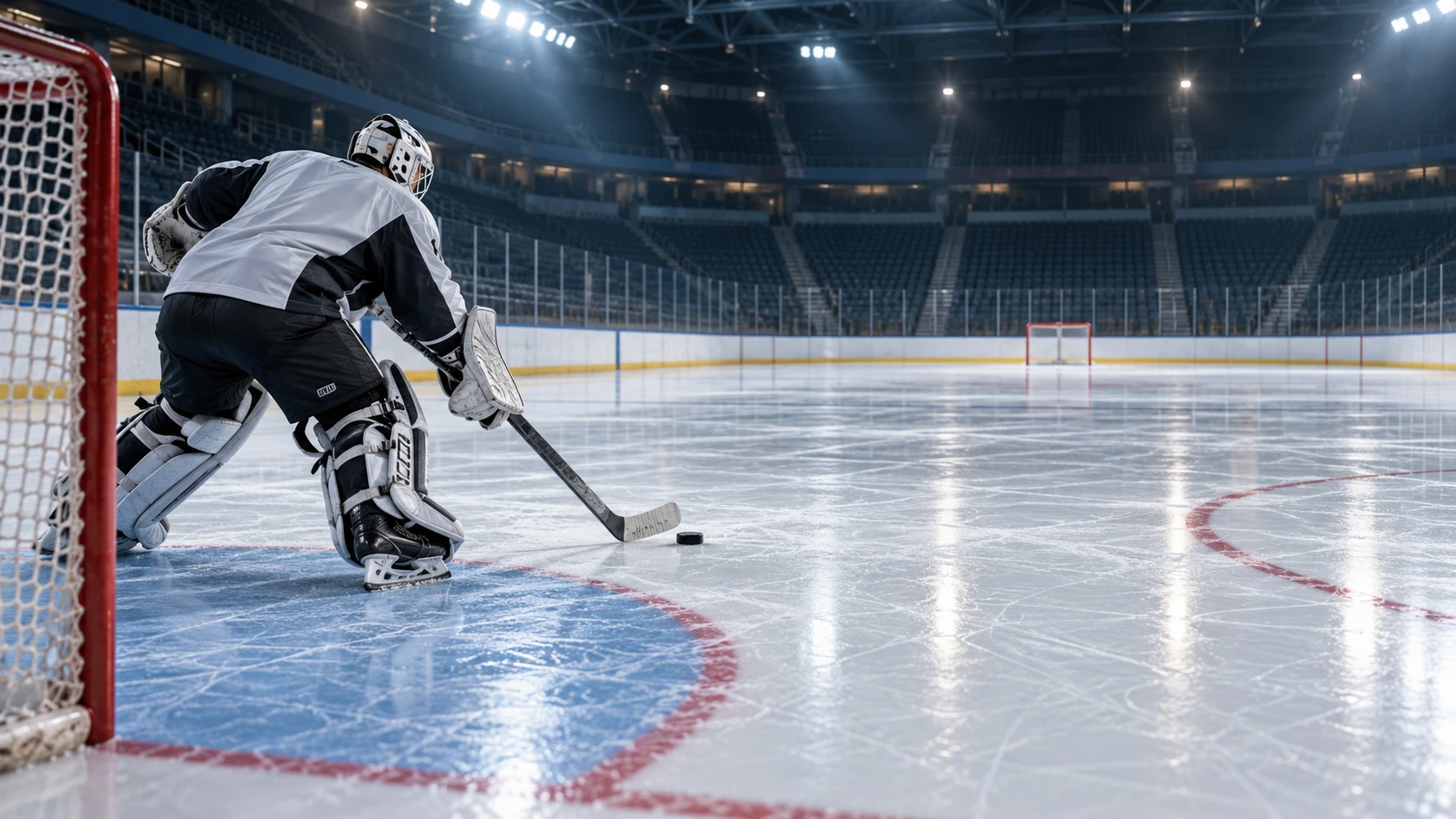
An NHL goalie is allowed to score. A goalie goal can come from an intentional shot or from scorer credit after the opposition puts the puck into its own goal. Recognizing those two paths makes the highlight and the official scoring entry much easier to understand.
Yes, NHL goalies can score: Shesterkin's October 2026 example
On October 1, 2026, Igor Shesterkin became the first Rangers goalie to score, at 17:26 of the third period against Tampa Bay. The NHL recap supplies the scoring record. The league's highlight page describes a shot travelling the length of the ice into the empty net.
This is the kind of goalie goal most people picture: the player normally responsible for stopping shots becomes the shooter. There is no position change on the lineup sheet and no requirement that a skater finish the play. What matters is that the puck enters the opposing goal legally during live play. The scoring system can recognize the goalie as the scorer just as it recognizes a forward.
One useful way to watch is to ignore the celebration on the first replay. Locate the far goal, check whether it is guarded, and follow the puck's route from the shooting end. The celebration answers whether teammates are excited; the route answers what happened. A dramatic clip beginning with the puck already halfway down the rink may leave out the very action that distinguishes a shot from an accidental own goal.
The scoring entry and the replay serve different purposes. The official entry identifies the player credited with the goal and the game time. The pictures show the puck's travel and help explain the opportunity. Use them together when a caption simply says “goalie goal,” especially if you want to compare the achievement with a historical first.
Publication dates need the same care. A morning recap or uploaded highlight may describe the previous evening's game. Counting the upload and the original game separately would invent an extra event. For live games, the NHL games today page provides a starting point for following the schedule. A scoring clip from an earlier game does not confirm who will start the next one.
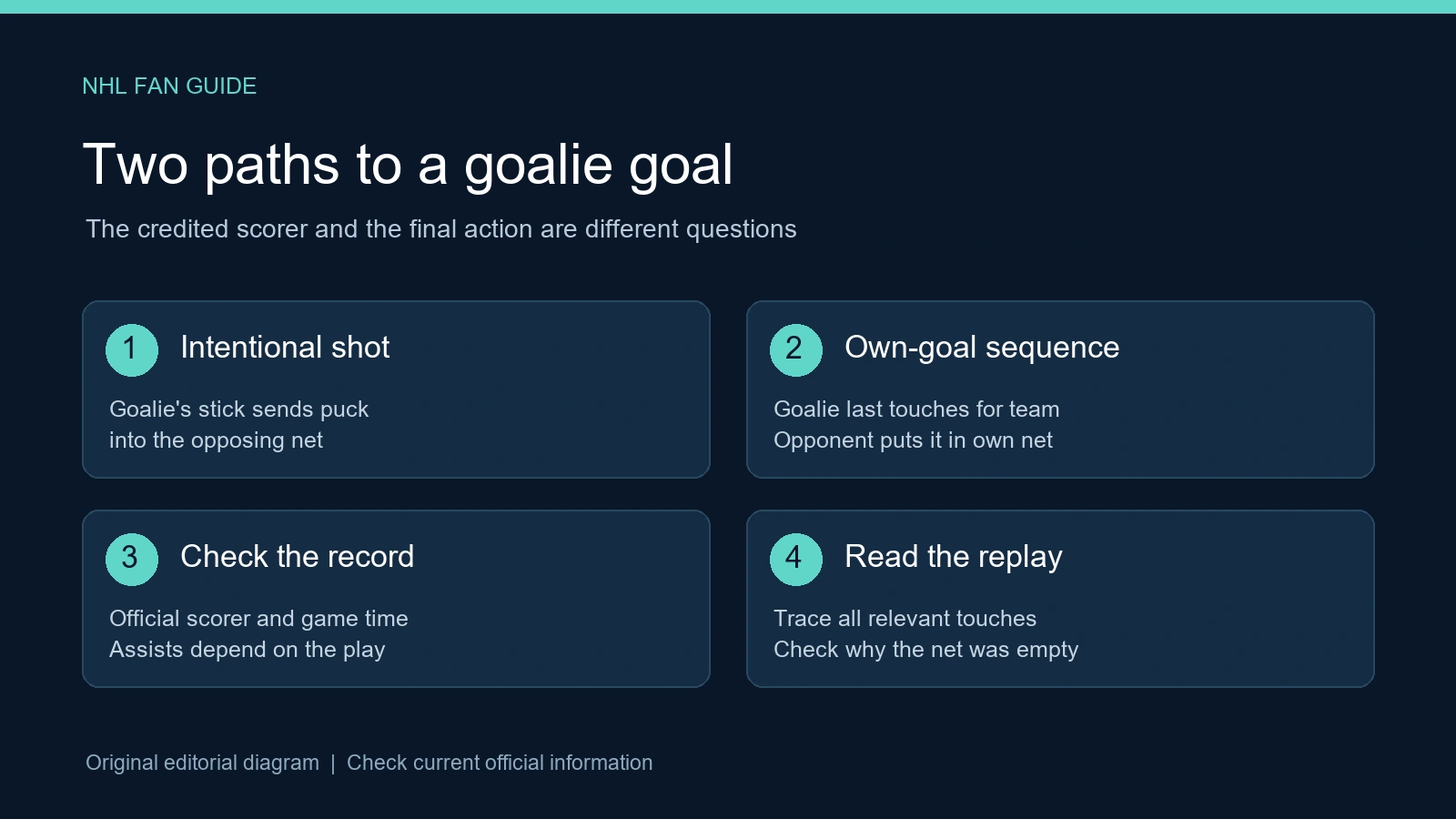
Two routes to a goalie goal
For scorer credit, start with Rule 78 in the official 2026-27 rulebook. It describes both ordinary goals and the special credit question when the defending team sends the puck into its own net. The goalie position is no barrier to receiving that credit.
Shooting the puck into the net
When the goalie actually shoots, the connection is straightforward: the goalie's stick sends the puck toward the opposition's goal, and the legal shot goes in. The puck has to cross the goal line entirely, between the posts and beneath the crossbar. An attempt that catches a post and stays outside is still only an attempt, however impressive its flight.
The scoring player receives one point for a goal. Distance adds drama, rather than extra value, and an empty net does not reduce the goal to a lesser statistical category. The goal belongs to the competition and game in which it happened. A regular-season goal remains separate from a playoff goal when someone later compares season or career totals.
Also distinguish a goal from an assist. A goalie might send an excellent outlet pass to a teammate who finishes the play. That can produce a goalie assist if the scoring rules permit one, but the teammate remains the scorer. “The goalie earned a point” is therefore a broader statement than “the goalie scored.” A highlight of a long pass cannot settle the distinction without the finish and official entry.
Receiving credit after an opponent's mistake
Consider a hypothetical sequence with an entirely different appearance. A goalie makes a save, leaving a live puck that an opponent collects. That opponent makes a misplaced pass toward an empty goal at their own end, and the puck goes in. The goalie may be the scoring team's last player to have touched the puck, so the resulting goal can be credited to the goalie without any attempt to shoot.
Change one detail and the credit can change. If one of the goalie's teammates touches the puck after the save, that teammate becomes the later touch to examine. The goalie does not keep a permanent claim to the goal simply because a save began the sequence. This is why replays of accidental goalie goals sometimes need to start well before the final misplaced pass.
The NHL records a scorer on the team receiving the goal, rather than putting an opponent's own goal in that opponent's goal total. For a defending player shooting into their own goal, Rule 78.4 assigns the goal to the last attacking-team touch and provides for no assist. When the defending player puts it in another manner, the rule permits assists to be awarded. Treating every accidental own goal as identical would miss that distinction.
The practical shortcut is to trace possession and touches first, then read the official scoring entry. It prevents confusing an intentional long-range shot, a save followed by an opponent's mistake, and a goalie assist on a teammate's finish. All three can produce memorable clips, but only the first two can put the goalie in the goal column.
Why an empty net creates the opportunity
An open goal at the opposite end of the rink is a very different target from one protected by a goalie. A long shot still needs direction and enough distance, but it no longer has to beat a goaltender's glove, blocker or pads. This makes the empty net central to understanding the opportunity, even though an empty goal does not guarantee a successful attempt.
Usually, the easiest situation to recognize is a team adding an extra attacker while trying to score. Its goalie leaves for the bench and another skater joins the play. The additional skater can help keep the puck in the attacking zone, but the team has traded away protection at its own net. If the goalie at the other end gains possession, the vacated goal becomes a potential target.
The delayed-penalty situation works differently. When the referee signals an infraction by the team without puck control, Rule 15.1 allows the non-offending team to continue attacking until the offending side gains control. The team with possession can replace its goalie with an extra skater during that interval. It must still handle the puck carefully: an accidental pass into its own exposed goal can cause trouble without the opponents taking control first.
This explains why some credited goalie goals look nothing like an attacking shot. The goaltender might have touched the puck earlier in a save, while the opponent's later possession mistake supplies the final movement into the open net. Watch the raised arm and possession sequence, rather than assuming every empty goal was created by a last-minute effort to tie the score.
For an intentional attempt, the goalie has to choose between shooting and other ways of managing possession. A teammate offering a short pass may be the more secure option. Sending the puck high can carry it over approaching sticks, but makes judging its eventual landing important. Sending it along the ice can reduce that flight problem while giving opponents more opportunities to intercept. These are ways to analyze the chance, rather than claims that any one trajectory always succeeds.
A miss may also invite an icing decision. Rule 81's ordinary conditions apply to any player, including a goalie sending the puck from their own half beyond the far goal line. The penalty-based shorthanded exception is a separate issue from the opposition having substituted a sixth skater for its goalie. Count the applicable penalty situation rather than treating the visible extra attacker as automatic permission to ice the puck.
The official NHL video rulebook provides current explanations alongside the season's PDF. Those details help explain the decision before the shot: an attempt can bring a memorable goal, a lost possession or a stoppage that sends play back toward the shooting team's end.
The milestones that shaped goalie scoring
The NHL's October 2, 2026 roundup lists 18 goalies with 21 goals: 19 regular-season and two playoff goals. Those are dated historical totals, so they should be checked again after another goalie scores.
Notice that the number of goals exceeds the number of goalies. Counting names answers how many different people have achieved the feat; counting goals includes repeat achievements by the same person. A list with one row per goalie will therefore have a different length from a list with one row per scoring event. Neither format is wrong, provided it says what it counts.
Billy Smith and Ron Hextall did different things first
Billy Smith received the first NHL goalie-goal credit on November 28, 1979, after a save and Colorado's mistaken pass into its own net. The NHL anniversary account documents that first. It is the foundational example of the credit route: the scorer did not need to intend a shot.
Ron Hextall made the first scoring shot on December 8, 1987; he later scored by shooting in the playoffs too. The October 2026 Hextall feature places his achievement in that history. The word “shot” is essential when comparing his first with Smith's earlier credit.
This resolves a common disagreement in highlight comments. Someone calling Smith the first goalie to score is referring to the official scorer. Someone calling Hextall the first goalie to shoot and score is describing the intentional scoring action. Removing the qualifying words makes two compatible records sound contradictory. Keeping them makes the history more precise and more interesting.
The regular-season versus playoff distinction is another useful filter. A playoff achievement belongs in the league's broader history, but should not be silently added to a regular-season-only total. When comparing a player's statistics with a compilation, check whether the compilation includes both competitions. An all-time video collection and a regular-season statistics page can legitimately produce different totals.
Finally, keep team firsts separate from league firsts. A franchise's first goalie goal can be newsworthy decades after the first league-wide event. The two labels answer different questions: whether anyone had done it before in the NHL, and whether anyone had done it wearing that team's uniform. This is why a new goalie-goal headline can celebrate history without claiming the league had never seen the play.
A goalie cannot roam anywhere to chase a goal
Permission to score does not give a goalie unrestricted freedom to play the puck around the rink. Two parts of Rule 27 matter especially when watching a long-range attempt: participation beyond the center red line, and playing the puck behind the goal line outside the designated handling area.
Rule 27.7 imposes a minor penalty for a goalie participating in play beyond the center red line, with the puck's position determining the rule's application. This is different from watching a goalie launch a shot from their own end. The shot can travel beyond center; the restriction does not stop the puck there. It limits the goalie's participation at the far side of that line.
That distinction answers the tempting idea of a goalie simply skating end to end to get closer to the target. The current NHL rule is relevant to participation, so an old story from a different competition or era does not establish that the same attack would be permitted now. Separate the date and league of a historical anecdote from the rules governing today's NHL game.
Behind the goal, the familiar trapezoid marks the designated puck-handling area. Under Rule 27.8, playing the puck behind the goal line outside that area brings a delay-of-game minor. The puck's location determines this restriction, and the rule provides an exception when the goalie maintains skate contact with the goal crease. A goalie standing in one place and reaching for a puck in another therefore needs closer attention than a freeze-frame of the skates alone.
The trapezoid does not mean the goalie must stay inside the crease, nor does it prohibit shooting a puck from a legal handling location. Think of it as a limit on where a puck behind the goal line can be played. A puck in front of that line and a puck in the restricted corner are different situations, even if the goalie moves only a short distance between them.
These limits help explain why a highlight's starting point matters. Before admiring the shot's flight, find where the puck was played. Was it in the crease, in front of the goal line, or behind the net? If it was behind the net, where was it relative to the marked area? You do not need to measure the entire shot to ask those rule questions.
The goalie also remains responsible for the home end after trying to score. A puck blocked nearby can return toward the goalie much faster than one successfully sent to the opposite end. That is a practical reason to consider teammates, approaching opponents and recovery position. An open target is only one part of the decision; protecting possession and being ready for the next play are part of it too.
How to read a goalie-goal highlight and score sheet
Begin with the game identity: teams, date and competition. Then find the official scorer and time. This avoids confusing an old compilation clip with a new event, or placing a playoff moment into a regular-season count. For locating games beyond tonight, the weekly NHL schedule supplies the wider context.
Next, establish why the net was empty. Look for the goalie leaving, an extra skater entering, the scoreboard and a referee's delayed-penalty signal. Those details explain the opportunity. They also prevent assuming the same tactical situation whenever a clip shows an unguarded goal.
Finally, follow the puck back to the credited goalie's last touch. An obvious shot needs little explanation, but a credited goal following an opponent's mistake may require an earlier replay. If a teammate intervened, that touch is relevant to scorer credit. The scoring entry should guide the conclusion rather than the loudest caption on a reposted video.
Rule 78.1 allows an obvious error in the announced scorer or assists to be corrected promptly. That is a reason to use the official game summary when an initial broadcast description and later scoring entry differ. It is not a reason to invent a correction whenever two fans disagree. Check whether an actual official change exists.
To follow a team over a longer period, the NHL calendar can help organize upcoming games. No schedule can predict another goalie goal. What it can do is put you in position to watch a game; the two scoring paths, possession sequence and current handling rules explain the rare event when it happens.
Comments
Comments are reviewed before publication. Spam, abusive content and policy-violating links are not published.
Sign in with Google to leave a comment.
Loading comments...