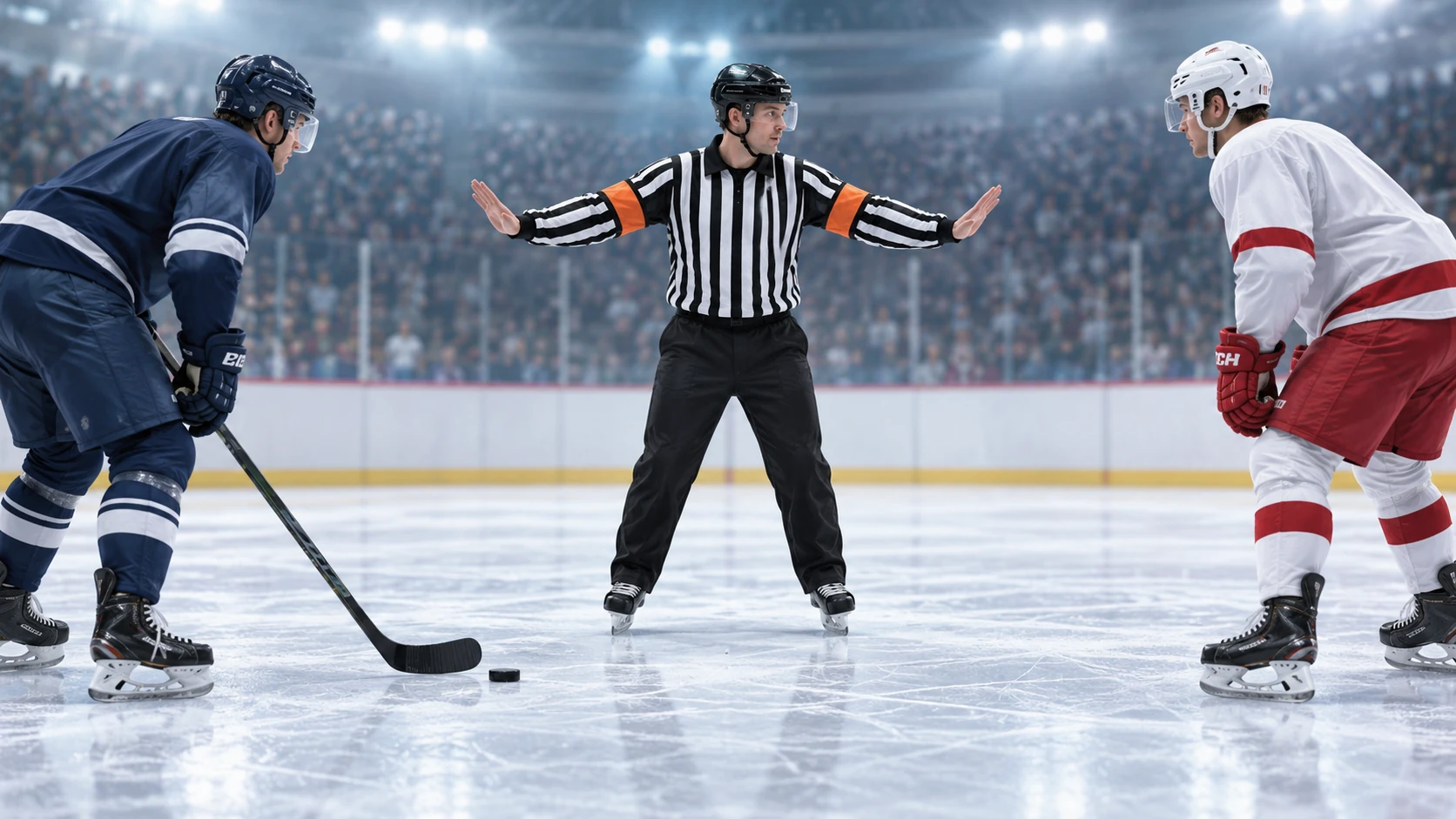
What the NHL decided in the Frank Nazar case
The NHL suspended Chicago's Frank Nazar for two games for an illegal check to the head against the Islanders' Bo Horvat. The October 10, 2026 decision concerned an incident in New York on October 8. That makes this a confirmed discipline decision, rather than a prediction based on the earlier hearing announcement.
The league reported that the incident occurred at 18:25 of the third period and that Nazar received a match penalty. Those details separate two parts of the story: what the officials assessed during the game and what the Department of Player Safety decided afterward. The two-game suspension was without pay; the announcement also reported a $68,041.14 forfeiture directed to the Players' Emergency Assistance Fund.
For a fan watching the replay, the immediate question is often whether the checker used a shoulder or elbow. That observation can matter, but it is not the complete head-hit test. Rule 48 asks about the head as the main contact point and whether that contact was avoidable. A hit does not become legal simply because the player's elbow stays down, and a collision is not automatically a Rule 48 violation merely because some head contact occurs.
The official Player Safety video page identifies the same two-game decision. When following the case, favor the final announcement over a post saying only that a hearing will occur. A hearing notice describes a process step; it does not by itself establish the final punishment or every reason behind it.
This explanation was checked October 11, 2026. It uses Nazar's case as a concrete starting point for understanding the rules and the discipline process. It does not assign an unannounced medical diagnosis to Horvat or infer Nazar's private intention from a short clip. The useful task is to understand the rule the NHL applied, then distinguish the confirmed decision from the additional claims people make about it.
Rule 48: the contact point and whether it was avoidable
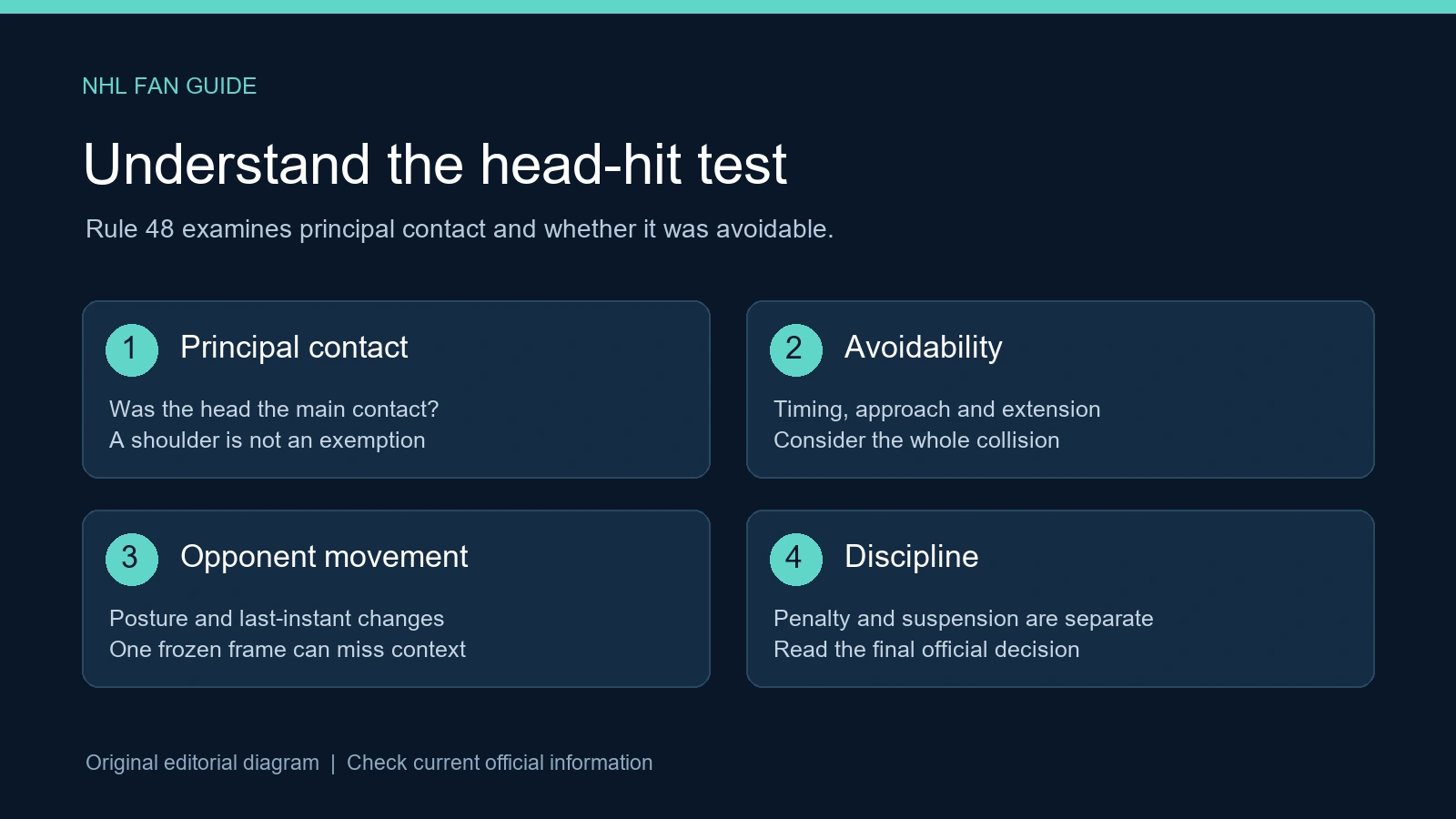
Rule 48's central test has two parts: the opponent's head was the main point of contact, and that contact was avoidable. Both matter. The current official rulebook is linked from the NHL Video Rulebook page. Use the current NHL rule rather than a rule from youth hockey, another professional league or an old social-media summary.
A shoulder hit can still make illegal head contact
The type of body part used is not a substitute for the contact test. Keeping an elbow tucked does not answer whether the shoulder primarily struck the opponent's head. Conversely, incidental head contact during a full-body check should not automatically be described as a Rule 48 violation. Watch where the force of the check goes and what opportunity the checker had to deliver the contact differently.
The rule calls attention to timing, the angle of approach and unnecessary extension upward or outward. Those details help explain why “he was finishing his check” is incomplete reasoning. A player can be trying to complete a physical play and still choose an approach that creates avoidable principal head contact. The legality question concerns the actual collision under the rule, not just a general description of the player's objective.
Consider a hypothetical contrast. In one play, a checker delivers contact squarely through the torso and some secondary head contact follows. In another, the approach misses the torso and concentrates the hit on the head despite an available body-contact path. Those situations raise different Rule 48 questions even if the checker uses a shoulder in both. These examples illustrate the test; they do not establish what happened in any particular disputed clip.
Why the opponent's movement matters
Avoidability includes what the opponent did immediately before and during contact. The rule considers a vulnerable posture that makes head contact unavoidable on an otherwise full-body check, as well as a material change in body or head position that significantly contributes to the collision. That is why the sequence leading into the hit can matter more than the most dramatic frozen frame.
It does not create a simple rule that a lowered head makes every hit legal. Ask whether the position was already established, whether it changed at the last instant and how the checker's approach related to it. A player being bent forward is one observable detail; the rule still requires an assessment of the full circumstances. Treat “head down” as the beginning of a question, not the end of the analysis.
For fans, the best viewing method is to watch the approach at normal speed, inspect the contact from available angles and then return to normal speed. Slow motion helps locate contact, while full speed helps you understand the time available to react. If an angle hides the relevant shoulder or head, acknowledge the limitation rather than treating the hidden detail as confirmed.
An on-ice penalty and a suspension answer different questions
An on-ice penalty governs the game being played. Supplemental discipline can affect the player's availability after that game. The Department of Player Safety FAQ explains that supplemental discipline does not require an on-ice penalty, and its classification can differ from the referee's call. “There was no penalty” and “the referee already punished him” therefore do not settle whether a later suspension is possible.
Rule 48's penalty provisions also deserve careful reading. The current rule provides for a minor penalty and, in specified circumstances, a match penalty at the referee's discretion. It does not provide an ordinary major penalty or game misconduct under Rule 48 itself. Other physical-contact rules have different provisions, so a general description such as “a five-minute head-hit penalty” can hide the actual classification.
Under Rule 48.5, the match-penalty judgment concerns an attempt to injure or deliberate injury with an illegal head check. That explains the rule category without proving every disputed detail of a particular player's intentions. When reporting Nazar's case, the confirmed fact is that the NHL said he was assessed a match penalty. Avoid expanding that report into a personal accusation unsupported by the official explanation.
Rule 28 authorizes investigation and additional fines or suspensions whether or not the referee penalized the offense. That authority is why a later video review by Player Safety is not simply a replay of the penalty-box decision. The officials have to administer a live game; the supplemental process considers discipline with a different set of information and procedures.
For a practical example, imagine a dangerous collision that officials do not penalize because their available angle misses the principal contact. Supplemental review can still examine the play. In a second example, officials assess a penalty but the later process categorizes the conduct under another rule. These examples explain the separation; they do not suggest that every hard hit must result in an additional punishment.
When reading a game report, keep four items distinct: the incident, the on-ice penalty, any hearing notice and the final supplemental decision. Add the team's subsequent lineup only when it is confirmed. That sequence makes it easier to discuss what actually changed and prevents an earlier hearing headline from being mistaken for the final outcome.
How Player Safety evaluates a hit and chooses discipline
Player Safety reviews the conduct under the league's rules and supplemental-discipline process. The hearing gives the player and representatives an opportunity to explain the play before a decision is made. It is not a public vote about the player's reputation, and a notice that a hearing will occur should not be mistaken for a completed ruling.
The NHL's process FAQ distinguishes telephone hearings from an opportunity for an in-person hearing when a suspension of six games or more may be considered. The format describes the possible range and procedure; it is not a promise of the eventual number. Fans should wait for the actual release before turning a hearing notice into a headline about a specific punishment.
Injury, history and the seriousness of the play
The department's published factors include the conduct itself, injury, previous supplemental discipline and the situation of the game. The conduct assessment can consider intent, recklessness and excessive or unnecessary force. Those are different questions from whether a player is generally admired, whether the victim immediately left the bench or whether the crowd reacted strongly.
Injury is relevant to the discipline assessment, but it does not replace the legality test. A hit can violate a rule without a publicly confirmed injury, and a painful-looking collision does not prove every element of Rule 48. Avoid using a player's return to a shift as a medical diagnosis. If the team has not announced a condition, describe the observed hockey event without inventing one.
History also requires precision. The FAQ's formal repeat-offender category for salary forfeiture is not the same thing as the department considering a player's past discipline. A player falling outside that particular time window does not have every earlier incident erased. At the same time, a fan's impression that someone is “dirty” is not an official disciplinary record.
Game context can affect how conduct is assessed. A late-game collision, prior events between the players and the circumstances around the puck may help explain the sequence. They are not a substitute for identifying the actual prohibited action. A useful discussion connects context to what occurred rather than assuming that any late hit in a heated game has the same disciplinary value.
There is no simple equation that converts “head contact plus no previous suspension” into a fixed number of games. To compare cases, start with the applicable rule, principal contact, avoidability and the published reasons for the decision. Then consider the other relevant factors. A shared suspension length does not establish identical conduct, and different lengths do not by themselves demonstrate favoritism.
For Nazar, the confirmed outcome is the two-game decision. These broader factors explain the process fans should understand; they do not claim access to private hearing testimony or an unannounced medical report.
Reading a suspension explanation without guessing motive
Start an official explanation by identifying the rule and the conduct the league says occurred. Then look for the evidence connecting the two. A useful head-hit explanation concerns principal contact and avoidability; a discussion of suspension length may add injury, history or game circumstances. Those layers should be read together rather than reduced to the final number of games.
The Player Safety hub brings decisions and educational material together. Use the case-specific item when asking what was decided, and the rule explanation when asking how the category works. A general educational clip helps explain a standard, but it does not replace the final ruling on the particular play you are discussing.
Watch enough of the sequence to see the approach. A clip beginning at impact can hide the timing and body-position changes relevant to avoidability. Look at whether the camera angle clearly shows the point of contact or whether the players overlap from that viewpoint. If a second angle reveals a detail the first one hides, consider both rather than choosing the image that best supports your initial reaction.
Normal speed and slow motion answer different questions. Normal speed shows the time available and the pace of the approach. Slowing the clip can help locate the principal contact, but it can also make a quick decision look like a long opportunity to react. Combine them before deciding what the checker could reasonably do in the circumstances described by the rule.
When comparing two incidents, state the differences that could matter. Were both reviewed under the same rule? Was head contact principal or secondary? Did the opponent change position immediately before impact? What disciplinary history and injury information did the league report? Without those checks, comparing two punishment lengths is closer to comparing headlines than comparing the underlying cases.
Fans can reasonably disagree about consistency, and a disagreement does not require pretending every angle is conclusive. Describe the point you dispute: the interpretation of avoidability, the weight assigned to history or the resulting length. That is more precise than asserting that the league favored a team because two visually dramatic collisions received different outcomes.
For Nazar's case, keep a link to the October 10 final decision when discussing the outcome. If a later official update changes something material, use the newer record. Reposting the earlier hearing notice after the decision can make a resolved process look unfinished and spread confusion about what the player is actually serving.
What fans should check before the next game
A two-game suspension is measured in games, not two calendar days. Use the Blackhawks schedule to understand the team's upcoming fixtures, then check the club's latest information for actual availability. Do not turn a calendar calculation into a guaranteed return announcement, especially if another official update changes the player's status.
The Blackhawks' news page is a useful place to check pregame reporting and confirmed roster information. A suspension does not automatically tell you which teammate takes the open role, which line changes or who receives special-teams minutes. Those choices belong to the club's actual lineup and coaching decisions.
Keep suspension, injury and roster transactions separate. A suspended player is unavailable for disciplinary reasons; that does not establish an injury diagnosis or a trade. A replacement entering the lineup does not by itself establish a permanent change in the depth chart. When following other roster news through the site's team transaction and rumor guide, look for the actual type of update before combining different stories.
For tonight's hockey, the current game slate helps you find the matchup. For following how a short suspension affects the next stretch, the weekly schedule provides the wider context. Neither page replaces an official lineup, and neither should be used to infer a player's medical condition.
If an appeal or later discipline update is announced, read the new official document before repeating a status claim. This guide does not assert that Nazar appealed or that his decision changed. It explains where a genuine update would fit into the sequence. Keep the final ruling's date alongside the current availability information so readers can tell which part of the story each item describes.
The next time you see a disputed head hit, ask the two Rule 48 questions first, then separate the live penalty from supplemental discipline. Watch the approach and contact, read the actual decision and check the lineup when it is available. Those steps make the game easier to understand without requiring a prediction about the suspension before the league has completed its process.
Comments
Comments are reviewed before publication. Spam, abusive content and policy-violating links are not published.
Sign in with Google to leave a comment.
Loading comments...