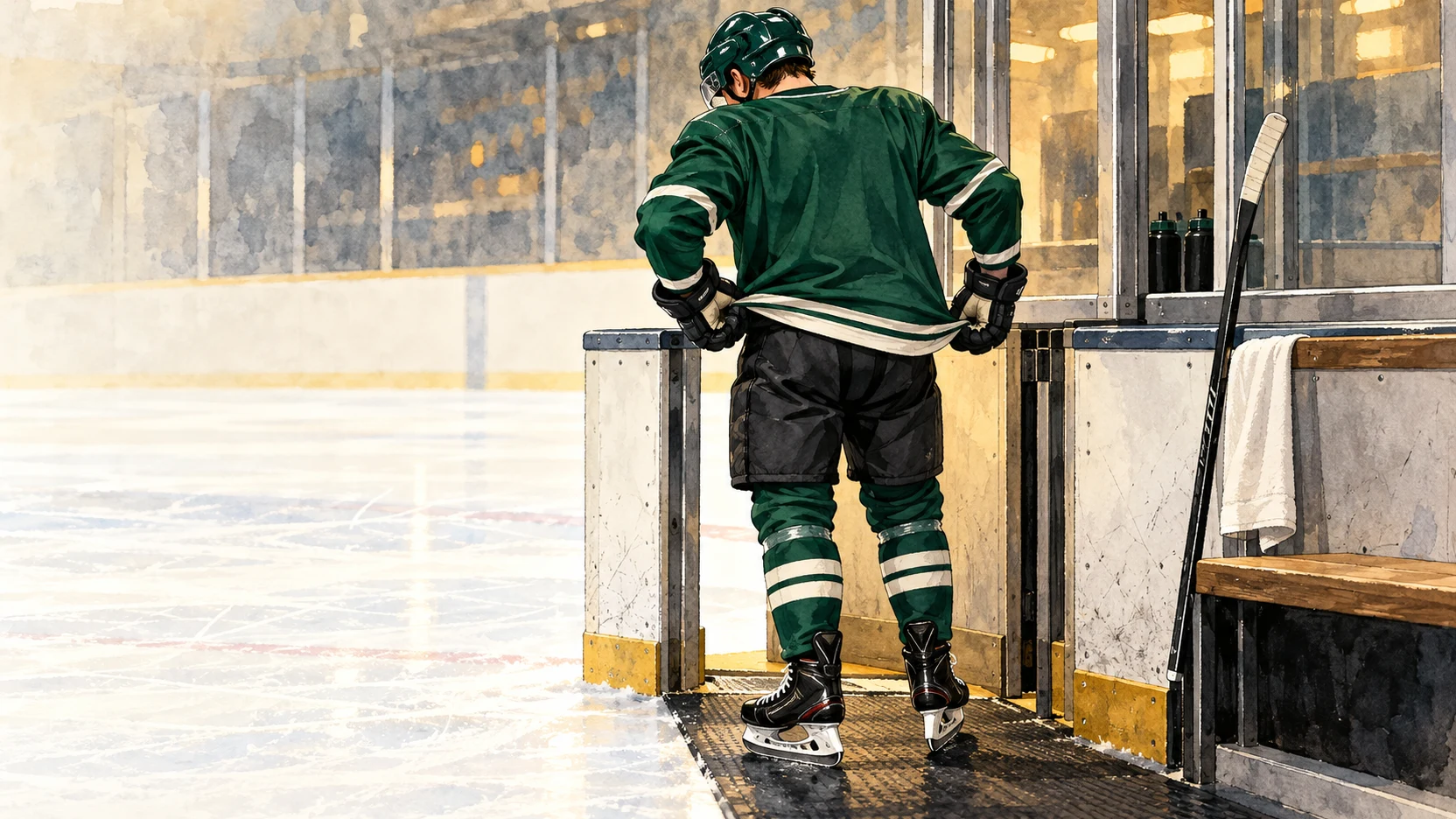
A tucked NHL jersey can lead to a two-minute equipment penalty when it exposes protective padding or otherwise violates the uniform standard and the player fails to comply after a warning. The 2026–27 emphasis does not mean every momentary fold during skating automatically deserves a minor. The condition at the start of a shift, the opportunity to correct it and the specific equipment rule matter.
Trevor Zegras's penalty against Boston on September 24, 2026 made the issue visible again. That was a preseason incident, rather than a new October controversy. Its lasting value is the question it raised: why can something that looks like a minor clothing adjustment put a team shorthanded?
Why a jersey tuck can become an equipment penalty
The basic rule concerns protective equipment being worn correctly under the uniform. Rule 9.5 of the current NHL rulebook requires protective equipment to be covered, with specified exceptions such as gloves, headgear, neck protection and a goalie's leg pads. It gives an exposed elbow pad as an example of a problem an official should have corrected.
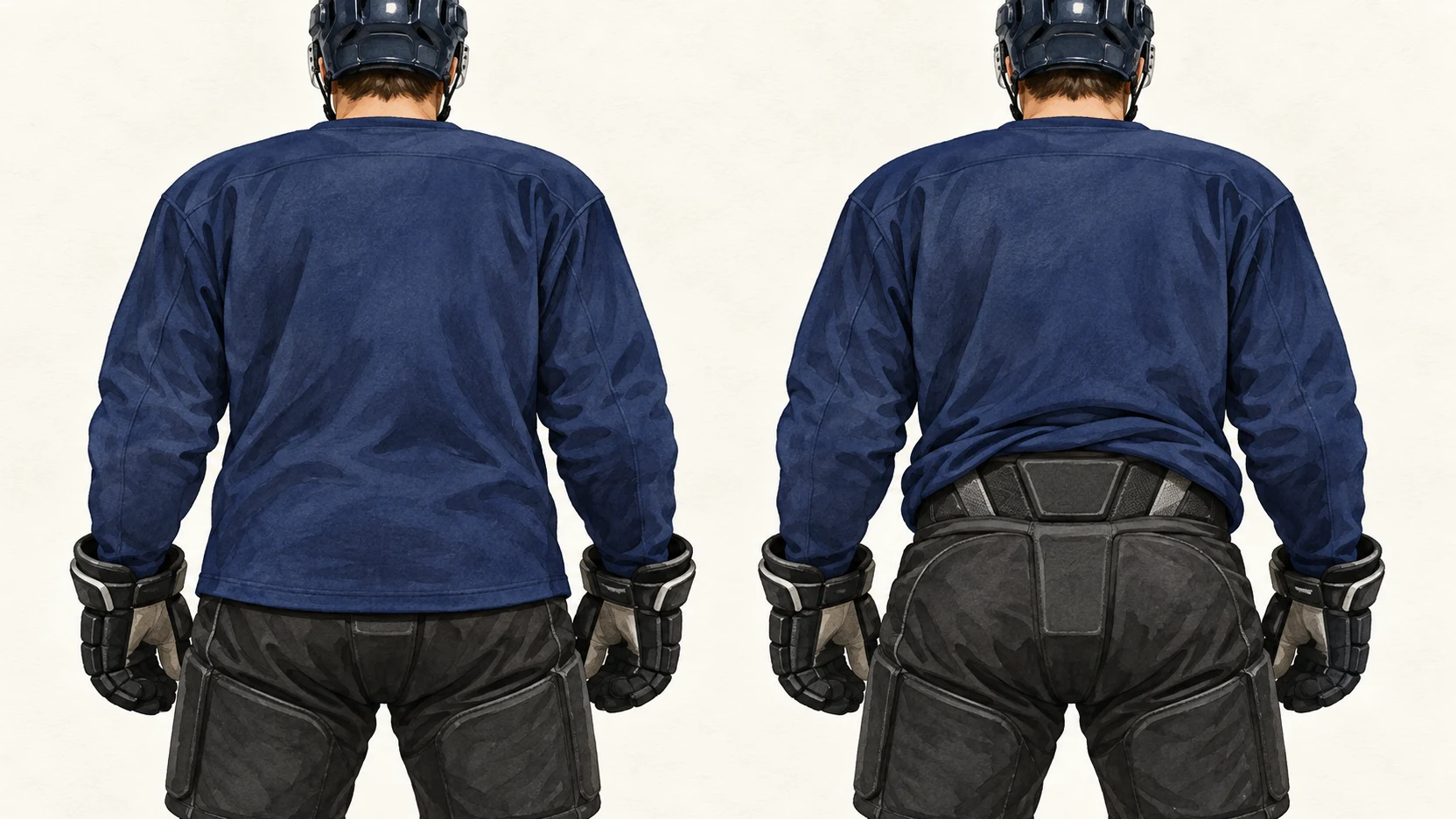
A jersey tucked into the pants can expose padding at the top of the pants or additional body protection. Uniform guidance also concerns keeping the back number unobstructed. The restriction therefore belongs to a broader equipment and identification standard, even if a particular player regards the tuck as a familiar personal preference.
The rulebook's procedure is relevant to the penalty. Under Rule 9.5, an official instructs a player to cover the equipment, and a second violation by the same player can produce a minor. Rule 12.1 also addresses illegal equipment, requiring correction and providing for a minor after a warning. A photograph of a tucked sweater does not show that entire sequence.
This does not settle whether a two-minute penalty is the best policy. It explains why the official has a rule to apply. Fans can criticize the consequence while still describing its basis accurately. Saying the jersey looked harmless and saying no equipment rule exists are different arguments.
What happened to Trevor Zegras in September?
Zegras received the equipment minor during Philadelphia's September 24 preseason game against Boston. Reports placed the call at 9:51 of the second period; the Flyers won 2–0. The memorable part was the sight of a player penalized over the back of his sweater rather than a stick or body-contact foul.
His explanation, as reported after the game, was that the tuck was familiar to him and the jersey had returned inside his pants while he was on the bench. That account helps explain the player's frustration. It does not establish every detail of the officials' earlier warning sequence, which should not be invented from a short clip.
The contemporary reporting connected the penalty to the league's renewed equipment emphasis. It also described a warning before a minor for continued noncompliance. The practical lesson for a player was to check the jersey before reentering play, even if his preferred fit or habitual tuck made that feel unnecessary.
A useful example, rather than proof of every later call
One preseason penalty establishes that the standard was enforced in that instance. It does not establish how often officials called it across the entire league, whether every later incident involved the same warning history, or whether another player received an exemption.
That limitation matters when the clip resurfaces weeks later. Viewers can use it to understand the rule without calling it a new event. Following the Flyers' upcoming games provides opportunities to observe current enforcement, but a new comparison still needs its own evidence.
Is the jersey-tuck restriction a new NHL rule?
The covered-equipment requirement is older than the current season. The previous official rulebook already contained Rule 9.5's instruction to cover an exposed pad and the minor for a second violation. The current discussion should therefore be described primarily as renewed attention to an existing restriction.
A new rule and an enforcement emphasis are different developments. A new rule changes the written obligations. An emphasis tells teams and officials to pay particular attention to an obligation already present. Both can alter what fans notice during a game, which is why they are easily confused.
The league's September 28 uniform-guidelines announcement covered jerseys alongside neck protection, warmup helmets and visors. Those items do not all share the same history. The current rulebook includes a new-player neck-protection requirement for 2026–27, while the protective-equipment and properly worn uniform questions have older foundations.
It is reasonable for a player to need time to adjust a long-standing habit when officials renew an emphasis. That practical difficulty does not mean the earlier absence of a visible penalty erased the rule. Conversely, renewed attention does not prove the league has rewritten every part of the standard.
For the reader, the useful question is which obligation changed and which obligation is simply receiving more attention. That is more informative than calling the whole package new, or assuming that a familiar player's previous appearance automatically establishes an exception.
How warnings and the start of a shift change the answer
The most useful detail in the enforcement discussion is when the player is expected to have the jersey properly arranged. Contemporary coverage of the league's guidance described an untucked jersey at the beginning of the shift and correction before resuming play. That addresses a practical reality: fabric can move while a player skates, turns or makes contact.
A jersey moving during play is a different observation
A sweater riding up during an active shift is not the same observation as a player stepping back onto the ice with exposed padding after being told to fix it. Treating both pictures as automatically identical skips timing and the opportunity for correction.
The specialist account of the uniform guidance explicitly noted that jerseys can ride up and described the need to untuck before resuming play. This does not grant a permanent exemption to leave equipment exposed. It explains why the surrounding sequence matters.
A warning gives the player a chance to correct the problem
The warning is a meaningful part of the process. It identifies the problem and gives the player an opportunity to comply. The minor follows continued or repeated noncompliance under the applicable equipment provision; a spectator should not assume the first visible adjustment on television is necessarily the player's first warning.
Imagine a player whose jersey lifts during a battle along the boards. Later he reaches the bench and fixes it before the next shift. Now compare a player told to cover his padding who returns without doing so. Those hypothetical sequences contain a fact a still photograph cannot supply: what happened after the instruction.
When debating a call, ask when the jersey became displaced, when the player could correct it and whether an official had already warned him. Those questions make the comparison more useful without requiring fans to agree that the punishment is proportionate.
Jerseys, neck protection, helmets and visors follow different tests
The uniform emphasis grouped several equipment issues together, but the underlying requirements differ. A veteran's exemption in one category does not automatically create an exemption in another. Distinguish who must use an item from how a required item must be worn.
Neck protection and the new-player requirement
Rule 9.8 begins the neck-protection requirement in 2026–27 for players, including goalies, with no previous NHL game experience. The protection must meet the specified minimum A5 cut level and be used as intended. Rolling, taping or cutting it to change how it is worn is not permitted.
The requirement includes pregame warmup. It does not make neck protection compulsory for every existing veteran under the same new-player provision. Nor does a cut-resistance rating mean an item can eliminate every injury risk. The rule specifies a protective standard and manner of use, rather than a guarantee.
Helmets during warmup
The warmup-helmet mandate uses a different dividing line. Players who entered the NHL in 2019–20 or later must wear a helmet during pregame warmup; currently playing players who entered before that season are exempt from that mandate. This is separate from the general requirement for helmets during games.
A fan seeing a veteran without a warmup helmet should therefore check the applicable entry date before assuming the same violation occurred. At the same time, that exemption does not answer whether a different player wore his jersey correctly. The comparisons involve different obligations.
A visor must provide eye protection
Rule 9.7 concerns a visor properly attached to provide adequate eye protection. Merely having a shield somewhere on the helmet does not answer whether it is positioned to serve that function. An upward tilt can become the issue even when the equipment itself is present.
Grandfathered eligibility to play without a visor and compliance by someone required to wear one are different questions. Avoid treating a veteran without a visor as proof that any player can wear a required shield however he chooses.
Our CBA changes guide provides the broader context. For a particular uniform flag, identify the relevant item and its own rule instead of applying one blanket age or experience exemption to all four categories.
Why fans consider two minutes out of proportion
The strongest objection concerns the consequence. A minor can put a team shorthanded, so a small uniform correction can produce a competitive cost far larger than the visual problem suggests. A fan can reasonably question that tradeoff without disputing that the equipment rule exists.
There is also a priority argument. Viewers want officials to address dangerous or unfair play, and an equipment flag is especially irritating when they believe a more consequential infraction received less attention. That reaction explains the emotional force of the discussion; it does not establish that a particular unrelated foul was missed or that officials were protecting a private interest.
A third concern is consistency. If a restriction has rarely been visible to viewers and suddenly produces a penalty, they need a clear explanation of the standard. Warning first, a recognizable opportunity to correct and consistent treatment of comparable situations make enforcement easier to understand. They do not guarantee that everyone will agree with the penalty's severity.
A valid criticism needs comparable situations
Compare the same facts. Did both players begin a shift with the same coverage problem? Had both received an instruction? Was the padding actually exposed, or did the picture show only a harmless fold? Was the comparison about jerseys, or did it involve a separate helmet or visor exemption?
If one player is being warned and another has already ignored a warning, different outcomes may follow the same procedure. If the relevant facts truly match and the outcomes differ, the consistency complaint becomes more specific. The useful evidence is the sequence and explanation, rather than two isolated screenshots.
It is possible to hold both conclusions at once: the rule gives officials a basis to act, and the league could explain or design the consequence better. That distinction turns a complaint about fashion policing into a clearer discussion about proportionality, communication and predictable enforcement.
How to read the next uniform penalty
Begin with the official announcement. Equipment is a broad category, and several other offenses can also produce a delay-of-game minor. A broadcast caption or social post calling something a jersey penalty may leave out the specific reason and the preceding instruction.
- Identify the equipment. A jersey, visor, neck protector and warmup helmet have separate requirements.
- Look for the actual problem. Exposed padding or an obstructed number is more informative than a folded piece of fabric alone.
- Check the timing. The start of a shift and an incidental movement during active play are different observations.
- Establish the warning sequence. Do not assume television showed every exchange between the player and official.
- Apply the correct exemption. An entry-date exception for one item does not extend automatically to another.
Watch a normal-speed sequence before judging a freeze-frame. See whether the player leaves the bench with the problem already present, whether he receives an instruction and what happens before he returns. Those observations answer the actual compliance question more clearly than the final penalty-box shot.
Correction also remains important after the penalty. Rule 12.1 does not let a player purchase permission to keep using illegal equipment by serving a minor; he cannot participate until the problem has been corrected or the offending equipment removed. A warning identifies the issue, the adjustment restores compliance and a penalty addresses the violation. They serve different functions. When watching a player's return, check that the equipment problem has actually been addressed, rather than assuming that time in the box settled every part of it.
These rules govern professional game equipment and the related warmup requirements. They are a different subject from choosing a supporter jersey. If the discussion has you comparing new designs, our Hometown Remix jersey guide addresses the fan-facing collection and its announcements.
The main lesson from Zegras's September example is to separate the written rule, its enforcement procedure and the debate over severity. A warning and a chance to correct are part of the explanation. So is the fact that a moving jersey does not automatically tell you what happened at the start of the shift. Keeping those details visible makes the next uniform controversy easier to assess.
Comments
Comments are reviewed before publication. Spam, abusive content and policy-violating links are not published.
Sign in with Google to leave a comment.
Loading comments...