
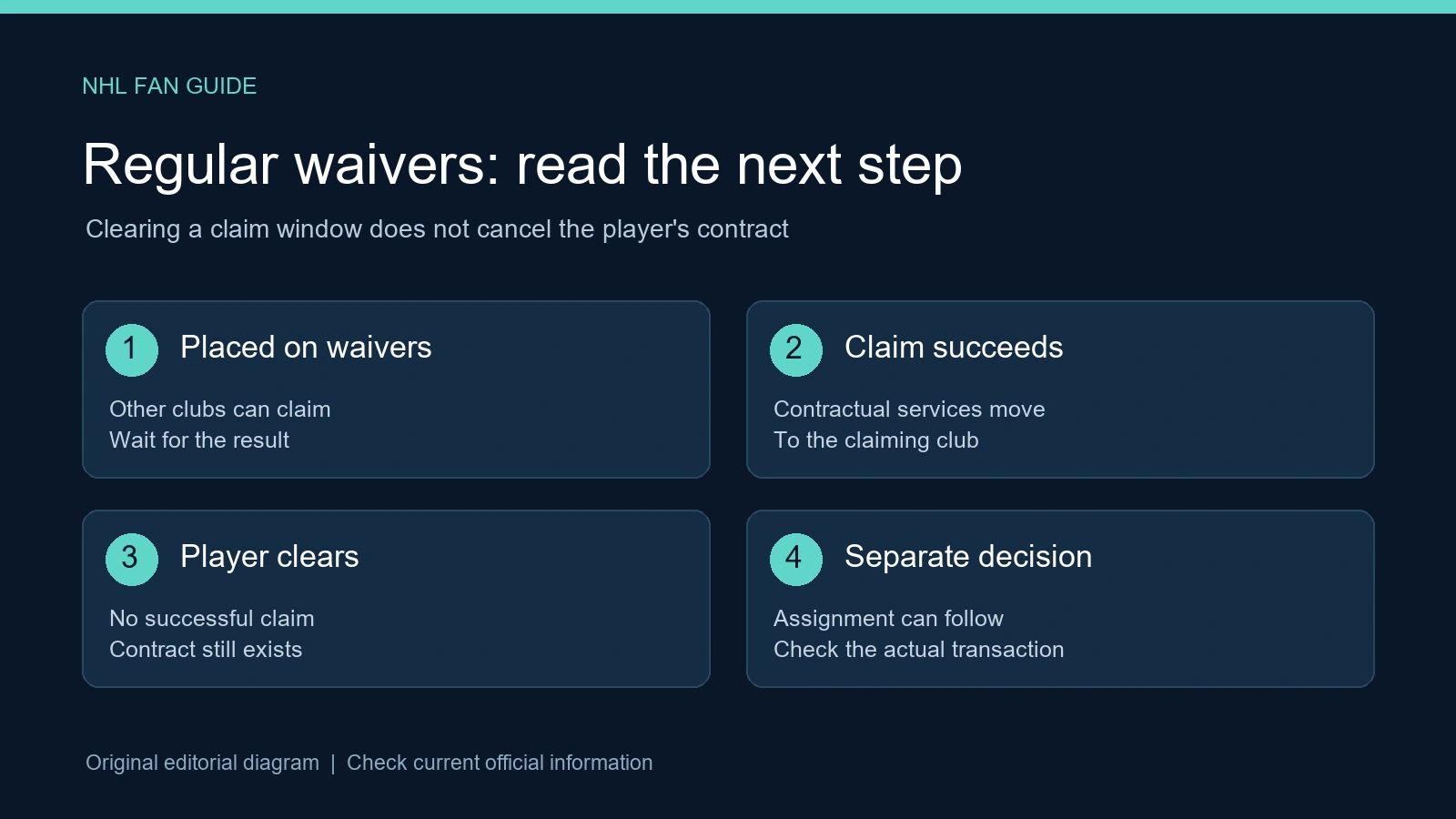
Clearing regular NHL waivers means no other club successfully claimed the player during that waiver process. It does not cancel his contract or make him a free agent. Placement, a claim, clearance and a minor-league assignment are separate steps, which is why a short transaction headline can be misleading.
Placed, claimed, cleared and assigned mean different things
“Placed on waivers” means the club has started the waiver process for a player. Other NHL clubs get the opportunity to make a claim. At this stage, the headline does not tell you the result: the player might be claimed or might clear. It also does not, by itself, establish that a minor-league assignment has already happened.
“Claimed” means another club acquired the player through that process. “Cleared” means the claim opportunity ended without another club taking him. “Assigned” or “loaned” describes the separate move to another league, commonly the AHL. A player can clear and stay with the NHL club, or clear and then be sent down. Read the actual subsequent transaction rather than assuming one must immediately follow the other.
A current example shows why clearance is not a permanent departure. Dylan Garand cleared waivers and went down September 28, 2026; the Rangers recalled him October 1. Those dates appear in the October 10 NHL report. The same organization could use the player again after the minor-league move.
Here is a hypothetical version with no player-specific assumptions. Club A wants to loan a waiver-eligible forward to its affiliate. It places him on regular waivers. If Club B gets the successful claim, the forward changes NHL organizations. If nobody claims him, Club A has the clearance needed for a qualifying assignment and can decide what to do next. The clearance answers the claim question; an assignment announcement answers where he will play.
The official CBA documents govern that process. The agreement distinguishes regular waivers from unconditional waivers, and sets conditions for loans to clubs in another league. A fan does not need to memorize every clause to recognize the basic sequence, but needs those distinctions before interpreting a roster move.
Regular NHL waivers should also be kept separate from a fantasy league's waiver wire. In fantasy hockey you may add a player to your own game roster under custom league settings. An NHL waiver claim is an actual club transaction involving the player's contractual services. Seeing an NHL waiver headline does not automatically change the player's fantasy status or tell you a fantasy claim deadline.
How the claim window and waiver priority work
The waiver period gives clubs a defined opportunity to submit a claim; it is not an open-ended auction. Article 13.18 provides a 24-hour claim period. Central Registry processes the request and reports the result. A reporter saying a player is “expected to clear” is describing an expectation before that result, rather than an official clearance.
The request and expiry dates matter. A placement announcement on one day and the result on the following day can describe the same waiver process. Seeing both headlines does not mean the player was waived twice. Also distinguish the transaction's actual time from when an article was posted or a social-media account repeated the news.
Priority follows the standings rule, not the fastest click
If one club makes a claim, that club receives the player. If several clubs claim him, Article 13.19 decides which claim succeeds. It does not reward the club whose staff submitted the first valid request within the window. A club with priority can win over another claimant even if fans heard about the other club's interest first.
The ordinary in-season rule uses the lowest percentage of possible standings points among the claiming clubs, measured at the relevant waiver-request point. The CBA uses the preceding regular season's final standings for claims outside the regular season and successful claims before November 1. Early October therefore should not be interpreted as though a few new-season results have already replaced the previous season's priority.
Points percentage differs from raw points. For a hypothetical comparison, a club with four points from five games has earned four of ten possible points, or 40 percent. A club with five points from seven games has earned five of fourteen possible points, about 35.7 percent. The second club has more actual points but the lower percentage. That illustrates why merely sorting a standings screenshot by its points column can produce the wrong answer.
Tied percentages require the agreement's tiebreaking procedure. You should not break a tie by inventing an alphabetical order or using a fantasy league's rotating claim list. The published CBA connects the procedure to league standings tiebreakers and applies per-game comparisons where appropriate. For an actual disputed claim, use the reported Central Registry result rather than treating a simplified calculation as final.
A successful claim also does not automatically send the club to the back of a rotating queue for the next player. The relevant standings rules continue to govern later claims. This differs from common fantasy systems in which making a successful claim consumes a team's current priority. Always check whether a discussion concerns real NHL transactions or the settings of a fantasy competition.
The weekly schedule can help place a claim in the team's upcoming games, but the schedule does not identify a winning claimant. Placement, the claim period and the official result supply that answer.
Who is exempt, and why a two-way contract does not decide it
A waiver-exempt player can be loaned without going through regular waivers when the exemption applies. That is why a young player may move between the NHL and the affiliate while a more experienced teammate faces a claim opportunity before a similar assignment. The exemption is a rule-based status, not simply a club deciding that it wants to keep the player.
One-way and two-way contracts concern compensation. A two-way contract provides different NHL and minor-league salary treatment; it does not, by those words alone, exempt the player from waivers. A veteran on a two-way deal can need waivers. A player on a one-way deal can still have an applicable exemption. The contract's salary label and the player's waiver status answer different questions.
The distinction remains important under the new agreement. The 2025 MOU revises the entry-level minor-league compensation provision, including its two-way treatment. That compensation provision is separate from the exemption criteria in Article 13.4. Do not read a two-way signing announcement as an automatic statement that the player can be sent down without a claim risk.
Age, position, seasons and games shape exemption
Article 13.4 uses age categories, position, an exemption period and NHL games played. Goalies and skaters have different thresholds. As one illustration from the table, the age-20 category gives skaters three years and 160 NHL games, while goalies have four years and 80 NHL games. This is a comparison of rule categories, not a declaration that every player who is currently 20 has those exact limits remaining.
The table's game threshold ends the exemption immediately when the applicable number is reached. The time limit is a separate boundary. Having played few NHL games does not preserve the exemption indefinitely after its allowed seasons expire; conversely, reaching the game threshold can end it before the nominal years run out. Both parts need to be tracked.
NHL playoff games count alongside regular-season games for these thresholds. For young age-18 or age-19 players, reaching eleven NHL games can also shorten the applicable exemption period. That eleven-game provision is a different rule from the entry-level contract's ten-game slide threshold. Mixing the two creates errors in both contract and waiver discussions.
For an individual player, confirm the relevant signing history and rule-defined age category, not just today's birthday or the length of the current deal. Then compare the applicable seasons and NHL appearances. A short signing headline rarely contains all of that information. When the team announces an actual waiver placement, treat it as a transaction to verify rather than trying to overturn it using only the phrase “two-way contract.”
A recall does not make the previous clearance permanent
A player who clears regular waivers can later return to the NHL, but that clearance does not provide unlimited future assignments. Article 13.5 sets expiry conditions for the right to loan a player who otherwise needs waivers. In the ordinary situation, thirty cumulative days on an NHL roster or ten cumulative NHL games triggers that expiry.
The word “or” is important. A player does not have to reach both thresholds. Someone can spend enough roster days to need another waiver process before a new assignment while appearing in fewer than ten games. A healthy scratch can therefore remain relevant to the day count even though no new game appearance is added.
The word “cumulative” is equally important. Imagine a player clears, appears in four NHL games, goes down, returns and plays five more. Those stints add up to nine appearances for the applicable count. Another counted NHL appearance reaches ten. A brief trip to the affiliate does not, on its own, turn the previous nine into zero. A fresh clearance would be a new waiver event, not an assumption based on the player changing dressing rooms.
Emergency recalls have a separate provision. Article 13.5(ii) uses ten cumulative NHL games while on emergency recall, and excludes games played on regular recall from that particular emergency-game count. This is why the official type of recall matters. The generic word “recalled” in a headline may not contain enough information to perform the calculation correctly.
There is also a new 2026-agreement detail worth knowing before assuming a paper assignment allows an immediate return. The MOU adds Article 13.12(p): when a loaned player has not been credited with a day under the specified Article 13 day-count provision for one or more days since the loan, he must actually report and play at least one minor-league game before recall eligibility. A goalie exception applies if the NHL club would otherwise have fewer than two goalies available for its next game.
That is a conditional rule, rather than a blanket statement that every minor-league assignment must last one game. It also does not replace the waiver-expiry counts. The fan takeaway is to check the actual assignment, recall classification and applicable day credit instead of treating every short move as an unrestricted reset.
The NHL calendar helps locate game dates, but an accurate waiver calculation needs transaction dates and roster status too. Team games, a player's appearances and credited roster days are separate numbers. Counting only the team's recent games is not enough to decide whether another clearance is required.
Regular waivers are different from contract termination
A regular waiver claim transfers the player's contractual services to another club through assignment of his Standard Player's Contract. The successful claimant is not simply adding an unsigned player who can negotiate a fresh deal that afternoon. Article 13.20 addresses the contract assignment, with specific provisions for the player's fitness and subsequent movement.
When the player clears regular waivers, the original contract does not disappear. The club has obtained clearance for the applicable loan process, subject to its conditions. A player can remain part of that NHL organization while playing for its affiliate. The absence of a claim says what other clubs did during the window; it does not announce that the player's employment contract ended.
Unconditional waivers are a different process. An announcement specifically stating “unconditional waivers for the purpose of contract termination” gives a different reason for the placement. For example, the Blues announced Mathieu Joseph's unconditional waiver placement for contract termination on March 5, 2026. That wording should not be silently shortened to a routine assignment headline.
Even there, the phrase “for the purpose of” describes the intended process. Check the later confirmation before claiming that termination is complete. A placement announcement and a completed contract-termination announcement are not identical events. The distinction matters when discussing whether a player can sign elsewhere or whether a club has finished a contractual step.
Article 13.21 addresses unconditional waivers in connection with termination, while recognizing exceptions and other contract protections. A short fan guide should therefore avoid treating every termination as the same procedure with the same financial result. The contract terms, reason for the action and applicable CBA provisions determine those details.
A buyout is also not synonymous with clearing regular waivers. The terms describe different actions and can have different consequences for compensation and team accounting. Seeing the word “waivers” does not tell you that a buyout occurred, that a club removed the entire cap charge, or that a player forfeited all money owed. Those claims need the specific transaction and contractual basis.
For following actual movement alongside speculation, the team-by-team NHL transaction and trade discussion guide provides broader context. A trade rumor, a regular waiver clearance and a termination report each answer a different question about the player's future. Use the confirmed verb rather than merging all three into “released.”
Read the full transaction before changing your roster expectations
A useful waiver-news check starts with the verb. Is the club requesting waivers, reporting a successful claim, confirming clearance, announcing an assignment or completing termination? The answer sets the next question. For placement, wait for the result; for clearance, check whether an assignment actually followed; for a claim, identify the acquiring club.
Sometimes an official log includes two completed steps in one entry. The Islanders' transaction archive records Adam Beckman clearing waivers and being loaned to Bridgeport on September 28, 2025. That historical wording confirms both clearance and the loan, instead of requiring a reader to assume the second from the first.
Then check the transaction date. An archive can contain years of entries, and the top of a search result may point to an old move. A report of last season's clearance is not evidence of a new clearance this week. Nor is an earlier recall proof that the player is on the NHL roster at the time you are reading.
Keep organizational membership separate from the night's lineup. A player can remain under contract to the NHL organization while assigned elsewhere. A player on the NHL roster may be scratched. A newly claimed player might require additional steps before appearing in a game. None of those situations is resolved by the single word “waivers.”
For the next game, use today's NHL matchups together with confirmed team roster and lineup news. The waiver process tells you how contractual rights or assignment permission changed; it does not promise an immediate starting role. Reading the completed transaction is the best way to replace vague “released” language with the actual outcome.
Comments
Comments are reviewed before publication. Spam, abusive content and policy-violating links are not published.
Sign in with Google to leave a comment.
Loading comments...