
Ohio Stadium gave NHL fans a different way to see a familiar college football setting when the Stadium Series came to Columbus. The lasting attraction is the contrast between an outdoor hockey rink and the surrounding football bowl. Understanding that contrast also means separating the Blue Jackets’ NHL event, Ohio State’s university teams and any future trip to the Horseshoe.
The Stadium Series brought the Blue Jackets to a different Columbus home
Keep the NHL event separate from Ohio State varsity hockey
The official game summary records Columbus beating Detroit 5–3 at Ohio Stadium on March 1, 2025, with 94,751 attending. Those are the completed event’s facts, rather than a projected crowd or a future matchup.
The Blue Jackets were the home NHL team for that occasion. They were not playing as Ohio State, and the Red Wings were not a university opponent. The stadium supplied the setting for a league game; it did not change the teams’ identities. That distinction matters when photographs circulate without the original date or caption.
For a hockey fan, the special location can dominate the memory. The rink sits within a much larger bowl, the crowd extends well beyond a normal arena frame and the campus landmarks help identify the place. Yet a dramatic event photograph does not turn the contest into a college exhibition. Read the team names and competition before drawing a conclusion from the building around them.
The same care applies to the result. A score attached to the Stadium Series belongs to the two NHL clubs. It says nothing about an Ohio State football season, a Buckeyes hockey team or a college rivalry’s competitive record. Shared geography can make the occasion feel connected to a campus without merging separate sports organizations.
It is also useful to distinguish pregame coverage from the record of what happened. An expected attendance is a forecast; the historical summary provides the reported attendance after the game. A reader returning to an old preview should not silently turn its future tense into a completed fact. Begin with the dated result, then use the earlier material to understand how the occasion was presented.
This approach leaves room to appreciate the spectacle. You can remember a major outdoor night for Columbus while still treating it as one specific event. The next NHL game, the next university home game and another outdoor showcase each need their own schedule and venue confirmation. The connection is the place, not an automatic continuation of the same itinerary.
A rink inside a football stadium creates a different view
Ohio State’s pregame announcement described the rink as a first for Ohio Stadium. That makes the transformation a useful starting point: the building remained recognizable, while the sport’s playing surface and event presentation changed.
The two aerial photographs accompanying this article show that relationship from above. The rink occupies part of the stadium’s interior, surrounded by a much larger bowl. The aircraft and fireworks also record the ceremony around the game. These are photographs of the actual March 2025 occasion, rather than a rendering of a proposed layout or a picture of an unrelated football crowd.
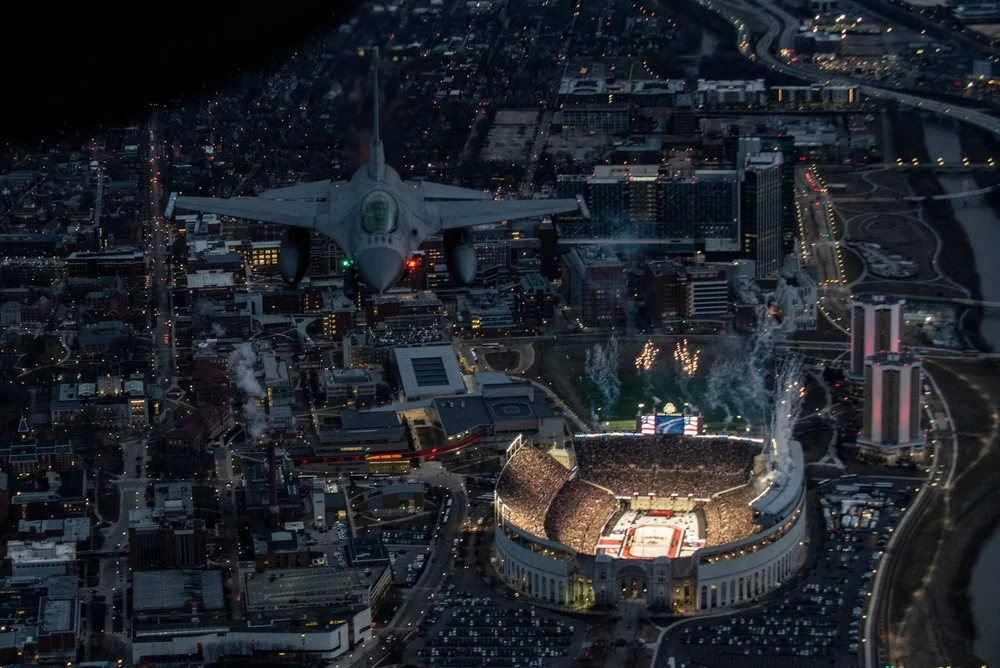
An aerial view explains scale, but it cannot promise the view from a ticketed seat. It does not reproduce a spectator’s eye level, another person standing in front, or the detail visible at the far end of the ice. Use it to understand where the rink sat within the stadium. For a future outdoor event, look for that event’s seating map and any available view from the actual section.
There is a practical tradeoff to consider. A photograph can make the full stadium feel like the main attraction; a fan trying to follow the puck may care more about angles and distance. Decide which experience matters most before comparing sections. Someone who wants the overall ceremony can have different priorities from someone who wants to study changes at the benches.
A familiar football section number is therefore a starting point for a question, not a complete answer. Ask how the temporary rink relates to it and whether the sales information describes any restriction. Do not assume that a seat remembered from football has an identical relationship to hockey action. That comparison depends on the particular event’s arrangement.
The cover photograph is a separate image from the same occasion, also by Tech. Sgt. Mikayla Gibbs / U.S. Air National Guard: DVIDS photo 8899370, public domain in the United States and converted to WebP. Neither photograph implies a military, university or NHL endorsement of this guide.
The Horseshoe’s usual identity is Ohio State football
The outdoor game’s novelty makes more sense alongside the stadium’s usual sporting identity. Ohio State’s stadium history identifies the venue with Buckeyes football and its horseshoe form. Its first game was against Ohio Wesleyan on October 7, 1922. The NHL event entered an established football home with a history extending far beyond that one night.
That context offers a different way to read the pictures. The unusual object is the rink within the familiar bowl. Return for football and the relationship reverses: the stadium is hosting the sport with which its name is normally associated. A visitor interested in architecture or sporting places can appreciate both experiences without treating them as interchangeable.
Following the Blue Jackets does not require supporting the Buckeyes. Nor does enjoying Ohio State football make a person a Columbus NHL fan. The clubs and university programs have separate competitions, schedules and communities. A shared city and a borrowed venue create a point of interest, not a requirement to transfer sporting loyalties.
For readers who want to explore the football side, College Football Schedule is part of our related schedule project. Its Ohio State team page provides another place to begin comparing dates. Confirm the opponent, home or away designation and announced kickoff against the university’s information before making a trip.
The home designation deserves particular attention. An Ohio State game on a calendar does not by itself mean that the team will be at Ohio Stadium. An away game takes the football team elsewhere; a neutral-site game requires its own location check. Start with the place you want to visit, then establish that the event you selected actually takes place there.
There is no need to use football capacity as a shortcut for the hockey experience. The 2025 NHL attendance is a historical event figure, while a football seating description serves a different purpose. Neither tells you which seats a future event will sell. The useful connection is a recognizable sporting home that temporarily accommodated another league.
Use the memory to choose your next event, not to reuse an old itinerary
A retrospective can inspire another visit without supplying the instructions for it. The March 2025 announcement contained gates, entertainment and ticket information for that specific Stadium Series game. Those details belong to a completed event. Saving that page as a memory is different from using it to decide when to arrive for a later football game.
Begin a new plan by naming the experience you want. To follow the NHL club, start with the Blue Jackets schedule. To compare upcoming hockey dates more broadly, use the current NHL week. The date list is a starting point; check the selected game’s venue rather than assuming that a Columbus home game returns to Ohio Stadium.
If the attraction is the Horseshoe itself, choose an event actually listed for that stadium. A football home date, a tour and another special event are different visits with different arrangements. Confirm the organizer, date and admission type for the experience you select. A photograph of a full stadium does not establish public access on a different day.
Once the event is clear, check its current official entry information, permitted items, accessible access and transport guidance. A rule remembered from an earlier hockey visit should be treated as a question to verify. The address may be familiar while the event’s operating plan is different. This is especially relevant when comparing a special outdoor showcase with a university home game.
Use the NHL calendar to organize hockey dates, then keep the football plan separately identified. Confirm local times before combining activities. Two events in the same city can still overlap, and a date without an announced start time cannot prove that both fit into one day.
A helpful final check is to read your plan as three separate lines: which team or event, at which venue, on which confirmed date and time. Then match the ticket to that exact event. The 2025 Stadium Series showed how striking hockey could look inside Ohio Stadium; it did not make the building a permanent replacement for the Blue Jackets’ regular home or turn every future visit into the same occasion.
Keep the event confirmation with your travel notes, too. It lets everyone in the group check the same location and time instead of relying on an old screenshot or a remembered stadium name.
Comments
Comments are reviewed before publication. Spam, abusive content and policy-violating links are not published.
Sign in with Google to leave a comment.
Loading comments...