Icing and offside use different lines and answer different questions
Icing concerns a long puck clearance across the center red line and the opponent's goal line. Offside concerns an attacking team's entry across the blue line. They can both stop play, but they examine different actions. For icing, follow where the puck was last played and where it travels. For offside, compare the puck and attacking skaters at the instant of zone entry.
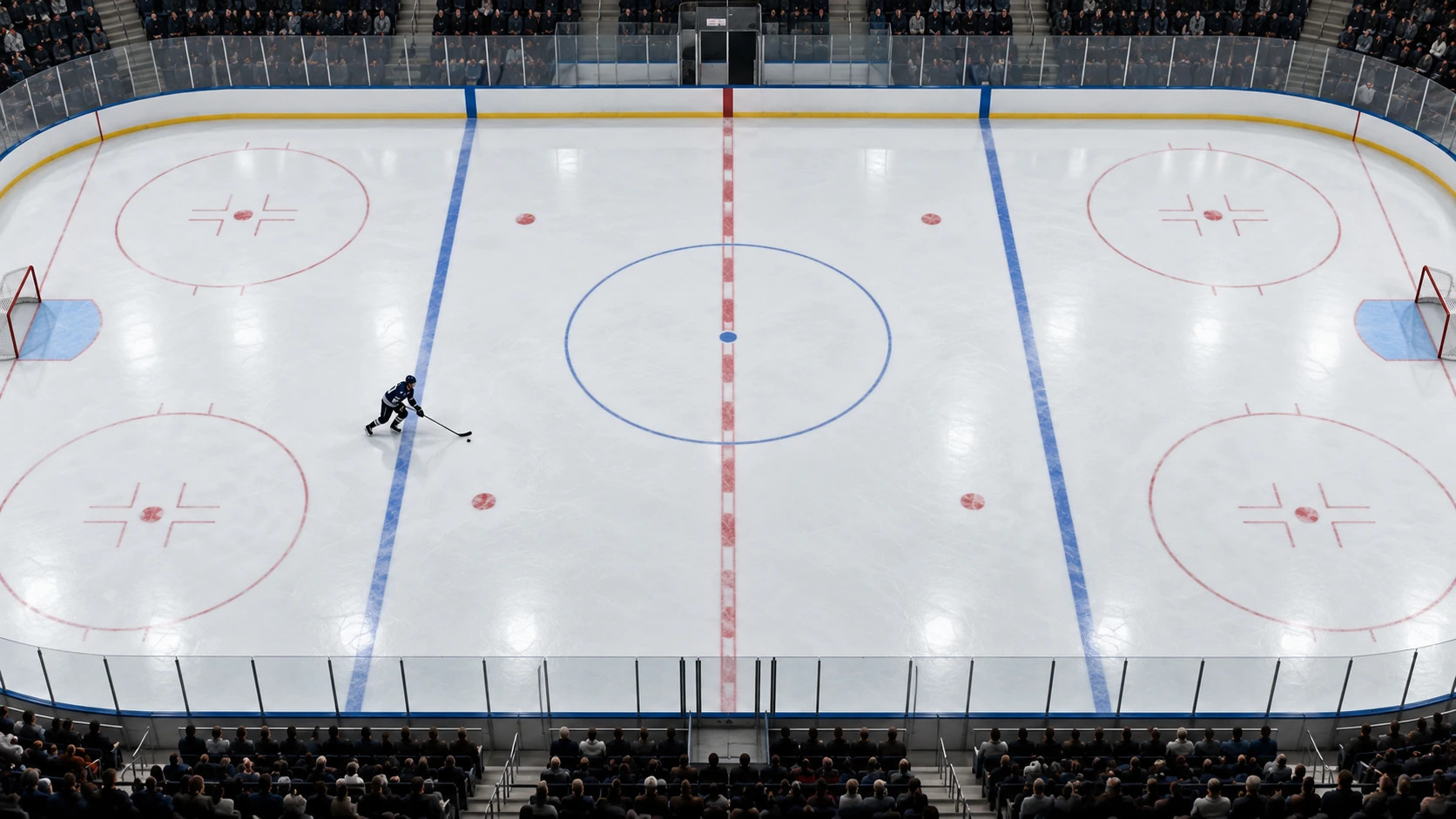
The rink has two blue lines, a center red line and a red goal line at each end. Rule 1.6 calls the area containing a team's own net its defending zone, the middle area its neutral zone, and the area around the opposing net its attacking zone. A team's attacking blue line is the boundary between the neutral zone and the end it is trying to enter.
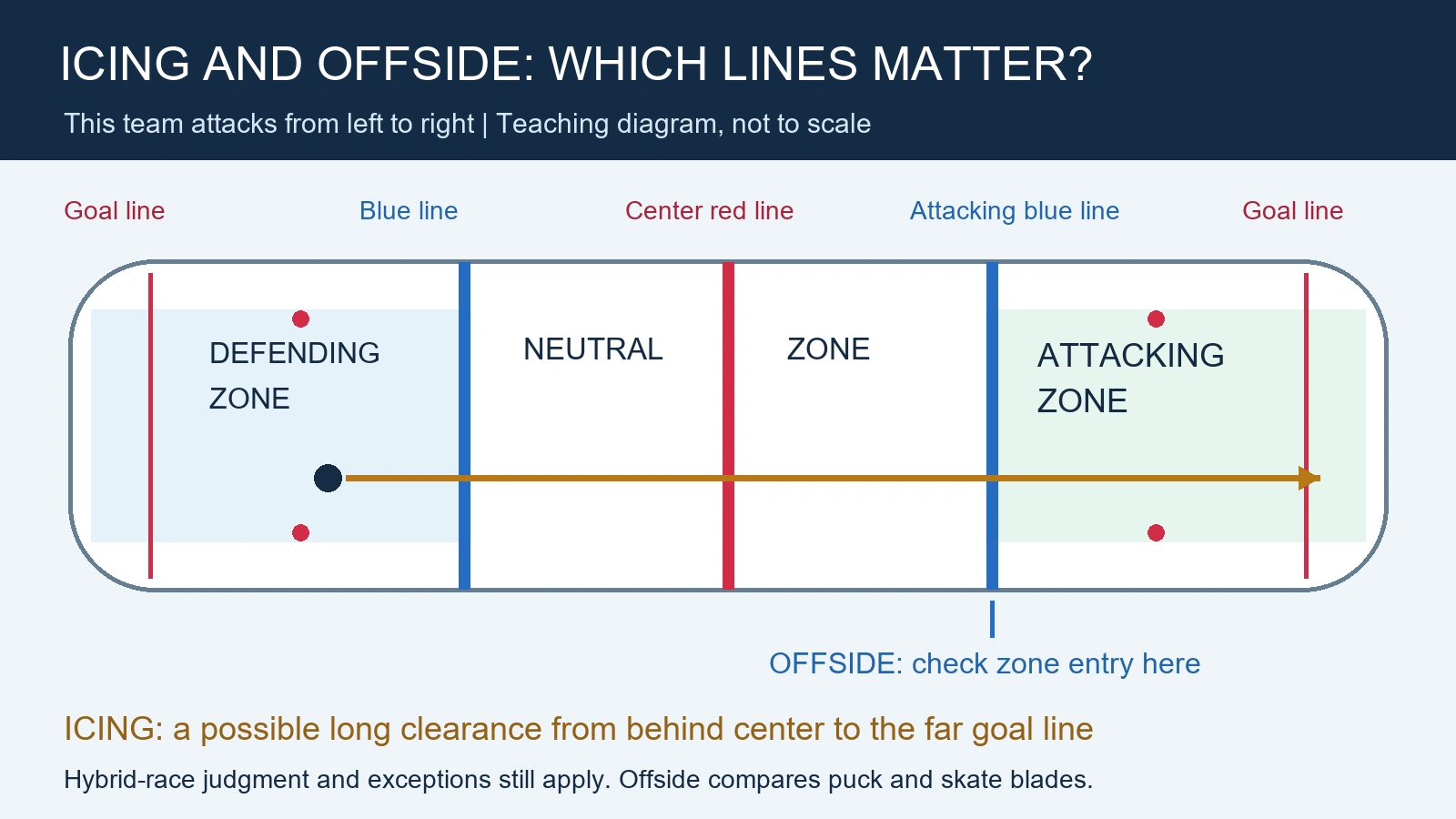
Those labels depend on which goal a team defends. When the teams change ends, the same painted end zone becomes the other club's attacking zone. The camera's left and right are therefore unreliable permanent labels. Locate your team's net first, then trace its movement toward the opposing net.
Consider two hypothetical plays. A defenseman sends an untouched puck from behind center ice past the far goal line. That can raise an icing question even if every teammate stayed behind the puck. On a different play, a winger enters the attacking zone ahead of a teammate's pass. That can raise an offside question even though the pass travels only a few feet. Distance alone does not determine offside, and an attacking skater's early blue-line arrival does not define icing.
The goal lines also explain a common visual confusion. Center ice is not the only place with a red line. For icing, officials connect the puck's starting half of the rink with the goal line at the opposite end. The blue line that the puck passes along the way is important for zone entry, but it is not the initial dividing line in the icing test.
Ordinary icing and offside are infractions that produce a stoppage, rather than automatically sending a skater to the penalty box. The whistle and ensuing faceoff are usually the immediate consequences. Other conduct during the same play may separately merit a penalty, but the words “icing” or “offside” do not themselves mean a two-minute minor.
If the player roles are unfamiliar, the hockey positions guide can help you identify the defenseman, winger and puck carrier. Any skater can be involved in these line-based decisions; the relevant action and timing matter more than the position printed on his roster entry.
When a long clearance becomes icing
Rule 81.1 starts with the center red line dividing the rink into halves. A team at equal or greater numerical strength can commit icing by shooting, batting or deflecting the puck from its own half beyond the opponent's goal line. Officials then apply the race judgment and exceptions rather than treating every long clearance as an automatic whistle.
The last point of contact by the team in possession determines whether it gained center ice. The rule looks at the puck on the player's stick making contact with the center red line, not the player's skates. A skater can be striding across center while the puck still trails behind him. Conversely, the puck can reach the line while his skates remain behind it. Watching the puck prevents the wrong starting-point judgment.
Hybrid icing is not a race to touch the end boards
The NHL uses hybrid icing. First, the linesperson judges whether the puck will cross the opposing goal line. Then the official judges which player would touch it first. The decision must be made no later than when the first pursuing player reaches the end-zone faceoff dots, using the player's skate position as the timing reference.
The important distinction is between the time of the decision and the object of the race. Reaching the dots first is not itself the sole test. The official is judging who would reach the puck first, which can depend on its route around the boards or back toward the faceoff dots. A defender and attacker approaching from different angles may have different paths to the same puck.
If the race is too close to decide by that checkpoint, Rule 81.1 directs the official to call icing. A tie does not automatically favor the attacking player. Nor must a defender win a high-speed race all the way to the wall and touch the puck to obtain the whistle. The NHL and NHLPA's implementation announcement described the change as a way to reduce injury risk on icing plays when it began in 2013-14.
Shorthanded teams and other icing exceptions
Under Rule 81.6, a team killing a penalty can send the puck down the rink without an icing violation while below its opponent's numerical strength. The power-play team does not receive that same exemption. In a normal five-on-four situation, the four-skater side may clear the puck this way; the five-skater side can still commit icing.
Timing matters when a penalty ends. If the clearing player's shot leaves his stick before the penalty expires, the icing exemption applies. A penalized player choosing to stay in the box after the time expires does not extend it. The rule also addresses an expired major when a team neglected to place someone in the box to return: continuing with fewer skaters for that reason does not permit icing. Being short of players visually is therefore not a substitute for checking the penalty status.
Rule 81.5 supplies other exceptions. Contact with an opposing player, including the player's stick or skates, can nullify icing. If an opposing skater could play the puck before it passes his goal line but chooses not to, the official can wave icing off. A puck sent directly down the ice from a faceoff is also excluded. A deflection off an official, however, does not automatically cancel potential icing.
The goalie's actions have a separate role under Rule 81.3. Attempting to play the puck, pretending to play it, or skating toward it can cancel icing. Merely being out of the crease is not enough in every situation: a goalie legitimately heading to the bench for an extra attacker without attempting to play the puck does not erase the call on that basis.
A puck that enters the opposing net legally is a goal rather than icing, including a possible long empty-net shot. That does not excuse other violations on the play. It explains why two apparently similar long clearances can have different outcomes: one misses the net and meets the icing conditions, while another produces a valid goal.
How the NHL decides an offside entry
Rule 83.1 requires attacking players to remain onside when the puck enters the attacking zone. The basic comparison is between the puck and the player's skate blades at the attacking blue line. An NHL official is not comparing the attacker with the last defending skater, as a soccer fan might expect. The painted boundary supplies the reference.
The current NHL rulebook makes the test more precise than simply saying “the player went in first.” A player's torso, stick and skate blades can reach different places at the same instant. The rule specifies which parts matter and a separate exception for the player controlling the puck.
The puck and skate blades at the blue line
A player is offside when both skate blades are completely across the relevant leading edge of the blue line before the puck completely crosses it. One blade still in contact with the line, or on its own side of the line, can keep the player onside at the instant of puck entry. A stick stretched backward does not perform the same function.
The NHL extends the blue-line boundary upward as a vertical plane. A trailing blade can be above the ice and still remain onside if it has not completely crossed that plane before the puck enters. It does not have to drag along the surface. This is why a freeze-frame showing an airborne skate is not, by itself, proof of offside.
For a hypothetical example, imagine a winger with his leading blade inside the attacking zone while the trailing blade remains above the blue line. If the puck completely enters at that instant and the trailing blade still satisfies the plane test, his early upper-body movement does not make him offside. If both blades have already crossed completely before puck entry, the same upper-body position would accompany an offside entry instead.
The puck must also complete its crossing. Its front edge reaching the attacking zone is not the same as the entire puck entering. On a close play, that distinction and the trailing blade's position must be assessed at the same instant. Watching only the fastest-moving player's shoulders can miss both parts of the test.
The puck carrier has a specific control exception
Rule 83.1 permits a player controlling the puck to cross ahead of it under specific conditions. He must have possession and control with his stick before his trailing skate completely crosses the blue line's leading edge. He must then maintain possession and control with his stick immediately after the puck enters the attacking zone.
That can allow a controlled backward entry in which the player's skates precede the puck. The exception depends on the stated control sequence, rather than on skating backward alone. A player who has already crossed with both blades and only then receives a teammate's pass cannot use the same explanation to make his earlier entry legal.
This distinction separates the puck carrier from a winger waiting for a pass. Control of the puck before the relevant skate crossing and immediately after puck entry must actually exist. Calling every attacker ahead of the puck offside would miss the exception, while calling every backward entry legal would remove its conditions. Neither shortcut gives the full NHL rule.
Delayed offside lets attackers clear the zone
A player ahead of the puck does not always produce an immediate whistle. Rule 83.3 permits delayed offside when the defending team can bring the puck out without delay or contact from an attacker, or when the attacking players are clearing the zone. The linesperson raises an arm to signal that the attacking team must resolve the offside before pursuing the play.
The attacking team can clear the delayed violation by having all its players clear the zone at the same instant, with skate contact at the blue line. Once the official lowers the arm, they may re-enter and pursue the puck. It is not enough for the nearest forward to tag up while another teammate remains inside. Nor can a forward leave, return early and assume a different teammate's later tag-up completes the process.
This is a different question from the airborne-blade entry test. For clearing a delayed offside, Rule 83.3 specifically describes skate contact with the blue line. The NHL's April 2024 Jarvis ruling confirmed a legal tag-up with skate contact before the subsequent attacking puck touch.
While the delayed signal remains, an attacker cannot touch the puck, attempt to gain possession of a loose puck, force the defending puck carrier farther back, or move toward physical contact with that carrier. Those actions cause the offside whistle. A player cannot chase aggressively and then offer to clear the zone afterward.
The defending team can also end the delayed situation by passing or carrying the puck into the neutral zone. Separately, Rule 83.1 allows play to continue when a defending player legally carries, passes or plays the puck back into his own zone despite opponents already being there. That defender-created return is different from the attacking team sending the puck into an occupied attacking zone.
There is an important goal exception to the normal tag-up opportunity. Under Rule 83.4, if an attacking shot creates a delayed offside and that original shot then enters the net, it is disallowed even if the attackers cleared the zone before the puck arrived. A deflection off the goalie, a player or the boards does not cure that original offside shot. The rule separately permits a goal if the defending team puts the puck into its own net without action or contact by the offending team.
A long pass is not prohibited merely because it crosses a blue line and the center red line. The current NHL entry question still concerns the attacking blue line and the applicable puck, skate and control conditions. Calling every pass across two lines illegal confuses a different rule description with the NHL game being played now.
What changes after the whistle or an offside goal review?
The restart helps distinguish the calls, but a shortcut such as “every offside faceoff is beside the blue line” misses important situations. The officials consider how the infraction occurred, where the puck was played and whether the offside was intentional. Icing also places a separate restriction on the offending team's substitutions.
Faceoff locations and the icing line-change restriction
Following icing, Rule 81.2 lets the opposing team choose which end-zone faceoff dot will be used in the icing team's defending zone. The puck comes back toward the team that cleared it, rather than remaining at the far end where it traveled. That gives the opponent another attacking-zone faceoff.
Under Rule 81.4, the icing team normally cannot substitute players before that faceoff. The rule permits specific changes to restore a goalie who had been replaced by an extra attacker, replace an injured player, or respond to a penalty that changes either team's on-ice strength. The relevant players are determined when the puck leaves the offending player's stick. “No changes, ever” is therefore too absolute, but a tired line cannot ordinarily exchange all its skaters just because the whistle stopped play.
Rule 87.1 also prevents the defending team from taking a timeout after icing. That combination explains the practical cost of a desperate clearance: the same players may have to defend another faceoff without obtaining either a normal line change or their own timeout. The rule does not say that both teams lose every timeout option at such a stoppage.
For offside, Rule 83.6 places a carried-puck entry faceoff outside the attacking blue line. A shot or pass can instead move the faceoff to the appropriate spot in the zone where it originated, giving the offending team the least territorial advantage. Intentional offside under Rule 83.7 moves the faceoff into the offending team's defending zone. An ordinary offside stoppage also does not impose the particular icing substitution restriction.
A missed offside can erase a goal
If an illegal entry is missed and a goal follows, Rule 38 provides an offside review procedure. The key limitation in Rule 38.9 is continuity: the puck must not have left the attacking zone between the offside entry and the goal. Officials cannot reach back to an earlier entry after the puck exited and a new attacking sequence began.
Detroit's October 10, 2026, game at Montreal provides a recent example. Alexandre Texier appeared to score the overtime winner, but the official NHL review found that Zachary Bolduc entered the attacking zone ahead of the puck. Texier's goal was disallowed. The game continued, and Montreal eventually won 1-0 in a shootout.
That review was initiated by the Situation Room. Rule 38.3 gives it responsibility for reviewing scenarios otherwise available through a coach's challenge in the final minute of the third period and at any point in overtime. Calling that particular overtime review a Detroit coach's challenge would misidentify who initiated it.
When watching today's NHL games, follow the attacking blue-line entry before interpreting an offside review. For a longer clearance, follow the puck from its last contact near center ice to the far goal line, then consider the race and exceptions. The weekly NHL schedule gives you more opportunities to recognize the two calls: icing concerns the clearance and restart, while offside concerns whether the attacking zone was entered legally.
Comments
Comments are reviewed before publication. Spam, abusive content and policy-violating links are not published.
Sign in with Google to leave a comment.
Loading comments...