
NHL Playoff Format History at a Glance
The NHL playoff format did not evolve in one straight line. It began as a short league championship that sent an NHL representative into an interleague Stanley Cup competition. It later became a stable four-team tournament, expanded through several experimental brackets, shifted from leaguewide seeding to division paths and conference reseeding, and finally settled on today's wild-card system.
| Season | Structural milestone | Why it matters |
|---|---|---|
| 1917-18 | Split-season winners played a two-game, total-goals NHL championship | The NHL champion still advanced to face another league's champion for the Cup |
| 1938-39 | One seven-team league; Stanley Cup Final became best-of-seven | Established the Final length used today |
| 1942-43 | Top four of the Original Six qualified | Created a stable two-round, best-of-seven tournament |
| 1967-68 | Expansion doubled the league and sent eight teams | Added a third playoff round |
| 1979-80 | Field expanded to 16 and teams were ranked leaguewide | Set the modern field size |
| 1981-82 | First two rounds became division-based | Made division rivals the main route to a conference title |
| 1986-87 | Opening round changed to best-of-seven | Every round now required four wins |
| 1993-94 | Conference 1-vs-8 seeding and reseeding arrived | Regular-season conference rank shaped later opponents |
| 2013-14 | Top-three division berths plus conference wild cards | Introduced today's fixed, division-based lanes |
| 2021-22 | Current system returned after two pandemic exceptions | Restored the 2013-14 model |
Across those changes, three questions kept reappearing: how many teams should qualify, whether geography or overall record should shape the bracket, and how long each series should be. The sections below follow those choices era by era rather than reproducing every annual variation.
1917-1942: Split Seasons, Total Goals and a Changing Stanley Cup
The NHL's first postseason did not crown the Stanley Cup champion by itself. In 1917-18, the regular season was split into two halves. Each half produced a winner, and those clubs met in a two-game, total-goals series for the NHL championship. The combined score across both games decided which team advanced to face the Pacific Coast Hockey Association champion in a best-of-five Stanley Cup Final.
A total-goals series was fundamentally different from today's best-of-seven. Winning one game did not count as one unit toward four victories; goals carried from one game into the aggregate. A team could lose the first game and still advance by overcoming the goal deficit in the second. The two-game structure also shows why “the original NHL playoff bracket” is not one permanent design.
The path shifted as western leagues entered, merged and disappeared. Some seasons sent the NHL champion through a Stanley Cup Semifinal involving champions from the PCHA and Western Canada Hockey League. After the 1925-26 season, the NHL was the only major professional league left and took sole control of the competition. Beginning in 1926-27, NHL clubs competed exclusively for the Cup, while Canadian and American divisions shaped their route.
Even then, the league mixed formats. Preliminary and divisional rounds could use two-game total goals, while the Final used a best-of-five. In 1938-39, the reduced seven-team league returned to a single table. Six teams qualified through a bracket that combined best-of-three and best-of-seven series, and the Stanley Cup Final became best-of-seven. The opening decades therefore established two long-term ideas—the regular season earned playoff position, and a series determined advancement—while repeatedly changing how those ideas were executed.
1942-1967: The Original Six Created a Stable Four-Team Tournament
When the NHL was reduced to six clubs in 1942-43, its postseason became remarkably simple. The top four regular-season finishers qualified, while the bottom two were eliminated. Two best-of-seven Semifinals produced the finalists, and another best-of-seven series decided the Stanley Cup.
The pairing was not the modern high-seed-versus-low-seed arrangement. First place played third, while second played fourth. That detail matters when comparing eras: a historical No. 1 seed did not automatically draw the last qualifier. There was also no wild-card race, conference crossover or second-round reseeding to calculate. With one standings table and only two playoff rounds, the route was visible as soon as the four qualifiers were known.
This structure remained in place through the 1966-67 season and gave the Original Six era a consistency missing from the league's first quarter-century. Four of six teams—two-thirds of the league—made the postseason, yet the small league still made a berth relatively selective in absolute terms. An official NHL retrospective notes that a fourth-place team won the Cup only once during the 25-season era.
The lasting contribution was not the exact 1-vs-3 pairing. It was the normalization of best-of-seven series in every round then played. A champion had to win eight games across two series, compared with today's 16 wins across four. When the league doubled in size in 1967, it kept best-of-seven play but needed a larger bracket and an additional round. Stability ended because expansion changed the basic math.
1967-1981: Expansion Forced Larger and More Experimental Brackets
The 1967 expansion doubled the NHL from six to 12 teams and ended the two-round model. The new East and West divisions each sent four clubs. Opening matchups stayed within a division, divisional winners advanced toward each other, and a third best-of-seven round was added before the Stanley Cup was awarded. Later adjustments crossed paths between divisions and, by 1971-72, used the more familiar 1-vs-4 and 2-vs-3 opening pairings.
Further expansion made the bracket less tidy. In 1974-75, an 18-team league sent 12 teams to the postseason. The four division winners received byes, while second- and third-place teams were pooled by regular-season record into a best-of-three Preliminary Round. Those winners joined the division champions in an eight-team Quarterfinal field, which was ranked again. The survivors were ranked again for the Semifinals. In other words, later opponents were not locked into fixed lanes on opening night.
The 1977-78 revision provided a recognizable ancestor of the wild card. The Preliminary Round included the four division runners-up plus the next four clubs by overall record, regardless of division position. It was not today's two-wild-card-per-conference system, but it demonstrated the same tension: reward divisional success while leaving space for strong teams outside the automatic places.
The most radical experiment arrived in 1979-80 after four former WHA clubs joined the NHL. Sixteen teams qualified. Four division winners had guaranteed berths, the next 12 entered by record, and then all 16 were pooled leaguewide from No. 1 to No. 16. The opening best-of-five round paired 1-vs-16, 2-vs-15 and so on. Winners were reseeded by regular-season record in subsequent rounds.
That national, record-first design lasted only two seasons. It minimized geography and could produce long-distance matchups immediately. The next change swung the other way, making divisions—not one leaguewide ranking—the organizing principle of the road to the Cup.
1981-1993: Division Rivalries Defined the Road to the Cup
For 1981-82, the NHL replaced leaguewide seeding with a route built around its four divisions. The first four teams in each division qualified. First played fourth and second played third in a Division Semifinal, then those winners met for the division title. Only after surviving two rounds inside that lane could a club play the other division winner from its conference.
This format made geography structurally important. A team could not be reassigned to whichever conference opponent had the lowest remaining seed after Round 1. It had to clear its own division first. Because the same contenders could qualify from the same group season after season, repeated early-round matchups became a feature of the system. The bracket did not merely preserve rivalries; it created more opportunities for them.
Series length was the remaining exception to modern expectations. From 1981-82 through 1985-86, the Division Semifinals were best-of-five, so three wins advanced a team. Division Finals, Conference Finals and the Stanley Cup Final were best-of-seven. In 1986-87, the opening round also became best-of-seven. Under the standard four-round format used from that season forward, the champion needed four series victories and 16 game wins—the workload associated with today's playoff run.
The division-first era rewarded finishing high within a local group, but it did not guarantee that the conference's strongest surviving record would always meet its weakest. Bracket position, not a fresh conference ranking after each round, controlled the next opponent. By the early 1990s, the league chose a different balance: divisions would still receive seeding value, but all eight teams in each conference would be ordered into a conference bracket and reseeded after upsets.
1993-2013: Conference Seeding and Reseeding Took Over
The 1993-94 realignment replaced the division-first road with an eight-team bracket in each conference. Division winners received the top two seeds, and the other six qualifiers were ordered by regular-season points. Opening pairings followed 1-vs-8, 2-vs-7, 3-vs-6 and 4-vs-5. A team could now meet any qualifier in its conference immediately, rather than first having to escape a four-team division group.
Reseeding meant the next round was not fully fixed in advance. After the first round, the highest surviving seed drew the lowest surviving seed, and the other two met. An upset therefore changed more than one winner's path: it could redraw the next opponents for every remaining team in that conference.
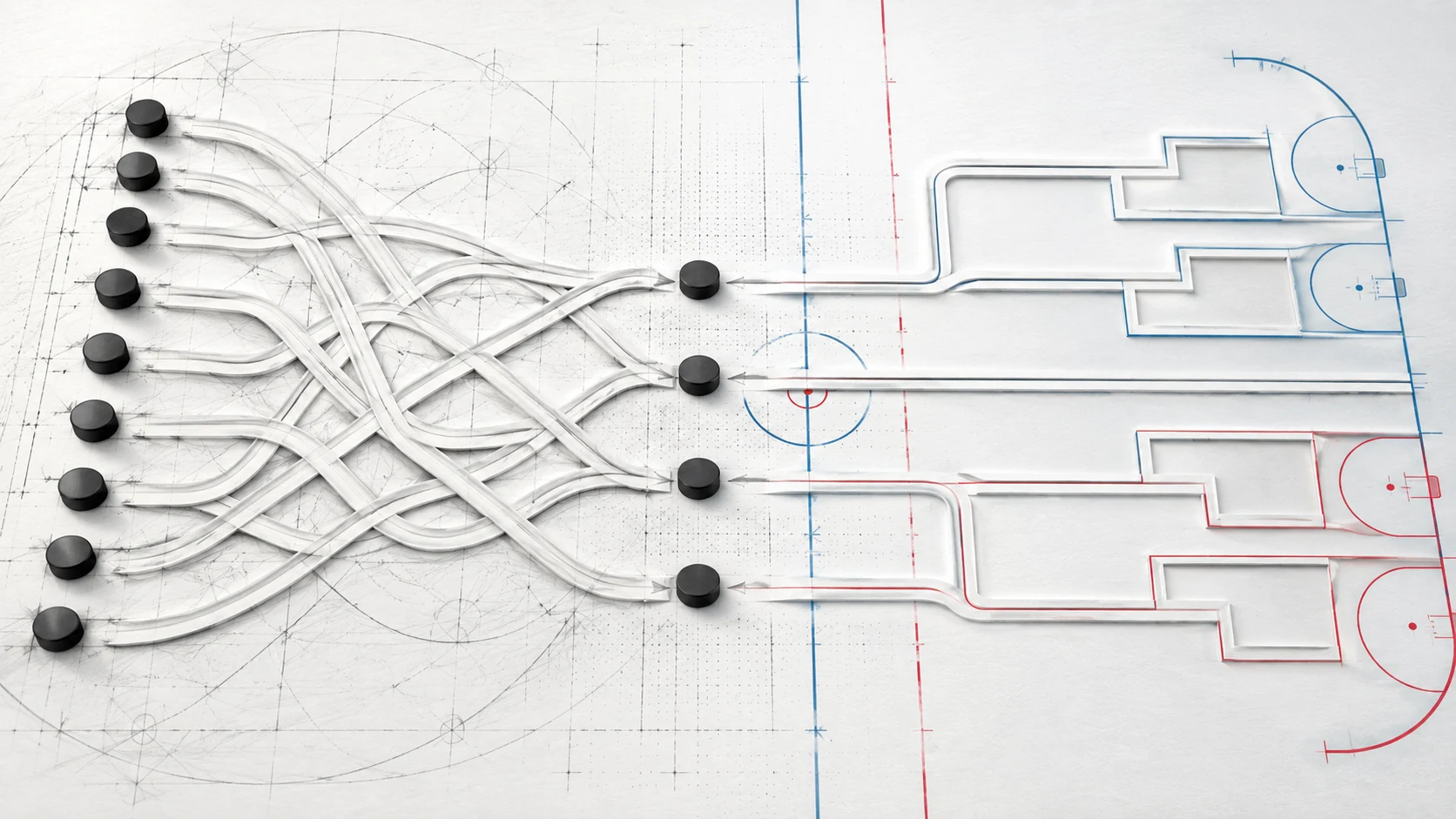
When league expansion produced three divisions per conference in 1998-99, all three division winners were seeded first through third, while the five next-best teams filled seeds four through eight. The first-round pairings and later reseeding principle remained. That system continued through 2012-13, although league pauses meant not every calendar season produced a tournament.
Did the NHL playoffs ever use a 2-3-2 format?
Yes, but only as a limited travel exception—not the universal NHL pattern. In 1993-94, series between Central and Pacific Division teams used 2-3-2. The team with more points could choose whether to begin at home or on the road. In 1994-95, the better-record team in those cross-division series could choose between 2-3-2 and 2-2-1-1-1 and, if it selected 2-3-2, which block of home games it preferred.
The Stanley Cup Final stayed 2-2-1-1-1. That distinction corrects a common memory borrowed from other sports: the NHL experimented with three consecutive games in one city for some western conference matchups, but it did not make 2-3-2 the leaguewide championship-series standard.
2013 to Today: Wild Cards and a Fixed Division-Based Bracket
The 2013-14 realignment restored divisions to the center of the playoff design without simply reviving the 1980s model. The league kept a 16-team field—eight per conference—but divided qualification into two paths. The top three finishers in each of four divisions earned 12 places. The next two teams in each conference, regardless of division, became wild cards.
Wild-card ranking determines which division-winner lane each team enters. The division winner with the better conference record plays the lower wild card, WC2. The other division winner plays WC1. Second and third in each division meet in the remaining opening series. One division can therefore contribute five teams while the other sends three.
The decisive change from the preceding era is what happens next. First-round winners remain in their original division-based lane and meet in Round 2; the conference is not reseeded. An upset does not cause the highest remaining seed to draw the lowest. Fans can trace two potential opponents from the start, while the structure increases the chance that divisional teams meet during the opening two rounds.
The current system still uses four best-of-seven rounds and the 2-2-1-1-1 host pattern. Regular-season placement determines home ice through the first two rounds, while better regular-season record controls it in the Conference Finals and Stanley Cup Final. Those operational details belong in our current NHL playoff format guide; the historical point is the trade: the NHL moved from conference-wide reseeding to predictable division-centered paths while retaining conference wild cards.
This design began in 2013-14, paused for two exceptional seasons, and returned in 2021-22. Treating the pause as a permanent overhaul would distort the timeline, so the next section isolates those temporary formats.
2020 and 2021: Temporary Pandemic-Era Exceptions
The league paused the 2019-20 regular season in March 2020 and later ended it with 189 scheduled games unplayed. Because clubs had completed different numbers of games, points percentage determined the top 12 participants in each conference. The resulting return-to-play competition involved 24 teams rather than the customary 16.
The top four teams in each conference played a round robin to set their seeds. Seeds 5 through 12 entered best-of-five Qualifying Round series—5-vs-12, 6-vs-11, 7-vs-10 and 8-vs-9—to determine who reached the official First Round. From there, each round was best-of-seven, and the highest remaining conference seed met the lowest. Games took place in Toronto and Edmonton hubs before the final two rounds shifted entirely to Edmonton. “Home team” described game designation, not a normal home arena advantage.
The 2020-21 season produced a different one-year structure. Four temporarily realigned divisions each sent their top four clubs. No. 1 played No. 4 and No. 2 played No. 3, and the winners met inside the division in Round 2. The four division survivors then left those lanes and were seeded by regular-season points: 1-vs-4 and 2-vs-3 in the Stanley Cup Semifinals. All four rounds were best-of-seven.
These seasons should be recorded as two separate exceptions, not one new era. The 2020 event expanded the entry field and added qualifiers; the 2021 event kept 16 playoff teams but reorganized divisions and the semifinal stage. In 2021-22, the NHL explicitly returned to the format used from 2013-14 through 2018-19. That return is why today's history line runs from the 2013 wild-card change through the present, with a two-season interruption in the middle.
What Changed Most—and What Stayed the Same
The biggest changes were not cosmetic names for rounds. They altered who qualified and whether a team could know its later route before the first puck dropped.
- Field size: the tournament grew from a tiny league championship to four Original Six qualifiers, eight after 1967 expansion and 16 in 1979-80. Sixteen has remained the normal playoff field, with the 24-team 2020 return-to-play competition as the exception.
- Geography versus record: some formats kept early rounds inside divisions; others ranked teams across the whole league or conference. Today's system combines guaranteed division places with conference wild cards.
- Fixed paths versus reseeding: a fixed bracket lets teams see their two-round lane. Reseeding waits for results, then pairs the highest survivor with the lowest. The NHL has used both approaches more than once.
- Series length: early hockey mixed total-goals, best-of-three, best-of-five and best-of-seven contests. Since 1986-87, the normal Stanley Cup Playoffs have required four best-of-seven series.
- Host order: 2-2-1-1-1 became the enduring best-of-seven pattern, while 2-3-2 was a limited 1990s western travel exception.
What stayed constant was the value of regular-season position. Even when the reward changed—from qualification or a bye to an easier nominal seed, home ice or a particular bracket lane—the league used the regular season to sort postseason access. The Stanley Cup also remained the endpoint as the field and route around it changed.
Fans planning the current postseason should treat history as context, not a schedule. Use the current NHL schedule for confirmed dates and the NHL calendar tools for game reminders. Those live resources answer when a team plays; this timeline explains why its path has the shape it does.
NHL Playoff Format History FAQ
When did the Stanley Cup Final become best-of-seven?
The best-of-seven Stanley Cup Final began in the 1938-39 season, commonly described by the calendar year 1939. Four wins were required to secure the championship. Earlier Finals used several structures, including best-of-three and best-of-five.
When did every NHL playoff round become best-of-seven?
Every round adopted best-of-seven in 1986-87. Before then, the Division Semifinals were best-of-five even though the three later rounds were best-of-seven. This is why 1987 is the clean dividing line for today's four-round, 16-win championship path.
When did 16 teams become the normal playoff field?
The NHL expanded to 16 playoff teams in 1979-80. The selection and seeding systems changed afterward, but the normal field size stayed at 16. The 24-team 2020 return-to-play competition was a special exception.
Did the NHL ever use 2-3-2?
Yes. Certain Central-versus-Pacific series used 2-3-2 beginning in 1993-94 to reduce travel, and the following season gave the better-record club a format choice in those matchups. The Stanley Cup Final remained 2-2-1-1-1, so 2-3-2 was never the universal NHL playoff arrangement.
When did the current wild-card format begin?
The division-plus-wild-card format began in 2013-14. It was used through 2018-19, paused for the two pandemic-adjusted seasons, and returned in 2021-22. The fixed lanes visible in the completed 2026 NHL playoff bracket are an example of that modern design, not a separate historical system.
Did the NHL always reseed teams?
No. Some eras used reseeding and some fixed the next matchup. The 1993-2013 conference model reseeded survivors; the modern wild-card bracket keeps first-round winners in preset second-round lanes. The printable 2026 bracket archive makes those fixed lanes easy to see without turning this history article into another year-specific results page.
Comments
Comments are reviewed before publication. Spam, abusive content and policy-violating links are not published.
Sign in with Google to leave a comment.
Loading comments...