
What the NHL nine-game trial actually means
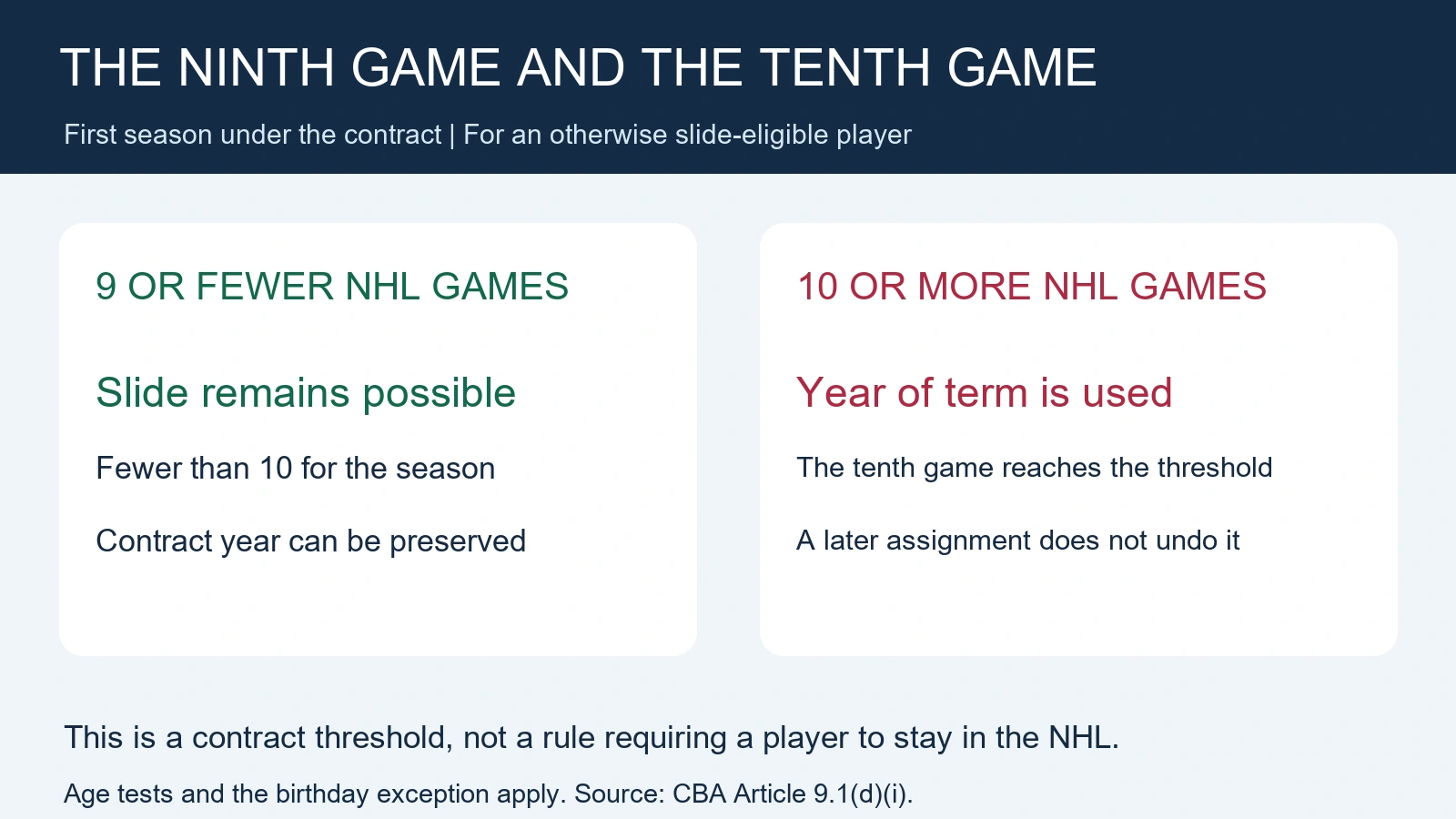
For a slide-eligible young player, nine NHL appearances can leave a contract year available to be preserved; the tenth appearance reaches the threshold that prevents that slide. The familiar “nine-game rule” is shorthand for a contract provision. It is not a rule that every rookie must leave the NHL after nine games, or that a player who reaches ten can never be assigned elsewhere.
The controlling provision is Article 9.1(d)(i) of the NHL-NHLPA collective bargaining agreement. It addresses an eligible 18- or 19-year-old who signs a standard player contract, or SPC, and does not play at least ten NHL games in the first season under that contract. The provision extends the contract term and the time in the entry-level system by one year. Its age conditions and birthday exception are essential; “rookie” alone does not establish eligibility.
The NHLPA's official CBA documents must be read together for 2026-27. The 2025 memorandum adopts the earlier agreement as amended in 2020, with its listed changes, and establishes a term beginning September 16, 2026. Its deletion of Article 9.1(c), concerning the former entry-level requirement for certain European players aged 25 to 27, is a different change. It does not remove Article 9.1(d)'s young-player slide provision.
Think of the tenth game as a decision about using a year of the contract's term. A team can value the player's NHL contribution enough to use that year. It can also decide that development elsewhere is preferable. Once the counted appearances reach ten, a later assignment does not turn that season back into one with fewer than ten NHL games.
The decision is based on the player's appearances, rather than the club's position on the calendar. A team may have played several games while the prospect was scratched, injured or assigned elsewhere. That does not mean the player has reached his own tenth appearance. Nor does scoring ten points, receiving a tenth shift or spending ten days on the roster satisfy the games-played threshold.
The contract also exists before the threshold is reached. The player has already signed an SPC, and some contractual payments can still matter in a slide season. Saying the contract “does not exist until game ten” confuses a signed agreement with whether a year of its term is used. For a fan following a prospect on today's NHL slate, the useful questions are whether he qualifies to slide and how many counted NHL games he has actually played.
Which young players can have an entry-level contract slide?
The ordinary slide provision is narrower than the entire entry-level system. Article 9.1(b) gives a first-contract signing age of 18 through 21 a three-year entry-level term, ages 22 and 23 a two-year term, and age 24 a one-year term. Article 9.1(d)'s young-player slide does not therefore apply to everyone who receives an entry-level contract. A 20-year-old can have a three-year ELC without qualifying for the same nine-game treatment as an eligible 18-year-old.
The age test, birthday exception and possible second extension need separate checks. A player's draft position, current points total or description as a “rookie” does not replace them. The relevant provisions are Articles 9.1 and 9.2 in the underlying agreement, read with the current amendments.
Signing age is measured on September 15
Article 9.2 defines age for this article as the player's age on September 15 of the calendar year in which he signs the SPC. It expressly applies regardless of his actual age on the day he signs. A broadcast's current age label can therefore differ from the signing age used in the contract provision.
For a hypothetical example, a player is 18 on September 15, 2026, turns 19 later that autumn, and signs his first SPC after that birthday. His Article 9 signing age is still 18. The example does not certify any real player's contract; it shows why the September checkpoint and the signing calendar year must be identified before counting his NHL appearances.
Being drafted at 18 is not enough either. If a player waits until a later calendar year to sign, the relevant September 15 age belongs to that later year. The rule asks about the signing year, rather than automatically freezing every prospect at his draft-day age.
The nineteen-year-old who turns twenty that year
Article 9.1(d)(i) excludes a particular group: players treated as 19 under Article 9.2 who turn 20 between September 16 and December 31 of the year they first sign the SPC. Their contracts do not receive this automatic extension merely because they play fewer than ten NHL games.
Imagine a player who is 19 on September 15, 2026, signs that year and turns 20 on November 1. He fits the exception. Compare a player who is 19 at the same September checkpoint but does not turn 20 until January 2027. That birthday falls outside the stated September-to-December window. The two players' similar ages on opening night do not make their slide treatment identical.
An eighteen-year-old can have a second slide
Article 9.1(d)(ii) provides a further extension when a player signed his first SPC at age 18, received the first extension, and then again plays fewer than ten NHL games in the second season under that SPC. The provision adds one further year to the contract term and entry-level period.
The conditions are cumulative: signing at 18, obtaining the initial slide and remaining below ten in the applicable second season all matter. A player who first signs at 19 does not receive that specific second-extension route simply because he later spends another season outside the NHL. Nor is the rule an unlimited opportunity to preserve a contract year every season.
The appearance threshold is applied to the relevant season, rather than combining two qualifying seasons into one total. Hypothetically, nine appearances in the first season and nine in the second could satisfy both below-ten tests for an otherwise qualifying age-18 signing. That is not the same situation as eighteen appearances in a single season.
Which games count toward the ten-game threshold?
Article 9.1(d) uses the defined term “NHL Games.” Article 1 defines it as regular-season games and playoff games. The threshold is therefore not limited to the regular-season column in a statistics table. It also does not count every game a prospect plays anywhere in the hockey system.
That distinction matters at both ends of the season. Preseason exhibitions are not regular-season or Stanley Cup Playoff games. AHL and junior appearances are not NHL games either. They can be important development opportunities, but they are not added to this particular ten-game NHL threshold merely because the player is under an NHL contract.
NHL playoff appearances can use up the remaining games
Consider an otherwise eligible player with eight NHL regular-season appearances in a season. If he then plays two Stanley Cup Playoff games that same season, the combined total reaches ten. His contract does not retain the ordinary below-ten slide simply because the regular-season total remained eight. Likewise, nine regular-season appearances followed by one NHL playoff appearance reach the threshold.
These are hypothetical examples of the agreement's definition, rather than predictions about a current prospect. Compare nine NHL appearances followed by an AHL playoff game: the minor-league game does not become a tenth NHL appearance. The word “playoff” alone does not determine the counting; which league conducted the game matters.
The 2020 memorandum also contains an explicit example in which a tenth appearance during the qualifying or subsequent playoff rounds prevents a slide. That document had special prorated rules for certain players in the disrupted 2019-20 season. Those dated exceptions should not be turned into a different normal threshold for 2026-27. The current ordinary provision remains the ten-game test discussed here.
A scratch is different from a game appearance
A skater who travels with the team but is a healthy scratch has not made an appearance simply because his club played that night. If he plays seven games and is scratched for three others, the club's ten-game sequence does not become ten appearances for him. Similarly, days on the roster or injured list are not a replacement for the relevant games-played count.
The public game log should be checked for the player, the season and the type of competition. A regular-season total alone can be incomplete once the playoffs begin, while a career total can combine seasons that the slide provision examines separately. Preseason and minor-league rows can also appear beside NHL rows in a broad prospect profile.
The weekly NHL schedule helps identify the club's upcoming games, but it cannot certify that a particular player will dress or play. The next scheduled matchup may become his tenth counted appearance, or he may remain out of the lineup. Keep the player's participation record separate from the team's calendar.
What slides, and what happens to signing bonuses?
The main thing that moves is the contract term. Article 9.1(d) extends both the standard player contract and the number of years the player remains in the entry-level system. A slide therefore preserves a year of the player's first contract instead of using it during a season with fewer than ten NHL games. The player does not need to sign a replacement contract for that extension to happen.
The provision also specifies how the contract's terms extend. Its general language includes Paragraph 1 salary, games-played bonuses and Exhibit 5 bonuses, with signing bonuses expressly excepted. The player and club can expressly agree otherwise for the terms covered by that qualification, but Paragraph 1 salary must extend in all circumstances. Those details matter because “everything moves back one year” is too broad a description of the actual agreement.
In particular, a slide does not automatically create another signing-bonus installment, nor does it make an existing signing bonus disappear. The Flyers' July 2024 Luchanko explainer confirms that scheduled signing-bonus installments remained payable despite a deferred contract year. The amount and payment schedule belong to the player's contract; the ten-game test determines whether the contract term can slide. Keeping those questions separate avoids treating a prospect's signing payment as proof that he has already used a year of NHL contract service.
A delayed contract year is not another playing season
Consider a hypothetical eligible player whose three-year entry-level term would ordinarily run from 2026-27 through 2028-29. If his first season qualifies for a slide, the three-year term instead runs from 2027-28 through 2029-30, assuming no further extension applies. Three contract years remain; the extension has moved their timing. It has not required him to play four full NHL seasons under a three-year deal.
That player might still spend 2026-27 playing a substantial development schedule outside the NHL. His hockey season is real, even though the entry-level term has been deferred. Conversely, a short stretch of NHL appearances can use the contract year if it reaches ten qualifying games. Counting months spent training or games played in another league does not replace the specific NHL-games test in Article 9.1(d).
There are therefore two useful questions when a prospect goes back to a development club: where will he play next, and did he reach the NHL threshold before leaving? A return after nine qualifying games can preserve an otherwise eligible contract year. A return after ten cannot undo the tenth appearance. The assignment may look the same to someone checking a roster announcement, while the contract consequence is different.
What the tenth game does not decide
Reaching ten qualifying NHL games decides the slide question for that season. It does not by itself guarantee a permanent NHL roster spot, certify that the player is ready for every assignment, or cancel his rookie status. Those conclusions involve different rules and different decisions. The contract threshold can matter to a team without being the only reason it chooses where a prospect plays.
Assignment and development remain separate decisions
An otherwise eligible prospect assigned after nine counted games can have his contract year preserved. The same prospect assigned after ten has used that contract year, but the tenth game has not prohibited the assignment. The NHL's October 2018 explanation of the deadline makes that distinction explicitly. Its player predictions belong to that historical season; the relevant point is that crossing the contract threshold and later leaving the NHL can both happen.
Nor does staying below ten give a club unrestricted permission to send a player to any league it chooses. Junior and minor-league assignment conditions are separate from the slide provision. A fan should check the announced destination and the rules applicable to that player, rather than infer AHL eligibility from the words “entry-level contract.” The contract-year calculation answers how the NHL appearances affect the term; it does not settle every condition of a loan or return to another club.
Development also involves the role available to the player. A club might prefer regular responsibility elsewhere to occasional NHL appearances, or might believe the prospect is already helping its lineup. To follow that decision, watch the player's actual work at his hockey position alongside his appearances. Neither a ninth game nor a tenth supplies a scouting verdict. A team can choose to use a contract year because it wants the player's contribution now, even if it later changes his assignment.
Calder eligibility follows a different set of rules
The Calder rookie test is not the entry-level slide test. The NHL's rookie qualifications exclude a player who had more than 25 regular-season NHL appearances in a preceding season, or six or more in each of two preceding seasons. A player who is at least 26 on September 15 of the season is also excluded. Those conditions examine prior seasons and a broader age range than Article 9.1(d)'s young-player slide provision.
The difference in game counting is visible in an official historical example. The Stars' August 2024 Logan Stankoven profile recorded 24 regular-season games and 19 playoff games in 2023-24, while confirming his Calder eligibility for 2024-25. Those playoff appearances did not push his prior regular-season rookie count past 25. By contrast, playoff appearances are NHL Games under the contract provision examined above.
A player signing at age twenty can consequently qualify as a rookie without qualifying for the 18- or 19-year-old slide. Likewise, an eligible youngster can cross ten games and use a contract year while remaining a rookie that season. When a broadcast mentions the nine-game trial, identify the contract age test and counted appearances first. Then assess assignment and award eligibility under their own conditions.
Comments
Comments are reviewed before publication. Spam, abusive content and policy-violating links are not published.
Sign in with Google to leave a comment.
Loading comments...