
All 32 NHL teams in alphabetical order
The NHL has 32 active teams. The list below sorts each club by its complete common English name, beginning with the location. It is current as of August 27, 2026 and includes the Utah Mammoth. This is the most useful version for spreadsheets, databases, school projects and any task in which “Anaheim Ducks” should be filed under A rather than D.
- Anaheim Ducks
- Boston Bruins
- Buffalo Sabres
- Calgary Flames
- Carolina Hurricanes
- Chicago Blackhawks
- Colorado Avalanche
- Columbus Blue Jackets
- Dallas Stars
- Detroit Red Wings
- Edmonton Oilers
- Florida Panthers
- Los Angeles Kings
- Minnesota Wild
- Montreal Canadiens
- Nashville Predators
- New Jersey Devils
- New York Islanders
- New York Rangers
- Ottawa Senators
- Philadelphia Flyers
- Pittsburgh Penguins
- San Jose Sharks
- Seattle Kraken
- St. Louis Blues
- Tampa Bay Lightning
- Toronto Maple Leafs
- Utah Mammoth
- Vancouver Canucks
- Vegas Golden Knights
- Washington Capitals
- Winnipeg Jets
The sequence follows ordinary human alphabetization. “Los Angeles” belongs under L, while New Jersey and both New York clubs appear together under N. “St. Louis” is filed under S using the displayed abbreviation. The two New York teams are then sorted by their next word: Islanders before Rangers.
A count check helps catch the most common error. There should be 32 entries, with Anaheim first and Winnipeg last in a full-name sort. An older list may contain Arizona Coyotes, Utah Hockey Club or only 31 clubs. Those versions should not be mixed into a current directory. The official NHL team page is the controlling reference when a franchise name changes.
This list deliberately contains names only. Standings, rosters and schedules change constantly, so attaching those data would make a simple evergreen reference go stale. To move from the directory to current games, use the complete NHL schedule, where dates and matchups can be maintained dynamically rather than frozen inside this article.
NHL teams alphabetically by team name, not city
Some searches use “team name” to mean the nickname or mascot rather than the complete franchise name. In that system, Colorado is filed under Avalanche, Boston under Bruins and Anaheim under Ducks. Keep multiword names together: Blue Jackets, Golden Knights, Maple Leafs and Red Wings each count as one team name.
- Avalanche — Colorado Avalanche
- Blackhawks — Chicago Blackhawks
- Blue Jackets — Columbus Blue Jackets
- Blues — St. Louis Blues
- Bruins — Boston Bruins
- Canadiens — Montreal Canadiens
- Canucks — Vancouver Canucks
- Capitals — Washington Capitals
- Devils — New Jersey Devils
- Ducks — Anaheim Ducks
- Flames — Calgary Flames
- Flyers — Philadelphia Flyers
- Golden Knights — Vegas Golden Knights
- Hurricanes — Carolina Hurricanes
- Islanders — New York Islanders
- Jets — Winnipeg Jets
- Kings — Los Angeles Kings
- Kraken — Seattle Kraken
- Lightning — Tampa Bay Lightning
- Mammoth — Utah Mammoth
- Maple Leafs — Toronto Maple Leafs
- Oilers — Edmonton Oilers
- Panthers — Florida Panthers
- Penguins — Pittsburgh Penguins
- Predators — Nashville Predators
- Rangers — New York Rangers
- Red Wings — Detroit Red Wings
- Sabres — Buffalo Sabres
- Senators — Ottawa Senators
- Sharks — San Jose Sharks
- Stars — Dallas Stars
- Wild — Minnesota Wild
This alternate order starts with Avalanche and ends with Wild. The middle of the list is a useful accuracy test: Lightning is followed by Mammoth and then Maple Leafs. A pre-Mammoth list will often jump directly from Lightning to Maple Leafs or still contain Coyotes, revealing that it has not been updated.
Choose the convention before copying data. Full-name sorting is safer for addresses, ticket records and schedule files because the complete club name is visible. Nickname sorting is useful for trivia, merchandise inventories, card collections and classroom exercises centered on mascots. If a worksheet simply says “alphabetical,” label your column “sorted by full franchise name” or “sorted by nickname” so another reader can reproduce the same result.
Software sorting deserves one small caution. Punctuation and spaces can change raw character order: “St. Louis” includes a period, while “New York” contains a space. A database may also treat accented and unaccented letters differently. For a human-facing list, use the familiar displayed names and normalize only behind the scenes. Do not shorten Golden Knights to Knights or Blue Jackets to Jackets unless the task explicitly requires dropping the full nickname.
NHL teams by conference and division
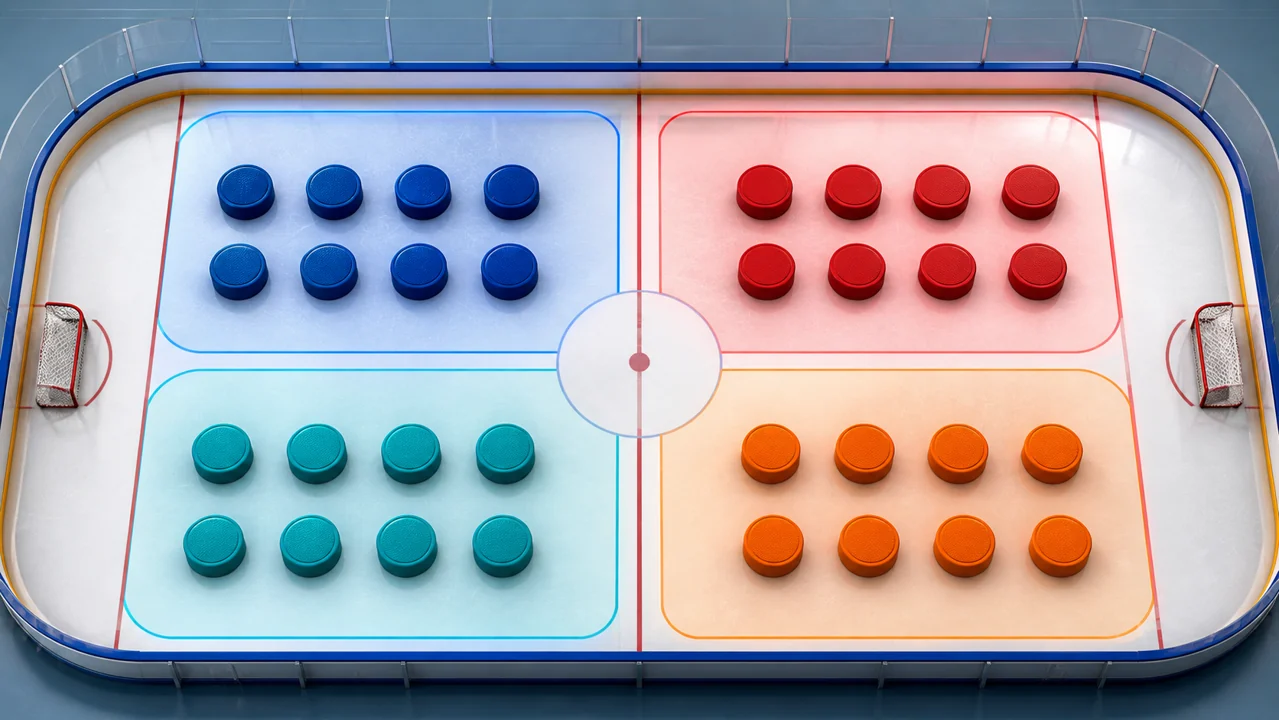
The NHL organizes its 32 clubs into two conferences and four divisions. The Eastern Conference contains the Atlantic and Metropolitan divisions; the Western Conference contains the Central and Pacific divisions. Each division has eight teams. These groups affect standings, schedules and playoff qualification, so they answer a different question from an alphabetical directory.
Eastern Conference — Atlantic Division
- Boston Bruins
- Buffalo Sabres
- Detroit Red Wings
- Florida Panthers
- Montreal Canadiens
- Ottawa Senators
- Tampa Bay Lightning
- Toronto Maple Leafs
The Atlantic contains four Canadian clubs and four United States clubs. It should not be confused with a purely geographic coast list: Detroit and Toronto belong here because league alignment, not a simple longitude sort, defines membership.
Eastern Conference — Metropolitan Division
- Carolina Hurricanes
- Columbus Blue Jackets
- New Jersey Devils
- New York Islanders
- New York Rangers
- Philadelphia Flyers
- Pittsburgh Penguins
- Washington Capitals
All eight Metropolitan teams are based in the United States. Both New York clubs appear in this division, along with their nearby New Jersey rival. Keeping this list separate from the Atlantic prevents a frequent mistake: treating every Eastern team from the Northeast as an Atlantic member.
Western Conference — Central Division
- Chicago Blackhawks
- Colorado Avalanche
- Dallas Stars
- Minnesota Wild
- Nashville Predators
- St. Louis Blues
- Utah Mammoth
- Winnipeg Jets
The current Utah club belongs in the Central. Winnipeg is the division's Canadian member, while the other seven clubs are based in the United States. A list that places Utah in the Pacific or still uses an old Utah placeholder should be corrected against the NHL directory.
Western Conference — Pacific Division
- Anaheim Ducks
- Calgary Flames
- Edmonton Oilers
- Los Angeles Kings
- San Jose Sharks
- Seattle Kraken
- Vancouver Canucks
- Vegas Golden Knights
The Pacific has three Canadian teams and five U.S. teams. Vegas is part of the Pacific despite its inland location, another reminder that league alignment is an operational structure rather than a literal coastline map.
Division membership does not indicate today's rank. Records and points change after every game, and schedule context changes week to week. Use this week's NHL schedule for current matchups instead of reading the order of these lists as standings.
How to use the list with schedules, calendars and team pages
A clean team list is most valuable when it becomes the stable key for a changing task. Start by choosing the canonical full name from the first list. Then attach the dynamic information you actually need—today's game, a printable season view or a calendar subscription—through a page designed to stay current.
Finding a game today
Do not scan an evergreen list for live status. Open today's NHL games, then match the displayed club to its full name here. This avoids ambiguous shortcuts such as “NY” and distinguishes the Islanders from the Rangers. It also keeps postponed games, start times and completed results out of static copy.
Building a printable checklist
Use the full-name order when you want one row per club, then move to the printable NHL schedule for schedule output. The directory can serve as a quality-control checklist: a league-wide worksheet should contain 32 unique teams, and a division sheet should contain eight. If a row is missing, compare the first and last names in each group before assuming the schedule source is incomplete.
Adding games to a calendar
A name list cannot update a phone or desktop calendar. Use the NHL calendar options for that task. Calendar feeds are preferable to copying dozens of dates into a blog article because schedule changes can be reflected by the maintained resource. Confirm the club name before selecting a team feed, especially when two teams share a city label such as New York.
Cleaning spreadsheet or database values
Keep two fields when possible: a display name and a normalized key. Preserve “St. Louis Blues” for readers, while software can store a lowercase, punctuation-safe key. Never merge “New York Islanders” and “New York Rangers” into one “New York” row. Treat location and nickname as separate columns if users need to sort both ways.
Abbreviations require their own verified mapping. Do not invent one from initials: clubs and data providers may use standardized codes that are not obvious from the display name. The same caution applies to links. A team name does not automatically prove a URL slug, so route existence should be checked before a direct team link is published.
This structure keeps the article useful without competing with the site's dynamic tools. The list answers “which teams exist and how are they organized?” The schedule, Today, printable and calendar pages answer “when do they play and how can I follow them?”
NHL team list FAQ
How many teams are in the NHL?
There are 32 active NHL teams in the official directory checked August 27, 2026. Sixteen play in the Eastern Conference and 16 in the Western Conference. Each conference has two divisions, and each division has eight clubs.
What is the newest name on the current NHL team list?
Utah Mammoth is the newest current club identity on the list. That naming history is different from expansion history: Seattle was approved as the NHL's 32nd team and began play as the Kraken. When updating a worksheet, replace an outdated Utah Hockey Club label with Utah Mammoth rather than adding a 33rd row.
How many NHL teams are based in Canada?
Seven: Calgary Flames, Edmonton Oilers, Montreal Canadiens, Ottawa Senators, Toronto Maple Leafs, Vancouver Canucks and Winnipeg Jets. The other 25 clubs are based in the United States. The Canadian teams are spread across three divisions; none plays in the Metropolitan.
Should “New York” or “Islanders” control the alphabetization?
It depends on the requested convention. In a full-franchise-name list, both New York teams belong under N. In a nickname list, Islanders belongs under I and Rangers under R. State the rule in the heading so readers do not mistake a valid alternate sort for an error.
When should this list be updated?
Recheck it after an NHL expansion, relocation, rebrand or official realignment. Routine trades, coaching changes, standings movement and schedule releases do not change the team directory, so they should not trigger edits here. The NHL's official Teams page remains the primary verification point.
For a quick audit, confirm four numbers: 32 clubs, two conferences, four divisions and eight teams per division. Then check the edge cases—Utah Mammoth, St. Louis punctuation, two New York clubs and the multiword nicknames. If those are correct, the directory is usually ready for use.
Why do some lists spell Montreal with an accent?
The NHL's directory displays Montréal Canadiens, reflecting the city's French spelling. Many English-language databases and searches use Montreal Canadiens without the accent. Those are not two different teams. If exact official display typography matters, preserve Montréal. If a technical system removes accents for search matching, keep one canonical team ID so the normalized spelling cannot produce a duplicate row.
Can historical team names be added to the same 32-team list?
Not as additional active clubs. Historical names may be useful in a separate alias or history field, but placing a former identity beside the current club as another active row breaks the count. Label historical material clearly and keep the active-team table limited to the NHL's current directory. This is especially important when combining old ticket files, standings exports or card inventories with current data.
What is the safest copy-and-paste format?
Use one complete franchise name per line in UTF-8 text. Avoid commas inside the name column, and place conference or division in separate columns only when needed. For CSV work, include a header such as `team_name,conference,division` and quote fields consistently. After import, verify 32 nonblank names and check for accidental leading or trailing spaces.
For a nickname-only project, retain the corresponding full name in another column. A bare label such as Stars or Wild may be understandable to a hockey fan but can be ambiguous in a larger sports or merchandise database. The full name is the stable human-readable reference that allows the shorter nickname to be validated.
Does alphabetical order show quality or playoff seeding?
No. Alphabetization is only a retrieval convention. Anaheim appearing first and Winnipeg last says nothing about records, strength or postseason position. Conference and division lists on this page also use stable membership, not live rank. Any workflow involving qualification, home ice or seeding must use current standings rather than list position.
Comments
Comments are reviewed before publication. Spam, abusive content and policy-violating links are not published.
Sign in with Google to leave a comment.
Loading comments...