Updated October 18, 2026. New Jersey Devils trade rumors need to start with the roster the team actually built. The summer brought a different collection of forwards, a different goaltending equation and a meaningful commitment of future assets. Another transaction should be judged against those changes, rather than against a target list written before free agency.
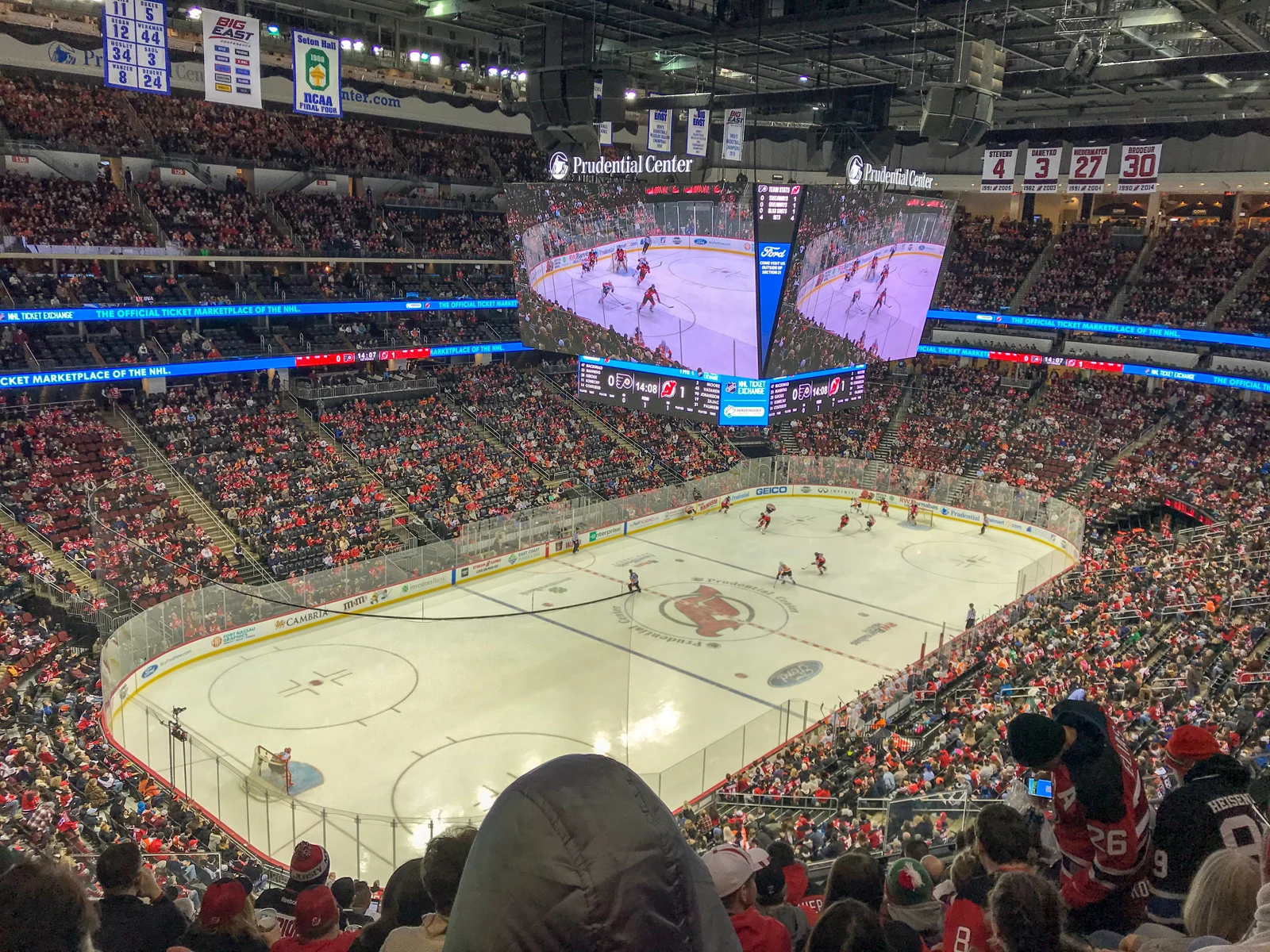
Cover photograph: Prudential Center interior in 2018 by Andrew nyr, CC BY-SA 4.0; resized and converted to WebP. Historical arena view.
Where Devils Trade Rumors Stand on October 18
The concrete story is a reset already underway. New Jersey added Luke Evangelista and acquired forwards from Florida while moving Jacob Markstrom. Those are completed transactions, listed in the Devils' official offseason notebook. They change both the opportunities available to the coaching staff and the price the organization has already paid to improve.
There is no specific next transaction that this article can present as agreed or imminent. That is a statement about the evidence available here, not a claim that management has stopped making calls. NHL teams can explore options without an agreement becoming public. A proposed destination, a writer's target list and a report that two clubs have discussed a player describe different stages of a story.
For Devils fans, the useful question is therefore more precise than whether the team is a buyer. What problem would another addition solve that the new roster cannot solve itself? Adding a winger has a different value if it pushes an effective player into a smaller role than if it creates a credible scoring line that previously did not exist. A goalie move can improve the position but also consume resources needed elsewhere.
The analysis below separates the completed moves from the judgments they invite. It does not assign imaginary asking prices or turn a familiar player's name into a trade connection. The best reading of a rumor is often a comparison: the incoming role, the outgoing role, the assets surrendered and the development opportunities that remain. That comparison is particularly important after a summer when several areas changed at once.
How New Jersey Rebuilt Its Forward Options
The forward changes should be evaluated as a group. A team can improve its best line while becoming easier to defend elsewhere; it can also add several modest contributors who make the whole lineup more difficult to manage. For New Jersey, the next trade discussion should begin with how much useful work the summer additions already perform.
Evangelista Was an Investment Beyond Opening Night
Evangelista subsequently signed a five-year extension starting in 2027-28, at $7.25 million annually, according to the September 16 announcement. That matters when reading older analysis that describes an unresolved contract year. The current decision is an investment in a continuing role, rather than a short audition followed by an immediate contract question.
Our interpretation is that the patience required to evaluate such an addition should exceed a handful of games. A winger joining new linemates must learn where passes arrive, when a center wants support below the puck and which offensive possessions justify taking a risk. Point totals can lag behind improvements in those habits. Conversely, a productive power-play stretch can conceal poor even-strength chemistry. Neither should determine the entire assessment.
A useful benchmark is whether the addition expands the combinations the coach can trust. If one scoring line can remain effective while another changes, the organization has bought flexibility. If all the offense still depends on the same narrow group, the need for additional help survives even when the roster has more recognizable names.
Rodrigues and Boqvist Changed the Depth Equation
Rodrigues, Boqvist and Steeves arrived in the Florida deal. The NHL's summer roster reset supplies the transaction context. The analytical question is how those additions change the jobs left for everyone else.
Depth has practical value when it allows a coach to respond without breaking up every line. A player who can handle a difficult shift, move alongside a different center or protect a lead can create opportunities for a more offensive teammate. Those benefits will not always appear in that player's scoring total. Watch who gets the next shift after an unsuccessful defensive sequence and who remains in the rotation late in a close game.
The opposite scenario also deserves attention. If veteran additions receive minutes without improving the underlying work, the cost includes the opportunity denied to a developing player. An evaluation should compare what each player contributes in the actual assignment, rather than treating NHL experience as proof that the assignment is being handled.
Mantha Was a Signing, Not a Trade
Mantha's two-year, $9.5 million signing used salary commitment instead of a trade package. That distinction helps explain the offseason more clearly than a single undifferentiated list of arrivals.
Signing a player preserves the picks or prospects that might otherwise leave in a trade, but it still occupies a roster place and future payroll. The relevant test is not simply whether the player scores. It is whether his contribution improves the lineup enough to justify the space committed to him and the alternatives that space could have supported. For the next rumor, ask whether its proposed role duplicates a job already assigned here.
The Blue Line and Draft-Pick Cost of the Reset
Nemec and Tsyplakov went to Calgary; Morin and draft assets came back. The June 23 release provides the conditional details. Those conditions matter because a future first-round selection is not always a pick that can be assigned one fixed draft year in a simple graphic.
The later Evangelista acquisition illustrates why an offseason should be read as an asset sequence. A club can convert a young NHL player into several assets and then spend part of that return on a different young NHL player. Calling the first transaction a rebuild and the second an all-in gamble misses the broader roster construction. New Jersey changed the type of asset it held and the position in which some of that value would be used.
There is nevertheless an on-ice consequence to moving a defenseman. A draft pick cannot take a defensive-zone faceoff shift this week. A prospect can become valuable without being ready for the same assignment immediately. The Devils therefore have two evaluation clocks: whether the NHL defense can handle its current work and whether the future assets eventually justify the opportunity surrendered. Neither clock should erase the other.
Chisholm cost a 2027 fourth-round pick and carried a $1.6 million annual cap figure in his acquisition announcement. That is a different kind of bet. It purchases another near-term option without demanding the same premium assets as a major scoring addition.
Our reading is that the next defense discussion should focus on assignment rather than replacement by name. Does the coach need another player who can move the puck through pressure, another option for a difficult matchup, or simply a dependable reserve? These jobs overlap, but they are not interchangeable. A player acquired to provide depth should not be criticized for failing to become a first-pair solution that the transaction never reasonably promised.
For fans comparing potential packages, treat conditional picks with care. Their value depends on which selection transfers and when the condition resolves. Adding every announced first-rounder together without tracking subsequent use can exaggerate the resources available. The more useful argument is whether spending another premium asset would fix a problem with substantial consequences, or merely add insurance that could be obtained more cheaply.
Why Goaltending Is a Separate Trade Question
The Markstrom departure connects two different judgments. New Jersey gained forward options, but those forwards do not stop shots. A favorable opinion of the return does not automatically establish that the goaltending plan will work. Equally, a difficult night in net does not erase useful contributions by the players received.
Daws re-signed for two years at a $1.1 million average annual value, as stated in his July 1 contract announcement. The organization therefore retained a developing option alongside Allen rather than treating every start as something that had to be purchased externally.
The depth picture also moved after July. Rittich was waived and Poirier claimed on September 27 in an official roster transaction. Summer signing lists alone are consequently an unreliable guide to which players are occupying NHL jobs now. Contract ownership, organizational depth and the active lineup are different things.
Judge the Tandem and the Defensive Environment Together
For Allen, the practical question is how much dependable work the Devils can request without making the schedule unmanageable. For Daws, it is whether an opportunity becomes a reliable share of the workload. These are complementary questions. If one goalie absorbs every important assignment, the organization learns much less about the other than the existence of two contracts suggests.
Our recommended viewing approach is to track the sequence before the shot. A clean outside attempt, a lateral pass across the slot and a rebound left unchallenged are not equivalent tests. When a new forward fails to support an exit and the puck returns immediately, the resulting goal can be recorded against a goalie while also exposing a team problem.
A trade should follow the diagnosis. If the team is allowing repeat dangerous possessions, a goalie acquisition alone may leave the same structural weakness intact. If the defensive work is sound but routine saves repeatedly fail to arrive, waiting for a winger to fix the result is equally unconvincing. New Jersey's forward investment and its goaltending evaluation have to meet at that distinction. There is room to be patient with development while still demanding a clear explanation of what is improving.
What Would Make Another Devils Trade Sensible?
The strongest argument for another trade would identify a persistent job the rebuilt team cannot perform. It would also explain why the solution has to come from outside. New Jersey has already changed enough that a general demand for more depth is incomplete. Which depth, for which assignment, and at whose expense are the questions that make the discussion useful.
Solve a Role That the Current Roster Cannot Fill
Casey's knee surgery carried an estimated eight-to-ten-week recovery in the October 2 injury report. That is a concrete availability problem. It is not, by itself, evidence that management is negotiating for a particular defenseman.
Kovacevic was activated October 10, according to the team transaction notice. Taken together, the two developments show why a single injury headline cannot describe the whole defense picture. One player can move toward returning while another faces a longer absence. Those changes affect how much insurance a team needs and how much it should be willing to pay.
Our assessment is that a temporary vacancy favors a different acquisition profile from a permanent weakness. A short-term addition should be able to contribute quickly without forcing another major lineup decision when the absent player returns. A longer-term addition needs a durable role after the immediate crisis passes. Otherwise the Devils could spend a meaningful asset to create a future crowding problem.
The same distinction applies up front. With Evangelista, Mantha, Rodrigues and Boqvist added, the next forward should offer something the current combinations consistently fail to produce. That might be a particular type of support through the middle or an assignment that frees an offensive player from difficult defensive minutes. It should be demonstrated in games, not assumed because a name is familiar.
Price the Next Two Seasons, Not Just the Next Two Weeks
Hischier's five-year extension begins in 2027-28, as the July 1 announcement confirms. With Evangelista's new deal also beginning then, a future payroll commitment should be evaluated against more than the current season's fit.
A lower acquisition price does not necessarily make a longer contract inexpensive. A deal can preserve a first-round pick while committing several years to a role that becomes redundant. Conversely, a higher asset price can be defensible if the player is a strong fit through an important competitive window. The right comparison combines term, role and the replacement options that remain available.
The roster place has value too. If an addition removes the only meaningful development opportunity for a younger player, the organization needs a reason the immediate gain is worth that tradeoff. New Jersey's reset should leave room to learn which internal options can contribute. Purchasing every answer before that evaluation occurs would make it harder to tell whether the underlying roster has actually improved.
How to Follow the Roster Reset in Real Games
Two recent results show how quickly the mood can change: New Jersey beat the Rangers 7-1 on October 15, then lost 4-2 at Washington on October 17. Neither result should become a complete verdict on the offseason.
Through October 17, New Jersey stood 4-4-0 with 25 goals scored and 27 allowed in the current standings. That snapshot points toward an unsettled evaluation, not a team whose season can already be reduced to a deadline label. The margin between successful and unsuccessful stretches remains small enough that deployment, health and execution can all change the reading.
When watching the next games, focus on three connections. First, does the Evangelista addition help sustain offense when the leading combinations change? Second, do the Florida additions allow the coach to distribute difficult work more effectively? Third, does the defense limit the kinds of sequences that make every goalie start feel precarious? Those questions tie the summer transactions to observable outcomes.
Use the daily game listings for the next viewing opportunity rather than relying on dates embedded in an old rumor story. For the wider context, the league power rankings offer an editorial comparison, while the playoff standings explainer describes what a position actually means. A ranking is a judgment; points and tiebreakers determine qualification.
Should the Devils make another trade immediately? The available facts do not establish that conclusion. They establish a roster with new options, future commitments and several unresolved tests. A sensible addition would strengthen a specific assignment at a price that leaves the rest of the plan workable. Until an attributable development changes the picture, the next useful update is as likely to come from how these players perform together as from a fresh list of speculative names.
Comments
Comments are reviewed before publication. Spam, abusive content and policy-violating links are not published.
Sign in with Google to leave a comment.
Loading comments...