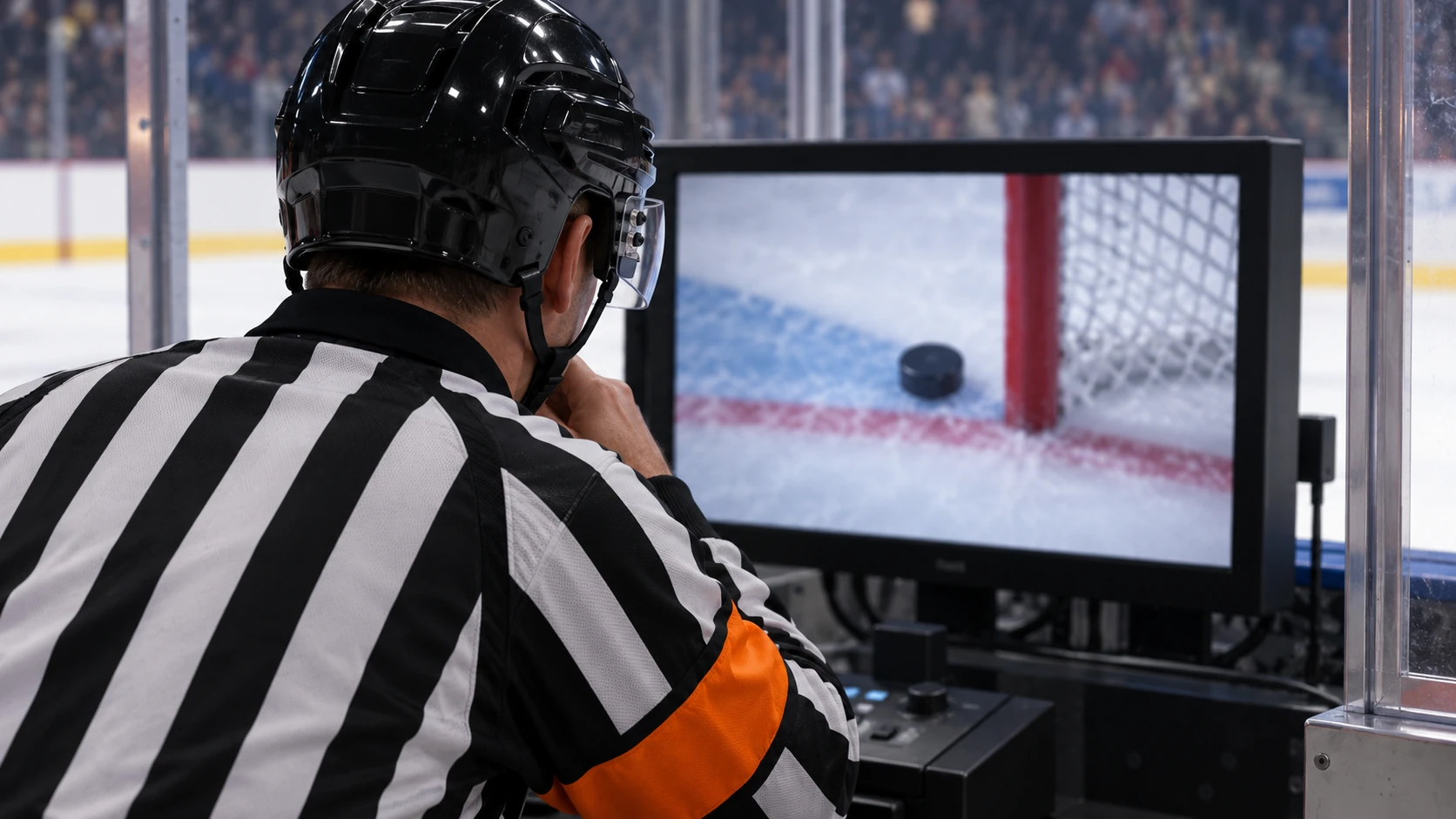
Montreal's three rejected goals show three different tests
An NHL goal can be disallowed because the puck never fully crossed the goal line, because an attacker interfered with the goalie, or because the scoring play began with an offside entry. Those are different questions. A replay showing the puck behind the goalie may answer one of them while leaving the others unresolved. The referee's explanation tells you which question the officials actually reviewed.
The Montreal Canadiens' game against the Detroit Red Wings on October 10, 2026, provided an unusually clear example. Montreal had three apparent goals waved off for three different reasons before winning 1-0 in a shootout. According to the NHL's game recap, Cole Caufield's first-period chance failed the goal-line test. Zachary Bolduc's second-period goal was disallowed because Jake Evans interfered with Detroit goalie Daniil Tarasov in the crease. Alexandre Texier's apparent overtime winner was erased because Bolduc had been offside earlier in the play.
That sequence explains why counting celebrations can be misleading. The first decision concerned where the puck went. The second concerned what an attacking teammate did around the goalie. The third concerned how Montreal entered the attacking zone before the shot. A goal celebration, a goal horn and a scoreboard change do not prevent the officials from correcting an eligible scoring decision.
It also matters who starts the review. The NHL's explanation of Caufield's chance identifies a Situation Room video review and says the call on the ice was overturned. Describing the entire evening as three successful coach's challenges would therefore obscure what happened. A coach's challenge is one route to a review; it is not a synonym for every replay stoppage.
After the reversals, Jacob Fowler and Tarasov each finished with 30 saves. Bolduc eventually supplied Montreal's deciding shootout attempt in the sixth round. The canceled plays did not become official scoring goals just because the arena initially treated them that way. The final outcome was determined by the plays that survived the applicable rules.
For fans watching a similar game, the useful first step is to separate the apparent finish from the legal scoring sequence. Ask whether the puck crossed, whether the goalie could play the position, and whether the attacking team entered legally. Then listen for the review category before trying to solve every question from the same slow-motion clip. You can follow the result on our today's NHL games page while using the explanation here to understand why the score changed.
Did the whole puck cross the goal line?
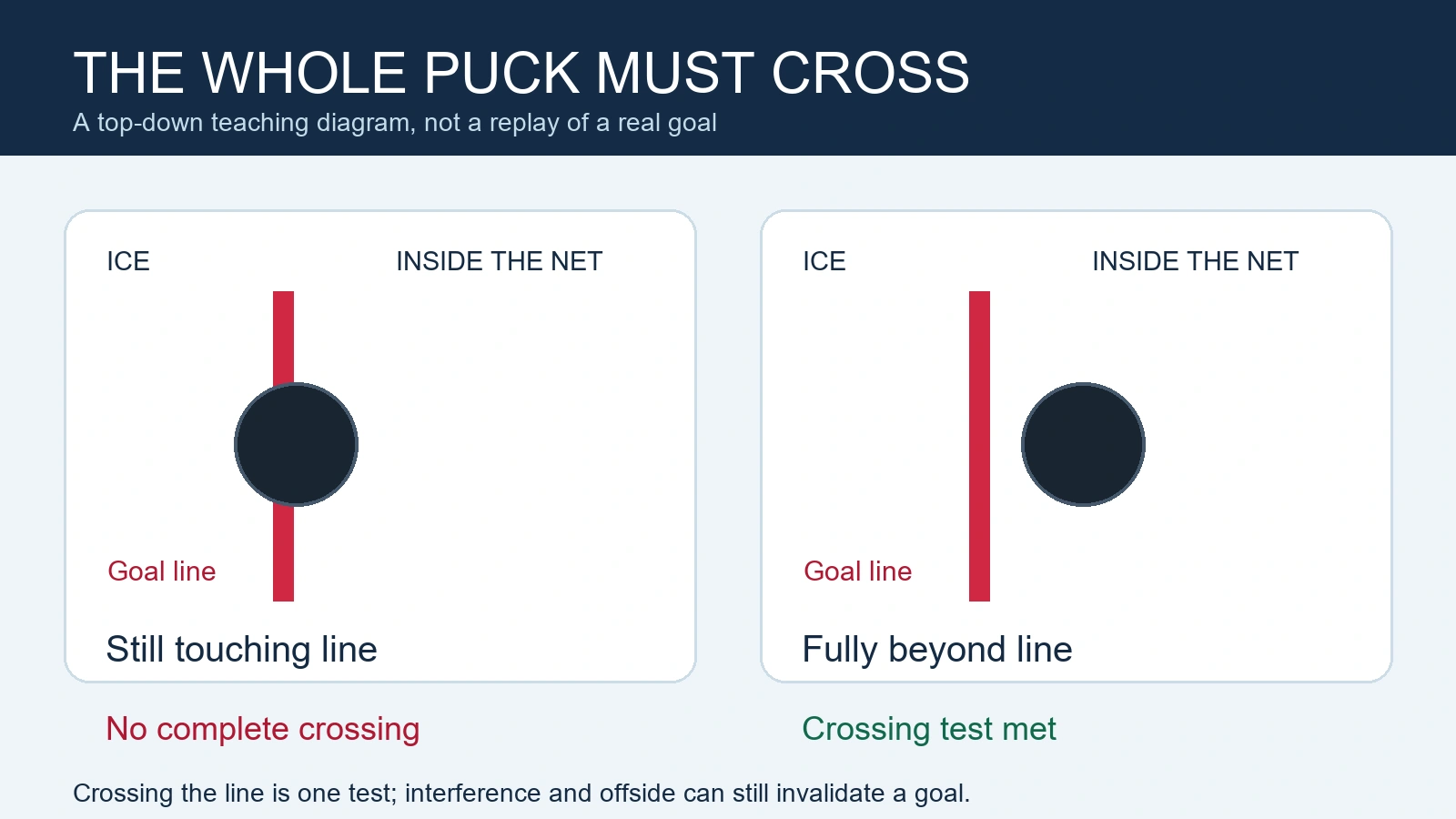
The entire puck must cross the goal line for the crossing test to be satisfied. A puck touching the line, resting partly above it or showing only its front edge behind it has not completely crossed. Hockey does not use the same threshold as sports in which breaking a plane with part of the ball is enough. The location of the puck's trailing edge matters as much as its leading edge.
That was the question in Caufield's apparent goal against Detroit. The official October 10 review explanation says the Situation Room examined whether his shot entered the net and determined that the puck did not cross the Detroit goal line. The original goal call was overturned. The reason was about the puck's position, rather than a teammate's interference or an earlier blue-line entry.
A glove can make this harder to judge. The puck does not have to drop visibly onto the ice inside the net before a crossing can be established. If it is carried across while inside a glove, its position still matters. Conversely, a glove partly behind the line does not by itself prove that the puck inside it was entirely across. Officials need evidence about the puck, not merely about the equipment surrounding it.
Why one camera angle may not settle it
A television view can show a sliver of dark puck without showing the whole boundary between the puck and the line. A pad, skate or glove may hide the trailing edge. An angled view also makes a narrow gap difficult to read. Slowing the same obscured frame repeatedly does not reveal the missing part of the picture. That is why the most dramatic broadcast angle is not necessarily the most useful angle for deciding the crossing.
Fans should distinguish a clear view from an intuitive impression. When the puck is visible, trace its full outline against the goal line. When it is hidden, avoid treating the position of a pad as a precise substitute. For a challenged call, the NHL's stated review standard requires conclusive evidence to overturn the original decision. A replay that merely creates doubt does not automatically produce the result a viewer prefers.
There is one further trap: proving that the puck crossed establishes only one part of a valid goal. The NHL documented a Buffalo-Montreal play in May 2026 in which a goal-line review established a crossing, but a subsequent goalie-interference challenge resulted in no goal. The order is logical. First establish what happened to the puck; then consider whether the scoring action was legal. A commentator saying the puck was in does not necessarily settle the referee's final announcement.
What counts as goalie interference?
Goalie interference is about the goalkeeper's ability to defend the net and the nature of the attacker's actions. Under Rule 69.1 in the 2026-27 NHL rulebook, an attacking player's presence inside or outside the crease does not, by itself, decide whether a goal counts. The officials consider whether positioning or contact impaired the goalie's movement or defense, and whether the attacker initiated deliberate contact.
In Montreal's second rejected goal against Detroit, the official recap identifies Evans' interference with Tarasov in the crease as the reason Bolduc's apparent goal did not count. The relevant action was therefore not limited to Bolduc's shot. A teammate's work around the net can make an otherwise successful finish illegal. Watch the goalie's path and the attacking player's position before following the puck into the net.
Screening is different from preventing a save
A forward trying to take away the goalie's view is doing a familiar hockey job. A legal screen does not automatically become interference because the goalie failed to see the shot. But screening is not permission to establish an obstructive position in the crease or prevent the goalie from moving. Rule 69.3 specifically addresses an attacker who occupies a significant position inside the crease, obstructs vision and impairs the goalie's ability to defend the goal.
The blue paint is therefore useful context, rather than a simple yes-or-no switch. The officials consider the player's position, the duration and effect of that position, and any contact. A skater can be in the crease in circumstances where a goal is allowed; a skater outside it can still initiate prohibited contact. Looking only for a skate touching blue paint can miss the action that decided the call.
Rebounds introduce another distinction. Rule 69.7 permits incidental contact when the goalie and attacker are simultaneously trying to play a loose puck, with any resulting goal allowed under that provision. That is different from pushing a goalie and the stopped puck into the net. The replay needs enough context to show whether the players were contesting a loose puck or whether the attacker prevented the goalie from doing the job. Our guide to hockey positions explains why forwards battle for this space in the first place.
What if a defender pushes the attacker?
The cause of a collision matters. Rule 69.1 says contact caused by a defending player's push, shove or foul is not treated as contact initiated by the attacker, provided the attacker made a reasonable effort to avoid the goalie. That qualification matters: seeing a defender's hand on a forward is not enough to resolve the entire play.
The reverse can also occur. If an attacker pushes a defender into the defender's own goalie, the rule treats that as attacking-player contact. A short clip starting at the collision may hide who created it. Follow the players from before the contact, consider the opportunity to avoid it, and then assess its effect on the goalie. This sequence is why two clips that end with a forward falling into the crease can receive different decisions without requiring a different written rule.
Why an offside entry can erase a later goal
An offside review looks back to the attacking team's entry into the zone, rather than asking only whether the eventual shot beat the goalie. If the play should have stopped at the blue line, the later scoring action cannot make that missed infraction disappear. The shooter may have finished cleanly and the puck may have crossed completely, yet the goal can still be erased.
That was the issue with Texier's apparent overtime winner against Detroit. The NHL's Situation Room explanation identifies Bolduc as the Montreal player who preceded the puck into the offensive zone. Officials overturned the goal after reviewing that entry. The problem was not Texier's shooting motion or an interference action at the net.
Rule 38.9 also places a boundary on how far that entry can follow the play. A goal is subject to review for the earlier offside only if the puck did not leave the attacking zone again between the infraction and the goal. A later exit changes the sequence officials are considering. This is why viewers should follow the whole possession rather than freeze one entry frame without checking what happened afterward.
Follow the puck and the skates at the blue line
Rule 83.1 focuses on the skate blades, not the attacker's stick or upper body. An attacker is offside when both skates are completely across the relevant leading edge of the blue line before the puck fully crosses it. A player leaning forward with a stick deep in the zone can still be onside if a skate remains on the permitted side when the puck crosses.
The NHL also recognizes the vertical plane above that edge of the blue line. A trailing skate does not have to be pressed flat against the ice to preserve an onside position; the blade's position relative to the plane is what matters. That makes a raised skate different from a skate already fully beyond the line. A broadcast freeze-frame needs the puck and the blade at the same instant.
There is a possession exception for a player actually controlling the puck. The current rule requires possession and control with the stick before the trailing skate completely crosses the line, with that control maintained immediately after the puck enters. A player carrying the puck under control can therefore cross ahead of it in qualifying circumstances. Merely chasing a puck or reaching toward it is different from meeting those conditions.
When a successful offside review removes a goal, the clock is reset to the time the play should have stopped, and play resumes with the appropriate face-off. That is why a viewer can see both a score correction and time put back on the clock. The officials are restoring the game to the missed stoppage, rather than simply subtracting a goal and continuing from the apparent finish. Even a small entry error can have that consequence when the subsequent play remained in the same attacking zone.
Who orders the review, and what happens next?
Ordinary video reviews and coach's challenges share replay technology, but they have different starting points. Rule 37 covers scoring questions such as a puck crossing the line, a distinct kicking motion, a puck played into the net with a stick above the crossbar, and other listed goal situations. A coach does not need to initiate every examination of those issues. Caufield's Detroit-Montreal review was one example of a Situation Room review of the crossing itself.
Rule 38 provides the coach's challenge process. Its scoring categories include offside leading to a goal, a missed game-stoppage event in the offensive zone leading to a goal, and potential interference on the goalkeeper. The current rule also includes a narrowly defined challenge of certain puck-over-glass delay-of-game penalties. It is not an unrestricted opportunity to ask officials to replay any disputed call or missed penalty.
In the final minute of the third period and at any point in overtime, the Situation Room initiates review of situations that would otherwise qualify for a coach's challenge. This applies in the regular season and playoffs. Montreal's erased overtime goal against Detroit was explicitly labeled a Situation Room initiated challenge. The review being governed by the challenge rule did not mean Detroit's coach had requested it.
Why coaches weigh the risk of a challenge
A coach must communicate the challenge to a referee before the applicable restart, giving a specific reason and an approximate time of the alleged infraction. The coach cannot turn the stoppage into an unlimited search for something objectionable. The written procedure allows one challenge per team per stoppage and limits undue delay while the bench decides.
The risk is concrete. Rule 38.8 imposes a two-minute delay-of-game penalty for an unsuccessful coach's challenge. If a team has already had an unsuccessful challenge and another fails, the penalty is a four-minute double minor. A coach weighing uncertain goalie contact or a close blue-line frame must consider both the chance of changing the score and the risk of giving the opponent a power play. A league-initiated review should not be confused with a failed request by the bench.
The burden also favors the original call when the video is inconclusive. Officials need conclusive evidence that the original decision was incorrect to overturn it under the challenge standard. A call that stands can therefore mean the replay did not establish enough to change it. It does not necessarily mean every camera supplied a perfect view of the disputed detail.
Read the announcement before judging the replay
During the next review, listen for four things: the original decision, the reason being examined, who initiated the examination, and the announced result. Then watch the replay that addresses that reason. A puck-in-the-net angle is useful for the crossing question; a view starting before contact is useful for interference; a blue-line view is useful for offside. Using the wrong frame can make a clear explanation sound contradictory.
After the announcement, check the scoreboard, the game clock and whether a penalty creates a power play. Those changes tell you how the ruling affects the next shift. Our this week's NHL matchups page helps you find another game to watch, and our playoff format guide puts postseason games in context. The same habit remains useful in either setting: identify the actual rule question before deciding whether an apparent goal should have counted.
Comments
Comments are reviewed before publication. Spam, abusive content and policy-violating links are not published.
Sign in with Google to leave a comment.
Loading comments...