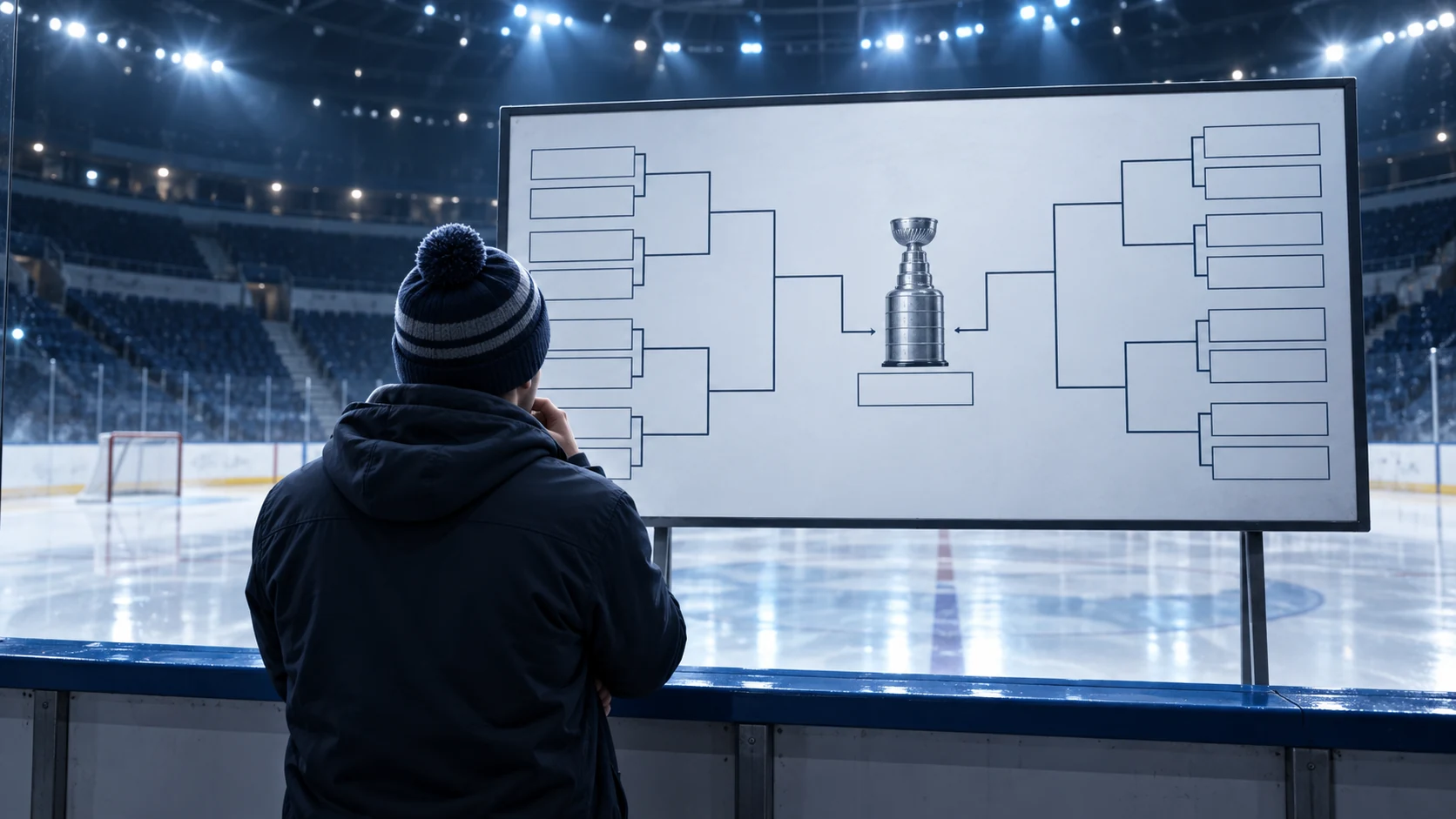
What is the NHL Playoff Bracket Challenge, and is it open now?
Updated September 26, 2026: The NHL Playoff Bracket Challenge is the league's fan prediction game for the Stanley Cup Playoffs. Fans choose which teams will win each series and follow those picks through the championship. The NHL ran its 2026 edition at NHL.com/Bracket and in the NHL app. That edition's entry window has ended. The NHL has not announced a 2027 opening date, deadline, prize list or official rules as of this update.
The distinction matters because a playoff bracket serves two different purposes. The real bracket records the 16 qualifying teams, their matchups and the series results. A Bracket Challenge entry is your prediction of that path before it is complete. Your pick may become wrong after an upset; the actual tournament does not change to match anyone's entry. If you need the completed tournament rather than a prediction game, our 2026 playoff schedule and results preserves the historical outcome.
The NHL's April 17, 2026 announcement invited fans to make predictions for each playoff series. It named an entry site, an NHL app route, a leaderboard and optional tools for making picks. Its dates and prizes applied to that edition. A later Second Chance Bracket announcement opened a separate game after the first round, illustrating why an old contest page can look active even when the original entry window is closed.
If you are planning for the next playoffs, bookmark the NHL's contest destination and wait for a new season-specific announcement. Read the rules attached to that edition before entering. Do not rely on a search snippet that still says “now open” beside a 2026 article: the publication date and contest year decide whether that invitation is current.
How to enter the official NHL Bracket Challenge
Entry starts with the NHL's current contest page, not with a bracket image saved from a previous season. The 2026 announcement offered online and NHL app entry. Because the next edition has not been announced, the practical steps below describe what to check and do when a new contest appears; the site's exact buttons and form fields may change.
Find the current contest and read its official rules
Follow a link from a current NHL announcement to the NHL Bracket Challenge site, or use the NHL's own app if that edition offers app entry. Check the year in the page heading before you begin. A completed 2026 board can be useful for looking back at predictions, but it is not an entry form for the next playoffs. A social-media link may also lead to a privately run pool that uses the same phrase; confirm that the organizer is the NHL if the league's official contest is the one you intend to join.
Read the rules linked from the active contest. Pay particular attention to the opening and lock times, time zone, account or consent requirements, age and location eligibility, number of permitted entries, scoring, tie procedure, prizes and notification process. “No purchase necessary” appeared in the NHL's 2026 announcement, but that sentence alone does not tell you whether a particular entrant is eligible or what a later contest will award. If a rule is unclear, use the current rules as the authority rather than a past article or a friend's screenshot.
Set aside a little time before the announced lock. The NHL may open entries after the playoff matchups are known, and a full bracket requires picks beyond your favorite team's first series. Waiting until the last minute invites a missed field, a sign-in problem or a misunderstanding about the deadline's time zone. The official deadline controls even if another site's countdown differs.
Complete, review and submit your bracket
Once the current game is open, work from the First Round toward the Stanley Cup Final. Choose a winner in each visible matchup, then place that winner in the next matchup along its path. Keep going through the conference rounds until the board has one champion. If the edition asks for series lengths, a final score prediction, a tiebreak answer or another field, answer those according to the current form and rules; do not assume that every year's entry asks the same questions.
The 2026 NHL game offered a Random Picks tool that generated a bracket users could edit and a Matchup Analysis tool with team statistics. Those features can speed up an entry, but the generated choices still need your review. A random Cup winner can force a string of earlier series picks that you would not have chosen independently. If those tools return in a future edition, treat them as aids rather than as a substitute for checking the whole path.
Before leaving, inspect every round for blanks and make sure the champion is the team you actually mean to select. Complete the site's submission action and look for the confirmation the active game provides; a browser tab containing an unfinished draft is not proof of an accepted entry. Keep a copy or screenshot of your submitted picks and the deadline shown in the official rules. That record helps you follow your bracket later without confusing it with a revised personal prediction.
Understand the bracket before you choose a champion
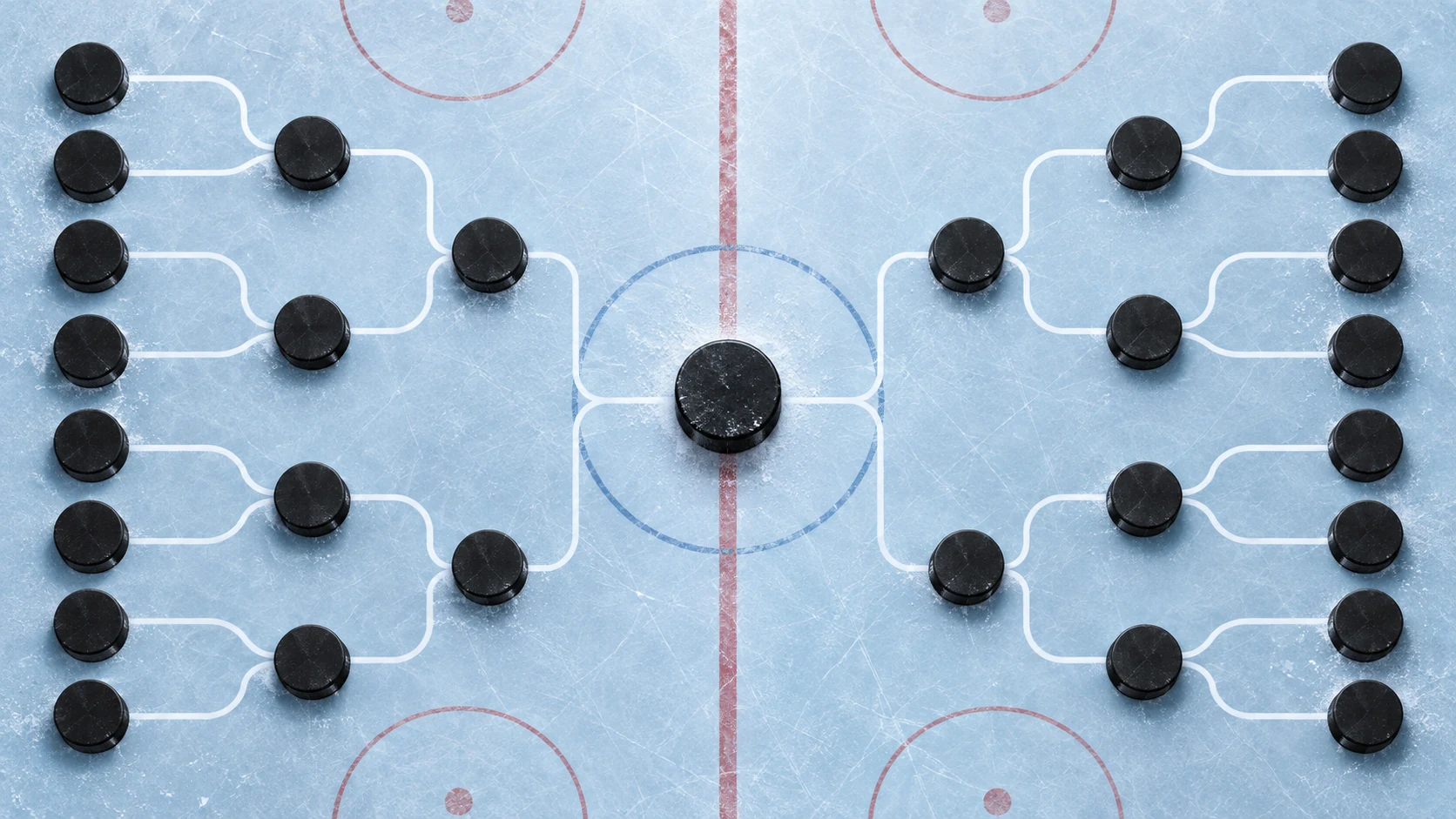
A contest entry is easier to complete when you can read the tournament underneath it. The NHL's format guide describes a 16-team field in a fixed bracket. Eight teams qualify from each conference. Four rounds take the field from the First Round to the Second Round, Conference Finals and Stanley Cup Final. Every series is best of seven: the first club to win four games advances. Your prediction board follows that path, even though the real winners cannot be known in advance.
Follow each team through the four playoff rounds
Start at the edges of the bracket, where eight First Round series reduce the 16 qualifiers to eight winners. In the NHL's division-based format, a division winner meets its assigned wild-card club, while the second- and third-place finishers from the same division meet. The two winners within that division's bracket play in the Second Round. The two remaining clubs in each conference meet in its conference final, and the East and West winners play for the Stanley Cup.
This is a fixed route, not a request to rank the teams from strongest to weakest after every upset. If you pick a lower-seeded club to win in Round 1, it occupies the winner's next slot in that same branch. It does not jump across the conference board to face a different opponent because of its regular-season rank. Our NHL playoff format explainer walks through the seeding and home-ice rules in more detail; our playoff standings guide explains how teams reach those first slots.
Trace your champion's path backward before submitting. A team cannot be your Cup winner if your own picks eliminate it in an earlier round. Likewise, a conference-final matchup must be possible under the winners you advanced from the first two rounds. The contest interface may prevent impossible selections, but a manual review still catches choices you made accidentally while moving quickly through the board.
Separate series winners from exact series lengths
Choosing a series winner answers who advances. Choosing its length answers how many games it takes. The NHL said its 2026 Bracket Challenge asked fans to predict the winner of every series through the Final and the number of games in each First Round series. Because a club needs four victories, a best-of-seven series can end in four, five, six or seven games. A four-game pick means a sweep; seven means the teams split the first six before a deciding game.
Those are separate judgments. You might strongly favor one team to advance but be uncertain whether a resilient opponent extends the series to six or seven games. Avoid treating a plausible winner as proof that you can predict the exact length. Read the next edition's rules to learn which rounds require game counts and how those answers affect scoring, if they are used at all. The 2026 announcement did not establish a permanent scoring table for every future contest.
Make useful picks without treating predictions as facts
A strong bracket starts with the actual first-round matchups, not with a Cup winner chosen in isolation. For each series, write down one or two reasons for your pick: the clubs' current form, scoring and defensive results, special teams, goaltending, confirmed player availability and the style of opponent they face. The NHL team statistics page is a starting point for comparable numbers. Use the same date range and filters for both teams, and check current NHL or club reports before treating an injury or lineup change as settled.
Statistics need context. A small late-season winning streak may involve very different opponents from a seven-game playoff series. A club's regular-season scoring rate describes what it has done over many games, but it does not guarantee goals against a specific defense or goaltender. Head-to-head meetings may reveal style clashes, yet a handful of games cannot represent every possible playoff situation. A practical approach is to use several independent signals rather than letting one memorable game decide the pick.
Then test the later rounds. If you advance two aggressive underdogs into the same second-round branch, only one can continue. You should also ask how each proposed conference finalist would reach that point, not merely whether it sounds plausible in a Final. A bracket is a chain of conditional predictions: changing one first-round result changes at least one later matchup. Work forward once, then review backward from your champion to catch choices made out of habit.
Do not mistake consensus for certainty. In the NHL's 2026 staff predictions, seven of 16 writers and editors chose Colorado to win the Cup, while five other teams also drew champion picks. Those were opinions made before the games, not facts about the future. A popular pick may be well supported, but its popularity alone does not establish the chance it will happen.
Choose upsets for reasons you can explain, and be honest about uncertainty. A bracket filled entirely with favorites may be coherent; one with several underdogs may be coherent too. What matters is that each pick fits its particular matchup and the path you have drawn. If the contest permits multiple entries, the current rules will tell you the limit. Different brackets can express different plausible scenarios, but multiplying entries does not turn a weak assumption into a reliable forecast.
Deadlines, leagues and second chances: what to check each year
Three details often determine whether a bracket is useful at all: when the original entry locks, how you compare it with friends and whether a later Second Chance game is offered. The NHL has used each feature in past editions, but each season's announcement and rules control. The dates below describe completed contests, not a forecast for 2027.
Confirm the lock time and whether edits are allowed
The 2026 NHL announcement said initial brackets would lock on Monday, April 20, 2026, before the first scheduled First Round Game 2. That arrangement let fans observe Game 1 and change predictions before the lock. In 2025, the published cutoff was before 7 p.m. ET on April 22. Those two dates show why “the bracket locks after Game 1” is an unsafe standing rule: the contest's named cutoff, not a pattern inferred from prior years, is what matters.
When a new edition opens, write down both the date and its stated time zone. Check whether the rules allow edits after initial submission, and until when. If you make a late edit, confirm the revised bracket was accepted; do not assume a saved view and a submitted view are identical. The first game of a series can begin before your local midnight, and an announced cutoff tied to puck drop can feel different in another time zone. Submit comfortably before the deadline, especially if a missed entry would prevent you from joining a group or prize drawing.
After the lock, keep your original predictions intact as a record. You can still make informal new predictions while watching the series, but those do not change the submitted contest entry unless the current rules explicitly provide a separate option. If you want to know when actual matchups or game times are announced, our playoff schedule announcement guide addresses that different question.
Compare brackets in a league or leaderboard
A private group can make the Challenge a shared postseason activity. NHL announcements in earlier years described public and privately created leagues, and the 2025 edition discussed both league and global leaderboards. The 2026 announcement confirmed a global leaderboard and the ability to share brackets. If the next contest offers group creation, use its current invitation method and check whether your friends must submit their own entries by the same lock. Do not infer a group registration deadline or button location from an old screenshot.
Agree on the point of your group before the games begin. A friendly league might care about who picked the champion, who called a particular upset or who finished highest under the game's official scoring. Those are different measures. The organizer should make clear whether group bragging rights follow the official leaderboard or a separate house rule. If there are prizes, the official contest's eligibility, scoring and tie procedures still apply to the league-operated award; a friend's private pool cannot rewrite them.
Look for a separately announced Second Chance Bracket
A busted original bracket did not necessarily end participation in 2026. On May 4, the NHL opened a Second Chance Bracket after the First Round. It let fans predict the remainder of the playoffs and locked before the first scheduled Second Round Game 2. The NHL said original entries remained eligible for the original grand prize; the new contest offered its own chance at a $1,000 NHL Shop Gift Code, subject to its rules. The second entry was a fresh contest, not a correction to the first one.
For a future edition, wait for an explicit NHL announcement before planning around a Second Chance Bracket. If one appears, read its separate cutoff, eligible entrants, scoring and prize conditions. The clubs remaining after Round 1 will be known then, so its board and decision problem differ from the original 16-team entry. If no new game is announced, you can still track the real bracket and compare your earlier predictions without suggesting that late contest entry is available.
NHL Bracket Challenge questions fans ask
These answers separate what the NHL confirmed for 2026 from what readers need to verify when a new edition is announced.
Is the NHL Playoff Bracket Challenge free?
The NHL said no purchase was necessary to participate in its 2026 Bracket Challenge. The same statement appeared in its 2026 Second Chance announcement. That does not replace the official rules for eligibility: a no-purchase contest can still have age, residence, account and winner-notification conditions. Read the rules for the next edition before assuming that an entry from your location qualifies for a particular prize.
Can I submit more than one bracket?
The 2026 NHL announcement said its Random Picks feature could generate brackets that fans could edit and submit as multiple entries. It did not make the same numeric entry limit a permanent rule for future years. If the next game allows several brackets, check its limit and make sure each one has been submitted rather than merely saved. Label your entries so you can tell a conservative path from an upset-heavy one after the games begin.
What can I win, and how is a tie broken?
For the completed 2026 edition, the NHL announced that the eligible entrant atop the leaderboard could receive an opportunity to attend a 2026-27 NHL event and a limited-edition Norqain watch. The NHL also said eligibility confirmation, winner notification and tiebreaker rules applied. Its news release did not spell out a full tiebreak algorithm. The separately announced Second Chance Bracket had a different possible award. Neither prize list should be presented as a 2027 offer. When the next contest opens, inspect its Official Rules for the scoring table, tied-entry procedure, prize restrictions and claim deadline before entering.
Is ESPN's Playoff Hockey Challenge the same contest?
No. ESPN's Playoff Hockey Challenge is an ESPN-hosted product; the NHL directed its own 2026 entrants to NHL.com/Bracket or the NHL app. Both may involve postseason predictions, but they have separate destinations and should be treated as separate games. An entry in one should never be assumed to count in the other. Choose the operator whose rules, group and prize you actually want, and verify the current contest year before you submit.
Comments
Comments are reviewed before publication. Spam, abusive content and policy-violating links are not published.
Sign in with Google to leave a comment.
Loading comments...