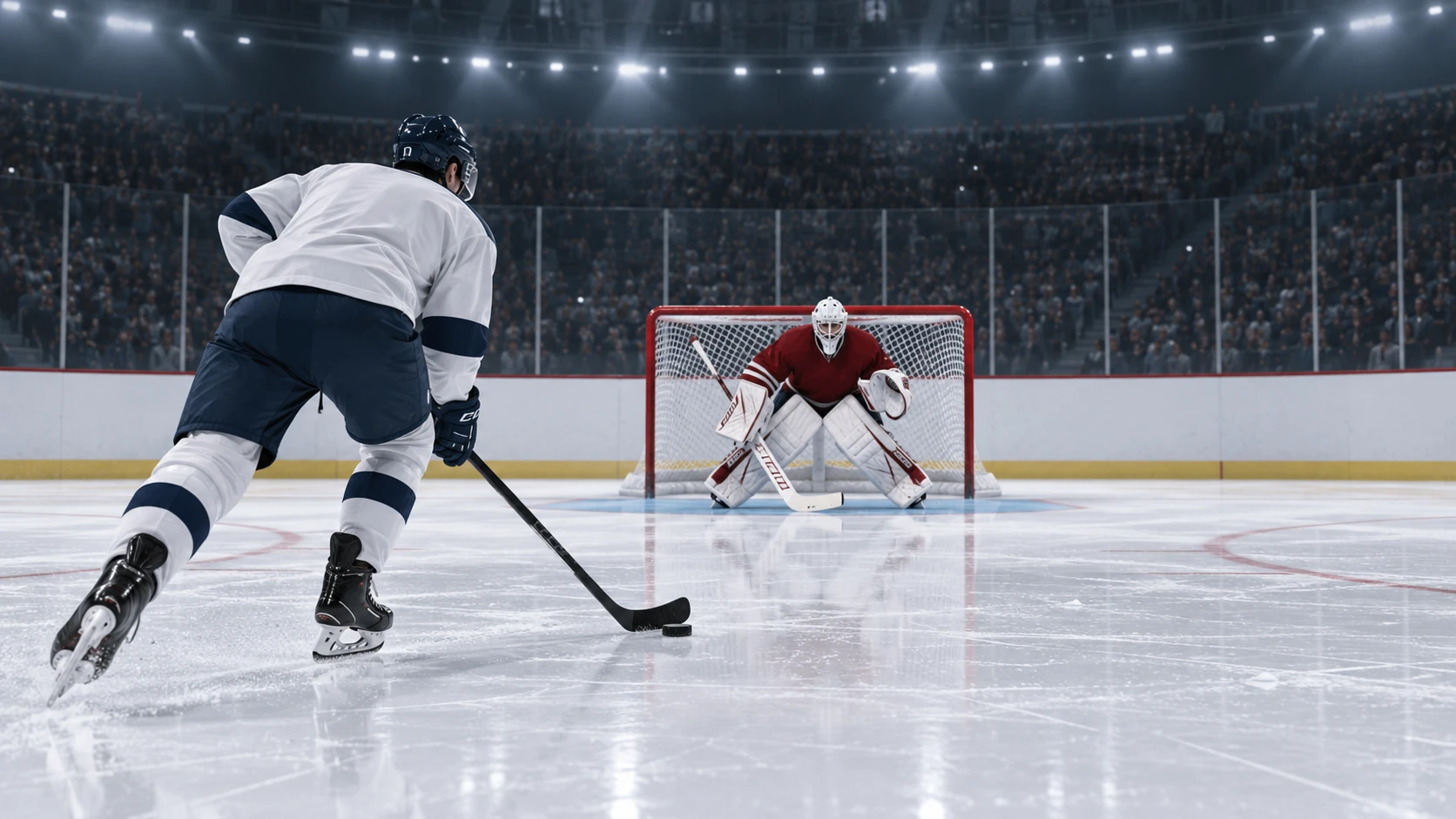
Why Detroit's losing goalie still recorded a shutout
An NHL goalie can receive a shutout even when his team loses in a shootout. If the goalie allows no goals during regulation and overtime, a shootout goal does not take away that individual shutout. The shootout decides the winner, while its attempts are recorded separately from ordinary player and goalie game statistics.
Detroit's game at Montreal on October 10, 2026, is a clear example. Jacob Fowler and Daniil Tarasov each made 30 saves, and neither team scored a valid goal during regulation or overtime. Montreal then won the shootout and the game was recorded as a 1-0 Canadiens victory. Both goalies nevertheless received shutouts, including Tarasov on the losing side.
The NHL's official recap identifies Zachary Bolduc as the deciding scorer in the sixth shootout round. He beat Tarasov, and Fowler then stopped Nate Danielson's response. That determined which club won. It did not turn Bolduc's attempt into a normal season scoring goal or add a regulation-and-overtime goal against Tarasov.
The apparent contradiction comes from reading the final score as if every number represented an ordinary goal conceded by the goalie. A shootout winner is credited with one extra goal in the team result. That accounting creates a one-goal final margin even if neither side scored before the shootout. The individual shutout answers a different question: did the goalie keep opponents from scoring in the game play that counts toward those individual statistics?
Montreal had also celebrated three apparent goals that were later waved off. Those plays did not enter the official scoring record. The arena reaction therefore did not change the zero goals allowed through overtime. To understand a goalie line, use the goals that officially counted, not the number of celebrations or the scoreboard's final shootout adjustment.
There is a separate qualification when two goalies share a scoreless performance. The NHL's glossary says a combined shutout is recorded for the club, with neither goalie receiving individual shutout credit. That is different from this Detroit-Montreal example, where each goalie played his team's scoreless regulation and overtime. A shootout loss and a shared goalie appearance are two different issues.
Our today's NHL results can help you identify the finish. Look for the shootout designation beside the score before interpreting an apparent goal against. A 1-0 shootout final can coexist with two individual shutouts because the result and the individual goalie record are keeping different kinds of information.
How an NHL regular-season shootout works
A shootout comes after overtime, rather than replacing it. Under Rule 84.1, a regular-season tie after three 20-minute regulation periods leads to an overtime period lasting up to five minutes. The first goal wins. The normal starting strength is three skaters and one goalie per team, although penalty situations can change the numbers. Only a game still tied when that overtime expires moves to a shootout.
Rule 84.4 then supplies a different procedure: individual shooters alternate attempts against the opposing goalie. The home team chooses whether to shoot first or second. That choice determines the order, not an extra attempt or an automatic advantage in the rules. The three skaters used in normal overtime and the three initial shootout opportunities are separate features of the format.
Three initial attempts do not always mean six shots
Each team initially receives three opportunities, but the rule permits the shootout to end earlier when the outcome is already determined. Consider a hypothetical sequence in which the first team scores on its first two attempts and its opponent misses both replies. The score is 2-0 in attempts, with only one opportunity left for the trailing team. It cannot catch up, so the remaining attempts are unnecessary.
That is why a short shootout is not evidence that someone forgot the third round. Count how many chances remain for the trailing club. Conversely, if one team still has an opportunity that could tie the result, the officials cannot end the competition merely because the other team just scored. The alternating order and the mathematical possibility of a tie work together.
Eligibility also matters. Rule 84.4 excludes players serving a misconduct, game misconduct or match penalty; the skater serving a goalie's misconduct is also ineligible. Once the shootout begins, a goalie can be replaced only because of injury. A coach cannot freely rotate goalies between attempts as a tactical counter to different shooters.
Extra rounds require matching opportunities
If the clubs remain tied after three attempts each, the shootout moves to additional sudden-death rounds. In that phase, one successful shot does not automatically end the game before the other team has its matching opportunity. A deciding round has one team score and the other fail. If both score, or both fail, the competition continues.
The Montreal-Detroit finish demonstrates that sequence. Bolduc scored in round six, but Detroit still had Danielson's response. Fowler's stop completed the winning pair of outcomes. Describing Bolduc's goal without the following save would leave out the event that actually secured the result.
A player cannot take a second attempt until every eligible teammate has taken one. The rule also handles unequal eligible pools caused by injury or penalties: after the smaller pool has been exhausted, both teams can select players who have already shot. That prevents the club with fewer eligible players from running out of legal shooters while the competition continues. For a game you plan to watch, the weekly NHL schedule shows the matchup; whether it eventually needs a shootout depends on the score after overtime.
Which shootout statistics count toward the season?
Shootout attempts belong to a separate statistical category. They do not increase a shooter's ordinary goals, assists or points, and they do not become ordinary shots faced or saves in the goalie line. Rule 84.4 expressly says the losing goalie is not charged with the extra goal used in the final result, and the deciding shooter does not receive a personal scoring goal.
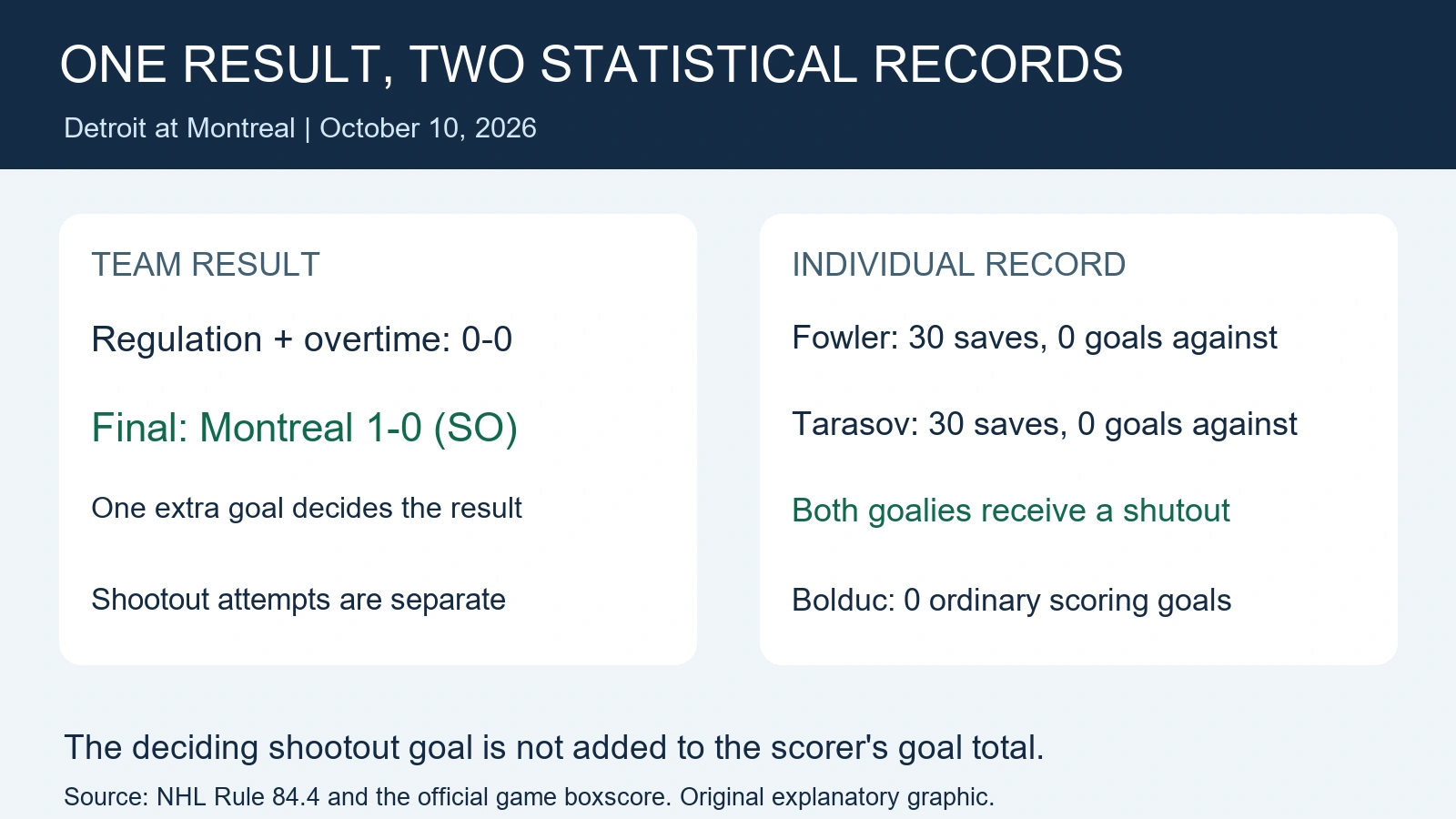
The official Detroit-Montreal boxscore makes that distinction visible. Bolduc has zero ordinary goals, zero assists and zero points despite scoring the deciding attempt. Both teams have 30 ordinary shots on goal, and each starting goalie has 30 saves and zero goals against. The extra shootout attempts do not turn either goalie line into 36 shots faced.
The final score and the goalie line answer different questions
The final score identifies the winning club and its result. The goalie line records the scoring chances and goals in regulation and overtime that count toward ordinary individual statistics. Read those records together instead of forcing the final score into the goals-against column. Tarasov can have a shootout defeat attached to a performance with zero goals allowed.
The NHL's glossary defines save percentage as saves divided by shots faced. For this game, 30 divided by 30 is 1.000. It defines goals-against average using goals allowed multiplied by 60 and divided by minutes played. With zero ordinary goals allowed, the game's goals-against contribution is zero. Those are calculations from the counted game statistics, rather than from the number of times a goalie was challenged in the shootout.
The same separation matters when the game is not scoreless. If teams finish overtime tied 2-2, a shootout win produces a 3-2 final result. The losing goalie is not charged with a third ordinary goal merely because of that final adjustment. This is a hypothetical illustration of the rule, not another description of the Montreal game.
Standings use the team result. The winner receives the additional point awarded after a regulation tie, finishing with two points while the losing club retains one. The NHL glossary also distinguishes regulation wins, which exclude overtime and shootout victories, from regulation-and-overtime wins, which exclude shootouts. A shootout win is still a win, but it does not increase those narrower win categories.
An actual overtime goal has a different consequence. It counts as an ordinary scoring goal and ends the game immediately. If it is the first goal allowed, the conceding goalie loses the shutout. The decisive distinction is therefore the phase in which the goal occurred. A shootout success and an overtime winner can both settle a game, but they enter individual statistics differently.
What makes a shootout attempt legal?
The puck entering the net does not settle every shootout decision. Rule 84.4 applies the penalty-shot procedure in Rule 24, including limits on how an attempt begins, how the puck moves and when the attempt ends. The 2026-27 NHL rulebook is the relevant standard for this season, even when an older highlight shows a different interpretation or an earlier rule.
Forward puck movement and the rebound limit
The shooter begins with the puck at the center faceoff spot after the referee's whistle. The goalie must remain in the crease until the player touches the puck. Rule 24.2 requires the puck to remain in motion toward the opposing goal line; once the shot is taken, the play is complete. The shooter cannot retrieve a saved shot and take another attempt as he might during ordinary play.
There is a narrow rebound exception: a puck can hit the goalpost or crossbar, then the goalie, and go directly into the goal. That sequence does not authorize a second shot by the shooter. It also does not make every rebound off the goalie legal. The specified order and the direct movement into the net matter.
A puck crossing the goal line without entering the net ends the attempt, as does the puck coming to a complete stop. These restrictions explain why the referee may wave off a puck that eventually reaches the net. In an official November 2023 review, Evan Rodrigues' attempt was disallowed because the puck entered on a rebound.
The goalie has obligations too. Under Rule 24.4, leaving the crease too early does not automatically produce a goal: if the shot fails, the referee permits another attempt. Throwing a stick or another object to stop the shot, or deliberately dislodging the net, can result in an awarded goal. Those are different violations with different consequences, so a goalie movement alone is not enough to explain every ruling.
Why a creative move can still be disallowed
Rule 24.2 expressly prohibits the spin-o-rama in which the shooter completes a 360-degree turn while approaching the goal. A successful finish does not override that restriction. An ordinary lateral deke and a full prohibited turn are not interchangeable descriptions; the official must assess what the shooter actually did.
A lacrosse-style move, with the puck carried on the blade and whipped toward the net, has its own conditions. The puck cannot be raised above shoulder height at any time, and at release it cannot be carried higher than the crossbar. Saying that every unusual move is illegal would therefore be inaccurate. The rule specifies which movements are permitted and the height limits that apply.
The Situation Room can review the legitimacy of a shootout attempt under Rule 37.3(j), including the shooter's actions and goalie violations. A review is not restricted to checking whether the puck crossed the line. For viewers learning the roles involved, our NHL positions guide provides the broader context; the shootout temporarily isolates a single eligible shooter against the goalie under these special procedures.
Why playoff overtime never leads to a shootout
The Stanley Cup Playoffs use a different overtime procedure. Under Rule 84.5, a game tied after the three regulation periods resumes after a 15-minute intermission with 20-minute overtime periods. Teams change ends for the start of each overtime period, and the first goal wins. There is no transition to a shootout after five minutes.
If the first overtime period ends scoreless, the clubs continue to another overtime period rather than sending individual shooters to center ice. The same principle applies if a second or later overtime period also ends without a goal. The game continues until a team scores a valid winner in ordinary game play.
That difference changes the shutout question. Imagine a playoff game that is still 0-0 after regulation and the first overtime period. Both goalies have kept opponents scoreless to that point, but the game is unfinished. When one club eventually scores the winner, that goal counts against the opposing goalie. The final 1-0 result therefore does not reproduce the double-shutout shootout situation seen in Detroit-Montreal.
It also changes how viewers interpret the result. Playoff victories count toward winning a series, rather than adding two regular-season standings points. The NHL's format uses best-of-seven series, so four game wins advance a club. A long overtime victory is still one series win, while a long overtime defeat does not supply a consolation standings point.
Our NHL playoff format guide explains that series structure. For the shootout question, begin with the season phase: a regular-season game can produce a shootout result with a losing goalie shutout, while a Stanley Cup Playoff game must be settled by a counted overtime goal if regulation ends tied. Then separate the final team score from the individual player and goalie statistics. That sequence resolves the apparent contradiction without treating a shootout attempt as an ordinary goal.
Comments
Comments are reviewed before publication. Spam, abusive content and policy-violating links are not published.
Sign in with Google to leave a comment.
Loading comments...